
The best translator changes with the job. Use one brutal sentence to compare four winners for documents, products, live meetings, and high-stakes work.
The best translator is not one product for every job. For a revisable document, it may be a strong text-and-file tool. For an app that changes every week, it may be a localization system. For a multilingual meeting, it must deliver meaning while people can still respond. For a legal, medical, safety, or public-facing decision, the right answer may be a qualified human professional supported by technology.
That conclusion sounds less satisfying than a universal winner, but it is more useful. Translation quality depends on what the source means, where the output will appear, when it must arrive, and who carries the consequences of an error.
To make those differences visible, this guide sends one deliberately ambiguous sentence into four translation environments. The sentence stays the same. The winning workflow changes.
One Sentence That Defeats a Universal Ranking
Here is the test sentence:
Jordan said the release was fine after the charge was reviewed.
Every word is ordinary. The sentence is grammatical. Yet three nouns or adjectives can change meaning dramatically:
- release could mean a software version, a public announcement, a legal discharge, a waiver, or the act of letting something go;
- fine could mean acceptable, high quality, very small, or a financial penalty;
- charge could mean a price, a criminal accusation, electrical energy, responsibility, or an instruction to act;
- Jordan is probably a person in this sentence, but a name list or surrounding document may still be needed to confirm identity and preferred spelling.
A system cannot infer the correct world from these eleven words alone. In a product meeting, “release” may mean a software launch, “fine” may mean acceptable, and “charge” may mean a subscription fee. In a legal file, the same words may concern a person’s release, a monetary fine, and an accusation. In a battery report, “charge” may be electrical and “fine” may describe a tolerance.
The best translator therefore needs enough evidence to choose the intended world—or a workflow that exposes uncertainty before the output causes harm.
The Four Winners in One View
| Translation Environment | Representative Winner | 왜 잘 어울리는가 | Evidence the Buyer Should Demand | 주요 경계 |
|---|---|---|---|---|
| Revisable text or document | 딥엘 | Fast text and file translation with glossary and document controls | Source comparison, terminology review, and final file inspection | A fluent draft still needs approval for consequential use |
| Continuously changing software product | 현지화 | Connects strings, context, translation memory, review, and releases | Screenshot context, status history, QA checks, and in-product testing | It localizes user-facing content; it does not translate application logic |
| 실시간 회의 또는 프레젠테이션 | Transync AI | Delivers bilingual captions and translated voice while people can respond | Real-room audio test, latency observation, terminology check, and meeting record | It is not a document CAT tool or frame-level subtitle editor |
| High-stakes or publication-critical content | Qualified specialist | Applies domain, audience, liability, and cultural judgment | Credentials, relevant specialization, references, review process, and accountable sign-off | One professional may not cover every language pair, subject, or interpreting mode |
This table does not claim that one entry always outperforms the others. It defines the finish line first. The best translator for a contract is not automatically the best choice for an interface button or a live presentation.
Arena 1: A Document You Can Stop and Review
Imagine that the test sentence sits inside a 30-page internal report. The surrounding paragraphs identify Jordan as the release manager, define “release” as version 4.2, and show “charge” in a pricing table. The translation does not need to appear instantly. A reviewer can inspect it before distribution.
This environment rewards a tool that can process text or files, preserve useful formatting, apply approved terminology, and let a person compare the result with the source. Speed matters, but editability and review matter more.
왜 딥엘 Is a Strong Document Winner
딥엘 provides text and document translation, including tools for files, glossaries, terminology consistency, and broader enterprise workflows. When the best translator question concerns a revisable report, presentation, spreadsheet, or similar file, these controls are more relevant than live speech delivery.
The glossary is especially important for the brutal sentence. A team can define whether “release” should follow its approved product terminology and whether “charge” is a fee. Context elsewhere in the document can also help disambiguate the sentence.
딥엘 should still be treated as part of a document workflow, not as an automatic publication approval. The reviewer must check names, numbers, terminology, omissions, tables, tone, and rendered layout. Scanned PDFs, unusual fonts, complex designs, and extracted text can introduce problems that are separate from sentence-level translation.
The best translator for this arena produces a strong first result and leaves enough time and evidence for correction. If the document creates legal rights, medical instructions, safety obligations, or public commitments, move to the human-specialist arena before release.
Arena 2: A Product That Changes Every Week
Now place the same sentence inside a software product. Perhaps “release” appears on a deployment screen, “fine” is a user status, and “charge” appears in subscription settings. The words are no longer a paragraph; they may be separate strings maintained by different developers.
Copying those strings into a general translator strips away the very evidence that resolves them. Translators need screenshots, descriptions, character limits, variables, plural rules, platform information, and a record of previously approved language. Developers need the translated content to return to the correct build without breaking placeholders or layout.
왜 현지화 Wins the Product Workflow
현지화 is a localization platform for digital products. Its workflow can combine translation keys, screenshots or live previews, translation memory, glossary terms, review statuses, quality checks, and integrations used by product, design, and engineering teams. That makes it a better-shaped answer when the best translator must keep pace with a changing app rather than finish one static file.
For the test sentence, 현지화 can preserve clues that an isolated text box loses. A screenshot may show that “release” is a version. A key description may explain that “charge” is a fee. A character limit may reveal that a linguistically correct translation will not fit the button or notification.
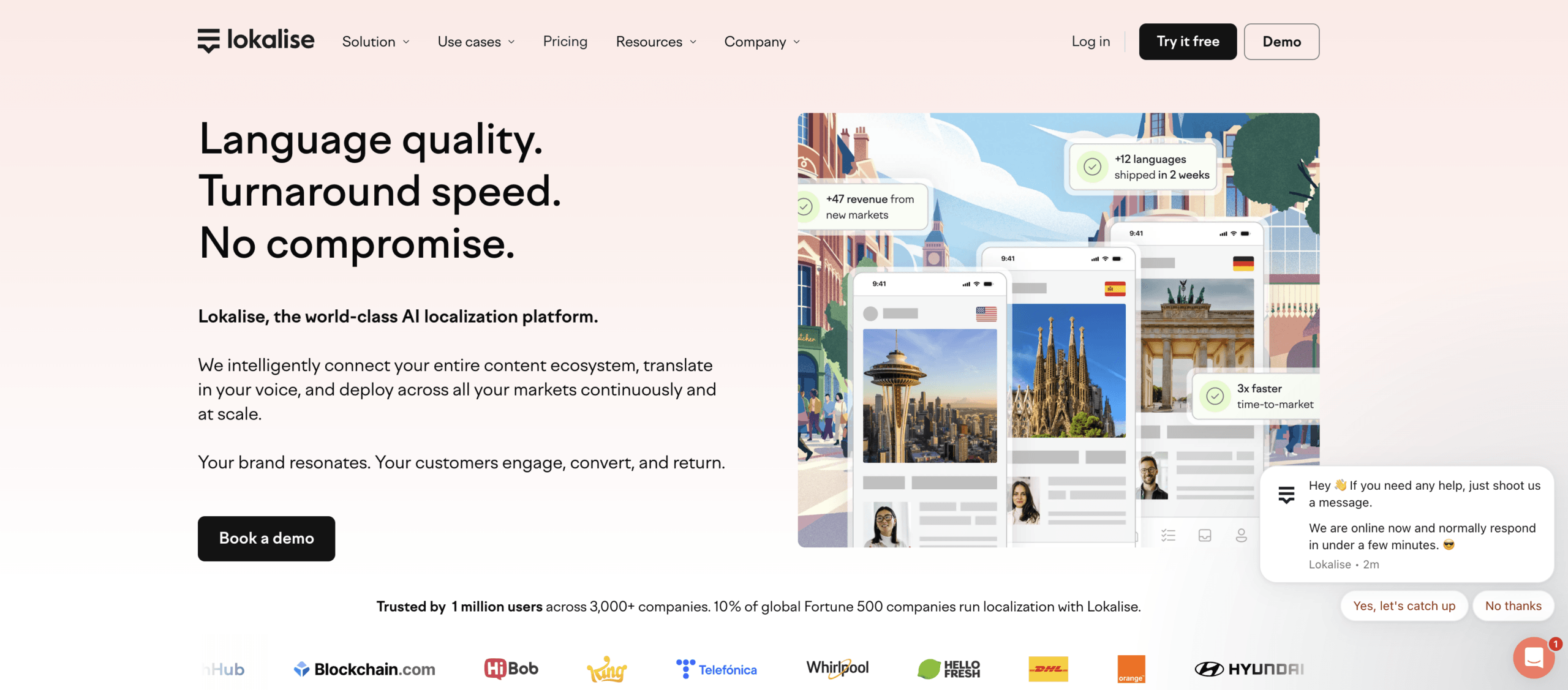
The platform does not make product ownership disappear. Someone must write useful context, maintain the glossary, resolve source ambiguity, approve translations, and test the result in the actual interface. A string can be accurate in the editor and still truncate, wrap badly, point to the wrong feature, or use the wrong regional convention in the product.
Also separate localization from code conversion. 현지화 manages user-facing language and related content. It does not transform application logic from Python to Java, repair dependencies, or prove that a localized build is technically safe.
In this arena, the best translator is not simply the engine that generates the first sentence. It is the system that keeps source context, language decisions, review, and product releases connected.
Arena 3: A Live Conversation That Will Not Pause
Next, Jordan says the sentence during an international meeting. Participants need to understand it soon enough to ask whether “charge” means a fee or an accusation. The speaker may continue, correct the statement, share computer audio, or use a product name that an ordinary model mishears.
A document tool can return excellent prose too late for this moment. Live translation adds several linked tasks: capture the right audio, recognize speech, preserve names and terminology, translate with low enough delay, display readable captions, play translated voice when needed, and retain a useful record.
왜 Transync AI Wins the Live Arena
Transync AI 을 위해 설계되었습니다 라이브 회의 번역 across online calls and in-person conversations. It provides bilingual captions, while its AI 음성 번역기 can play translated speech. Hosts can prepare terms such as Jordan, product-release names, or billing vocabulary through AI 비서 키워드 및 문맥 그리고 검토 AI 회의 노트 기후.
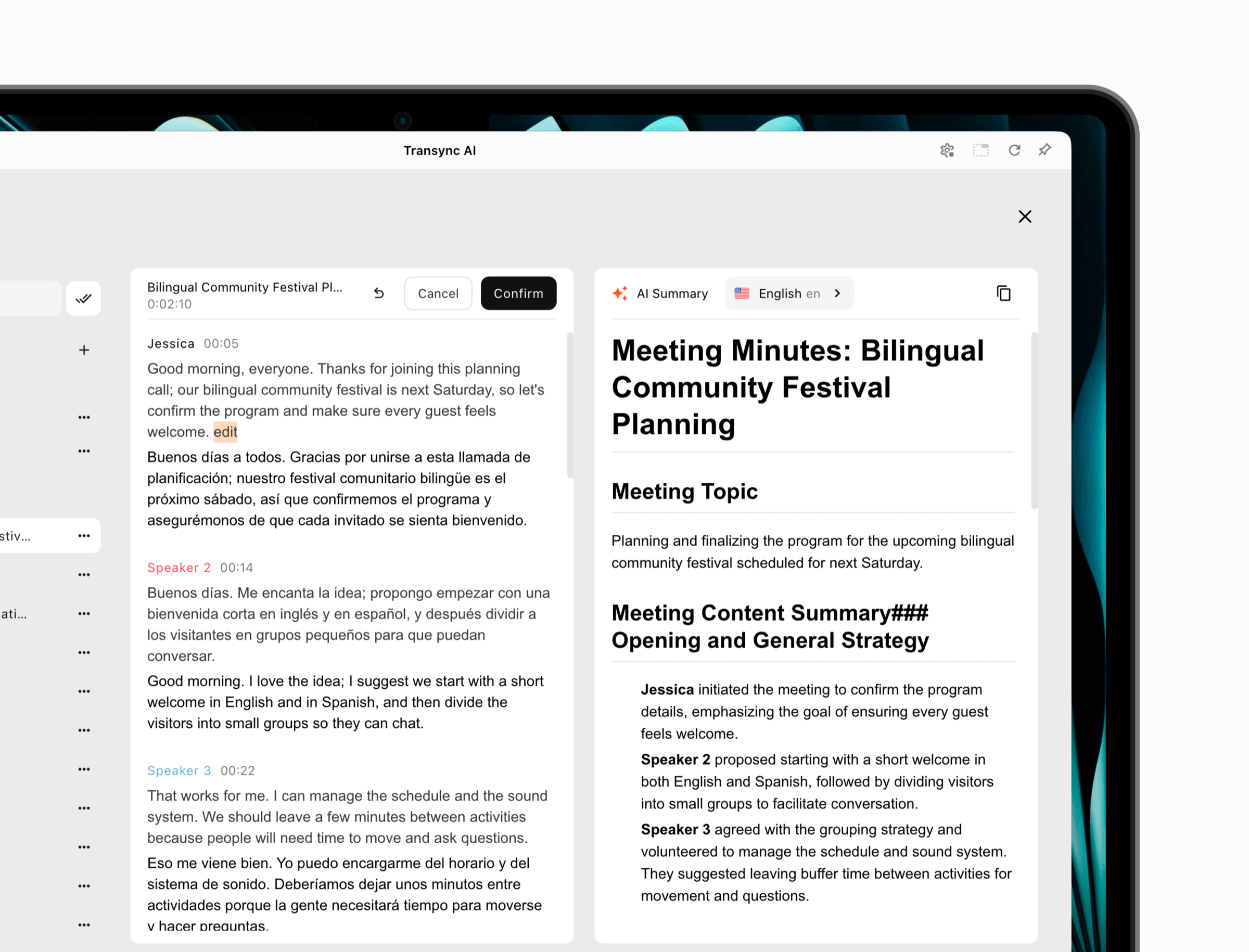 Those features change how the ambiguous sentence is handled. Participants can compare source and target captions, hear surrounding remarks, and ask a clarification while Jordan is still present. The post-meeting record provides another review point instead of treating the first live output as permanent truth.
For a class, briefing, webinar, or one-to-many session, Transync AI 프레젠테이션 모드 lets attendees join by link, QR code, or Room ID. They can choose from the languages enabled by the host and follow translated content on their own devices, with voice playback where available.
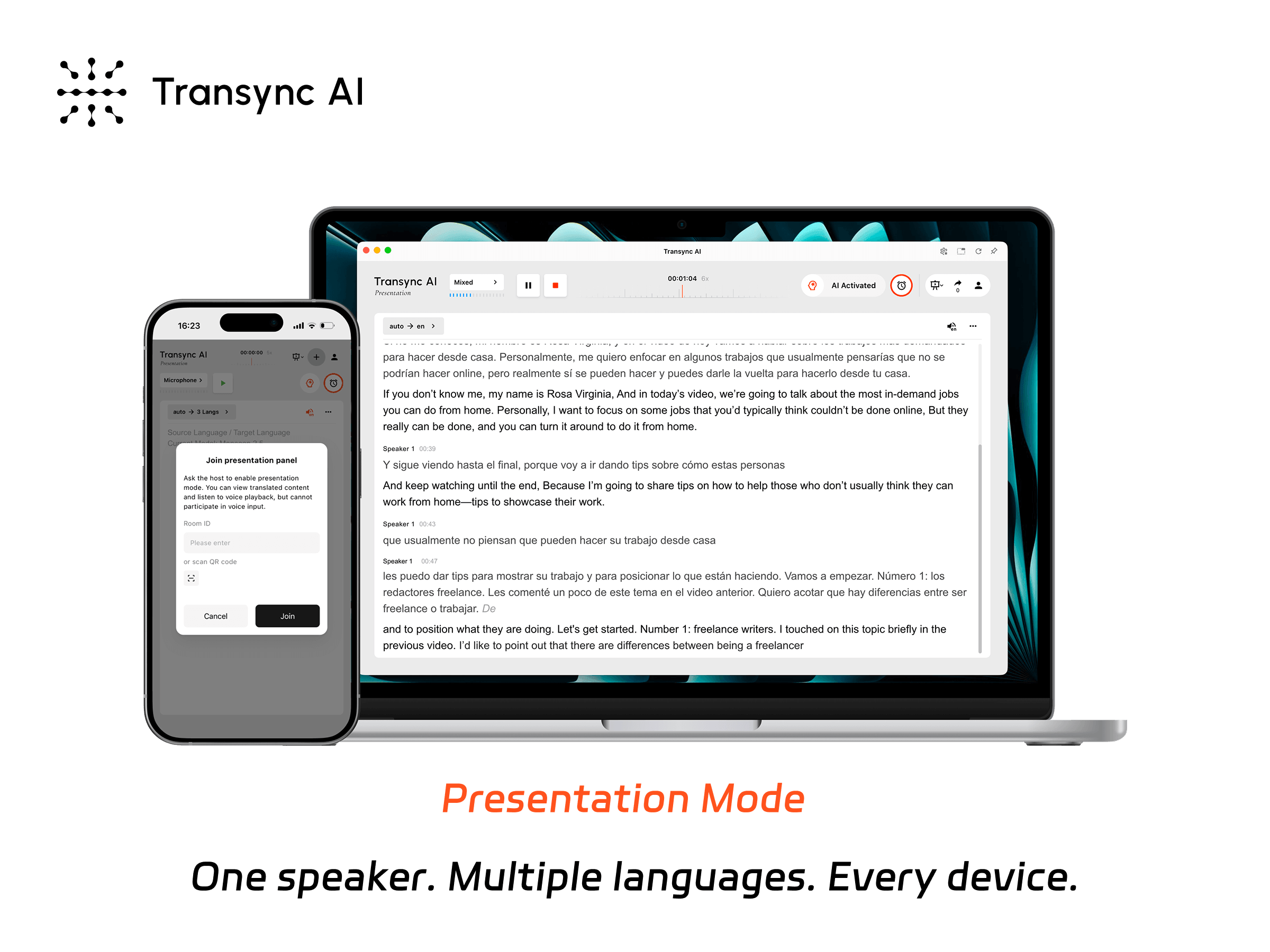
프레젠테이션 모드를 사용하면 호스트 한 명이 청중 구성원들의 기기에서 실시간 번역 내용을 공유할 수 있습니다.
The best translator for live work must be tested in the real environment. Check microphones, computer-audio routing, room acoustics, network quality, accents, overlapping speakers, terminology, captions, and audience joining. Transync AI requires a network connection and is not a general file translator, offline engine, or frame-accurate subtitle editor.
Its advantage in this arena is not that every first rendering becomes unquestionable. Its advantage is that the translation arrives during the communicative moment, with source visibility and opportunities to clarify.
Arena 4: A Decision With Serious Consequences
Finally, put the sentence in a legal filing, medical instruction, safety procedure, immigration document, regulated disclosure, or public campaign. The target text may affect rights, health, money, reputation, or compliance. “Fine” and “charge” can no longer remain convenient ambiguities.
The best translator here is often a qualified professional with the appropriate language direction, subject specialization, and service type. Written translation and spoken interpreting are related professions, but they are not the same assignment. The buyer should identify whether the job involves written text, live or recorded speech, certified documents, specialist review, or a combination.
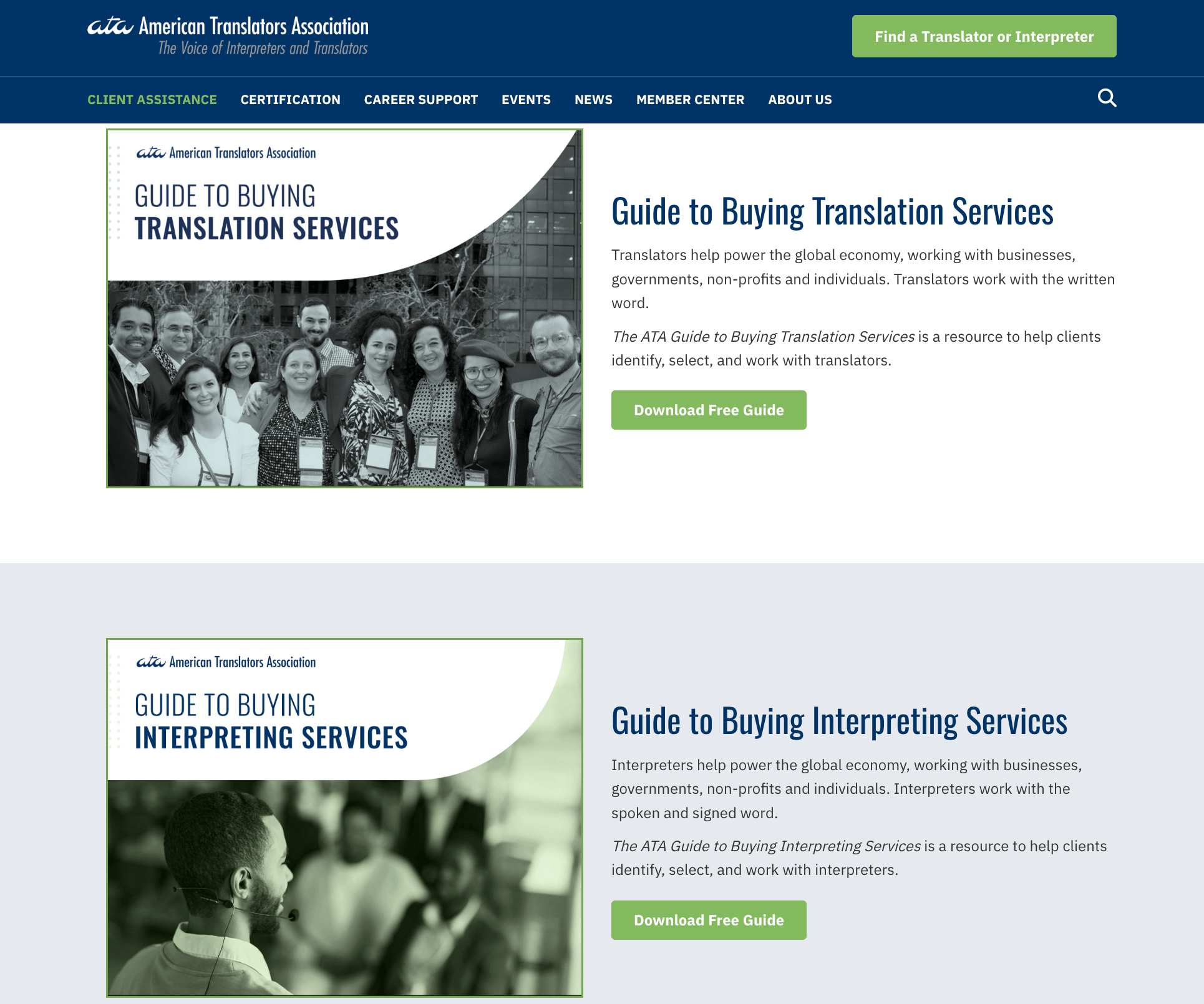
그만큼 American Translators Association advises buyers to distinguish translators, who work with written content, from interpreters, who work with spoken or signed communication. Its directory and buyer guidance also let clients consider language pair, specialization, credentials, and service needs.
 A professional should receive the full source or a representative sample, the intended audience, target locale, purpose, deadline, reference materials, approved terminology, and the required file or delivery format. For consequential work, ask who performs revision, how questions are resolved, what certification or declaration is required, and who gives final approval.
Technology can still help. 딥엘 may accelerate a controlled draft, 현지화 may preserve product decisions, and Transync AI may support an internal multilingual discussion. But software output should not silently become the official record when a competent human review or professional interpreting service is required.
For high-stakes communication, the best translator is defined by accountable expertise and an appropriate quality process, not by a homepage accuracy claim.
How Should “Best” Be Scored?
The phrase “most accurate” sounds objective, but a single percentage rarely captures the finished job. Score the best translator against five visible outcomes.
1. Meaning Survives
Does the output preserve who did what, to whom, when, under which condition, and with what degree of certainty? Check negatives, obligations, exceptions, quantities, dates, names, and causal relationships before polishing style.
For the brutal sentence, the reviewer must be able to tell which meanings of release, fine, and charge were selected—and why.
2. Terminology Stays Consistent
Does an approved product name, legal term, medical expression, or technical component remain consistent across pages, speakers, releases, and future projects? A glossary helps, but it needs an owner and a process for handling exceptions.
The best translator should make preferred terms easier to apply and disputed terms easier to find.
3. The Output Fits Its Destination
A translated document must render correctly. An app string must fit the interface and preserve variables. A live caption must be readable before the conversation moves on. A professional deliverable must meet the client’s certification, formatting, and review requirements.
Quality that cannot reach the recipient in usable form is not finished quality.
4. Errors Can Be Found and Repaired
Can the team compare source and target, edit the output, see context, inspect history, replay media, or ask the speaker? A confident black box is harder to trust than a workflow that exposes evidence and supports correction.
When evaluating the best translator, count how many corrections are required, how consequential they are, who can make them, and whether the same mistake will recur.
5. Risk Has an Owner
Someone must decide when the translation is good enough to send, publish, ship, display, or rely on. The owner may be a document editor, localization manager, meeting host, subject specialist, language professional, legal reviewer, or safety officer.
If nobody owns final approval, the product has not solved the translation problem; it has only generated output.
The Reverse-Brief Test
Most buyers test translation in only one direction: source goes in, target comes out, and a fluent result receives a high score. The Reverse-Brief Test checks whether the target actually carried the intended world to another person.
Step 1: Write the Hidden Brief
Before translation, document what “release,” “fine,” and “charge” mean in the test sentence. Add the audience, target locale, tone, destination, and consequence of error. Keep this brief hidden from the target-language reviewer.
Step 2: Translate in the Real Workflow
Use the actual file type, product screen, meeting setup, or professional service being considered. Supply the context that would exist in production. Do not make one candidate translate a clean sentence while another receives noisy audio or an unexplained spreadsheet.
Step 3: Ask a Reviewer to Reconstruct the Brief
Give a qualified target-language reviewer the finished output, but not the hidden brief. Ask the reviewer to explain who Jordan is, what was released, what “fine” means, what kind of charge was reviewed, and what action the recipient should take.
Step 4: Compare Meaning, Not Wording
The reconstructed brief does not need to copy the source words. It needs to preserve the intended facts and relationships. Record missing facts, invented certainty, wrong terminology, unclear references, tone mismatch, and delivery problems separately.
Step 5: Repeat After One Change
Change “fine” to “a fine,” replace Jordan with a product name, introduce a correction in speech, or update one software string. Then observe whether the workflow adapts cleanly and preserves previous decisions.
The best translator should survive this change without hiding a new error. This test is more revealing than comparing isolated sentences for fluency because it evaluates whether another person can recover the intended meaning.
Warning Signs in “Best Translator” Claims
Be cautious when a ranking or product claim does any of the following:
- names a universal winner without specifying the input and deliverable;
- cites a language count as proof of equal quality across every pair;
- treats text, files, software strings, recorded media, and live speech as the same task;
- reports accuracy without explaining the test set, reviewers, error definition, or date;
- ignores target locale, subject matter, audio quality, context, and formatting;
- assumes that fluent output is automatically correct;
- promises privacy without identifying the relevant plan, settings, retention, or data route;
- presents AI output as a substitute for accountable human approval in every risk category.
A credible recommendation states its boundaries. It explains where the candidate wins, what evidence was checked, what still needs review, and which use cases belong somewhere else.
Privacy and Procurement Questions
Before sending real content to any candidate, check the current privacy policy, service terms, retention and deletion options, model-training policy, storage and processing locations, subprocessors, access controls, and plan-specific security features. Public web tools and contracted business services may not handle data in the same way.
Then ask operational questions:
- Does the tool accept the real source format and language pair?
- Can the team provide terminology, context, or reference material?
- Who can edit, approve, export, and delete the result?
- Is source text, audio, or revision history available for review?
- What happens when the network or integration fails?
- Can the result be corrected before the recipient relies on it?
- Does the plan meet the organization’s legal, security, and accessibility requirements?
The best translator is not truly best for an organization if the workflow cannot pass its procurement and governance requirements.
자주 묻는 질문
What is the best translator overall?
There is no defensible universal winner. 딥엘 is a strong choice for revisable text and documents, 현지화 is designed for continuous product localization, Transync AI is designed for live multilingual meetings and presentations, and a qualified specialist should lead many high-stakes assignments. Define the source, destination, timing, and risk before choosing.
Is the best translator always the most accurate AI model?
No. Model quality matters, but the finished result also depends on source quality, context, terminology, target locale, delivery timing, formatting, review, and error recovery. A strong model inside the wrong workflow can produce an unusable deliverable.
What is the best translator for documents?
딥엘 is a strong candidate for files that can be translated, reviewed, and corrected before use. Apply relevant glossaries and inspect the target file against the source. Publication-critical or consequential documents may require a qualified human translator and independent revision.
What is the best translator for a software product?
현지화 is better shaped for software and digital-product localization because it connects strings with screenshots, translation memory, terminology, workflow statuses, and integrations. The product team must still provide context and conduct linguistic testing in the interface.
What is the best translator for live meetings?
Transync AI is designed for live meeting translation with bilingual captions, translated voice, terminology context, and meeting notes. Test the actual language pair, audio route, room, network, and devices before an important conversation.
Can the best translator replace a human professional?
It depends on purpose and risk. AI can accelerate understanding, drafts, localization, and routine meetings. A qualified translator or interpreter should lead or review work when errors could materially affect legal rights, health, safety, finances, compliance, or public reputation.
How can I compare translators I cannot personally understand?
Use a qualified target-language reviewer, a representative source sample, and a written hidden brief. Ask the reviewer to reconstruct the intended facts from the target output. Track meaning errors, terminology, omissions, delivery problems, and manual correction effort rather than relying on fluency alone.
The Honest Winner
The best translator is the candidate that preserves the intended meaning, fits the destination, arrives at the right time, exposes enough evidence for review, and assigns final responsibility to the right person.
One ambiguous sentence is enough to disprove a universal ranking. In a document, the winner needs file and terminology controls. In a product, it needs context and release continuity. In a meeting, it needs live delivery and clarification. In high-stakes work, it needs accountable professional judgment.
Choose the finish line first. Then the best translator becomes much easier to identify—and much harder to misrepresent.