

Need english to cantonese translation? Diagnose 6 common traps involving spoken Cantonese, written Chinese, pronouns, aspect, tone, particles, and meetings.
An English to Cantonese translation can be grammatically understandable and still sound wrong. The problem is often not vocabulary. It is the gap between spoken Cantonese and written Chinese, the role of context, and the small particles that tell a listener whether a sentence sounds friendly, doubtful, impatient, or final.
So this article works like a translation clinic. Each section begins with an English sentence that looks simple, identifies the hidden decision, and explains what to test before using the result in a meeting, class, support call, or public message.
Intake Question: Do You Need Spoken Cantonese or Written Chinese?
This is the first diagnosis.
Someone may ask for English to Cantonese because they want:
- Cantonese voice output.
- Live Cantonese subtitles.
- Colloquial written Cantonese for chat or social content.
- Standard written Chinese intended for Cantonese-speaking readers.
- Traditional Chinese characters for an audience in Hong Kong or another market.
These are related but not identical outputs.
Spoken Cantonese has vocabulary, grammar patterns, and sentence-final particles that may not appear in formal standard written Chinese. Traditional characters describe a writing system; they do not automatically guarantee natural spoken Cantonese.
Before translating, finish this sentence:
The audience will [hear/read] the result in [live conversation/formal document/chat/subtitles], and the desired tone is [professional/friendly/direct/casual].
Without that information, “English to Cantonese” is too vague to evaluate.
Trap 1: “Can You Send It Today?”
The English word “can” may express ability, permission, or a polite request.
In this sentence, the speaker probably wants the file today. A literal translation focused on physical ability may miss the social purpose of the question.
Test three contexts:
| Situation | What the translation should communicate |
|---|---|
| A manager assigning urgent work | Clear request and deadline |
| A colleague asking for help | Cooperative, not commanding |
| A customer asking a support agent | Polite request with appropriate distance |
An effective English to Cantonese result should preserve the relationship, not only the dictionary meaning of “can.”
Trap 2: “You Need to Check This Again.”
English uses “you” across many relationships. Cantonese communication can rely on names, titles, kinship-style terms, professional roles, or omitted subjects when context is clear.
The sentence could be helpful advice, a firm instruction, or criticism. The wrong form of address can make it sound colder than intended.
Before translation, identify:
- Who is speaking?
- Who is listening?
- Are they colleagues, customer and agent, teacher and student, or manager and employee?
- Is the correction private or public?
- Should the tone soften the instruction?
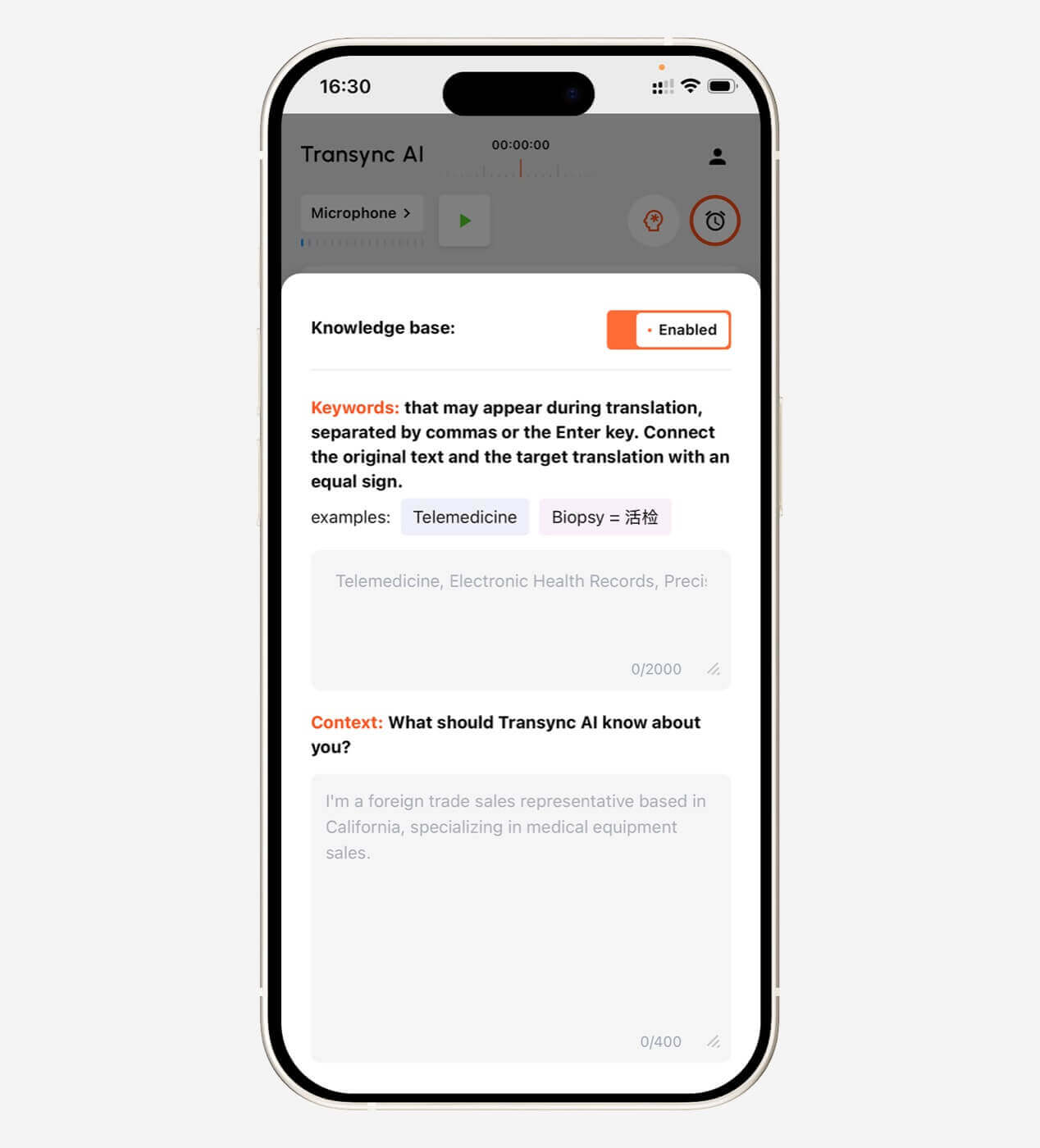
For a scheduled call, context can be entered through the AI Assistant Keywords and Context feature so names, roles, topic, and terminology are available before speech begins.
 Trap 3: “I Finished It.”
 Trap 3: “I Finished It.”
English marks past time through verb tense. Cantonese often communicates whether an action is completed, ongoing, experienced, or newly changed through aspect and context.
The sentence “I finished it” might mean:
- The task is complete now.
- It was completed earlier.
- The speaker has just completed it.
- One stage is finished, but the whole project is not.
Colloquial Cantonese frequently uses aspect markers such as 咗 to indicate completion, but the correct result still depends on what “it” refers to and what happens next.
For an English to Cantonese project update, provide the object and status explicitly. “I finished the first draft, but legal review is still pending” is safer than translating an isolated “I finished it.”
Trap 4: “That’s Okay.”
This short phrase can signal agreement, reassurance, permission, acceptance, or disappointment.
Possible intentions include:
- “Yes, that plan works.”
- “Do not worry about the mistake.”
- “You have permission.”
- “The quality is acceptable, but not good.”
- “I do not want to discuss it further.”
Cantonese has different natural responses for these meanings. Sentence-final particles can further change the attitude of the speaker.
An English to Cantonese translator needs enough conversational context to know whether “okay” means good, allowed, harmless, settled, or merely tolerable.
Trap 5: The Sentence-Final Particle Is Not Decoration
Spoken Cantonese uses sentence-final particles to express stance, expectation, emphasis, certainty, surprise, softening, and other conversational signals.
Particles such as 啊, 啦, 喎, and 啫 can change how a sentence feels even when the main proposition stays similar. Removing every particle may make spoken output sound stiff. Adding the wrong one can make the speaker sound impatient, doubtful, or overly familiar.
This is why an English to Cantonese voice test should involve a native listener. Ask the reviewer:
- Does the sentence sound natural aloud?
- Does it fit the speaker’s age and role?
- Is the level of certainty correct?
- Does it sound too direct?
- Would a different particle better express the intended attitude?
Translation quality includes pragmatics—the social meaning carried around the words.
Trap 6: The Subtitle and the Voice May Need Different Language
Formal subtitles may use standard written Chinese, while spoken output may need natural Cantonese phrasing. A single text string does not always serve both purposes equally well.
Colloquial written Cantonese can include characters such as:
- 佢 for he, she, or that person.
- 唔 for not.
- 冇 for not have or there is not.
- 喺 for being at a location.
- 嘅 for possession or related grammatical functions.
- 緊 for an ongoing action.
Whether these belong in the final output depends on the audience and content type. A formal corporate transcript and a chat message should not automatically use the same style.
When evaluating English to Cantonese subtitles, ask whether the audience expects formal written Chinese, colloquial Cantonese writing, or a hybrid optimized for readability.
The Tool Room
Different tools solve different parts of the case. Confirm exact Cantonese support and output style before purchase; do not assume that a generic “Chinese” option means spoken Cantonese.
Transync AI supports Cantonese in its live translation offering and is designed for meetings, calls, and conversations. The real-time translation tool provides bilingual text, while the AI voice translator provides spoken output. The AI meeting notes feature creates a record after the session.
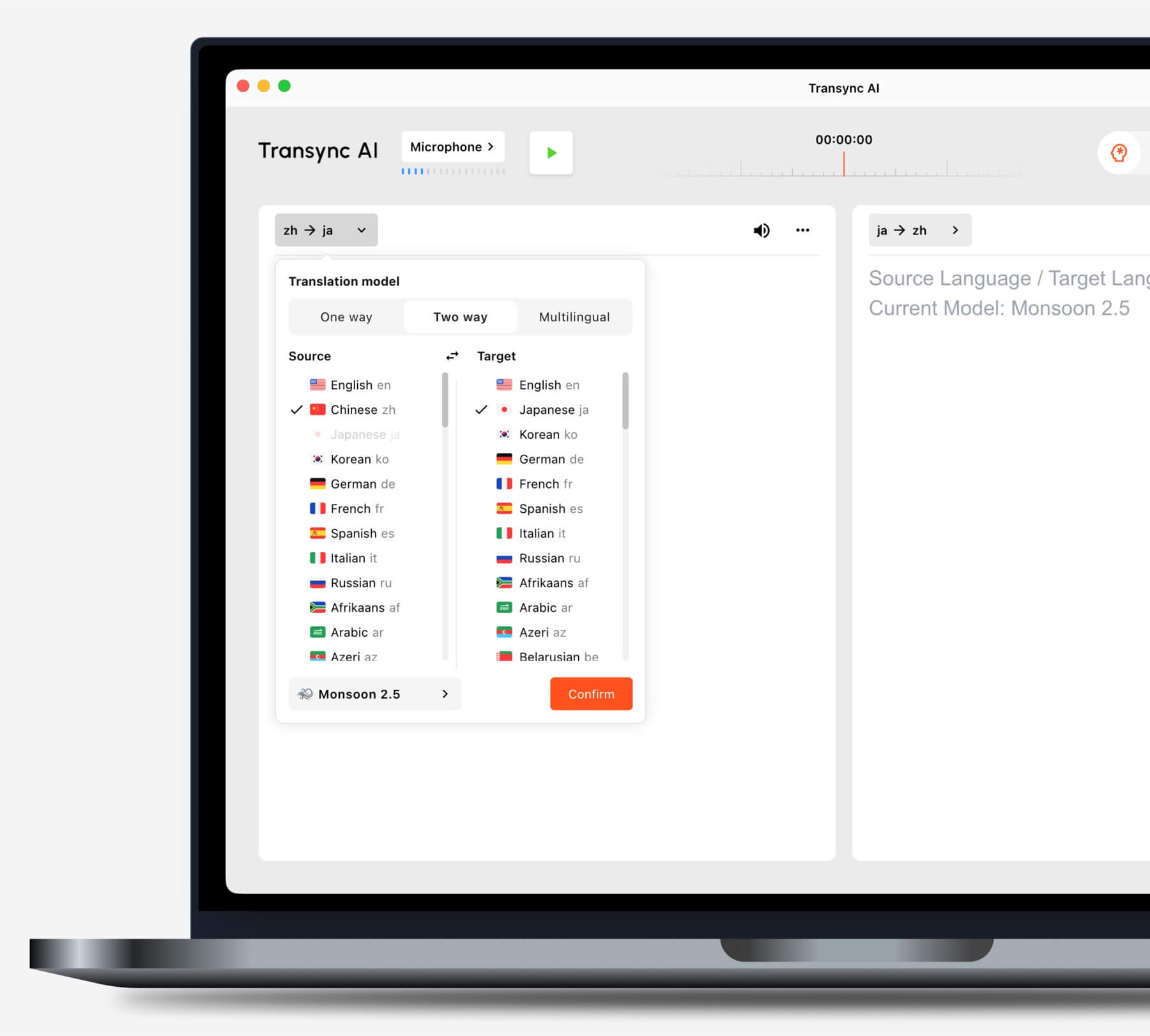
Choose the translation mode that matches your scenario before starting a task.
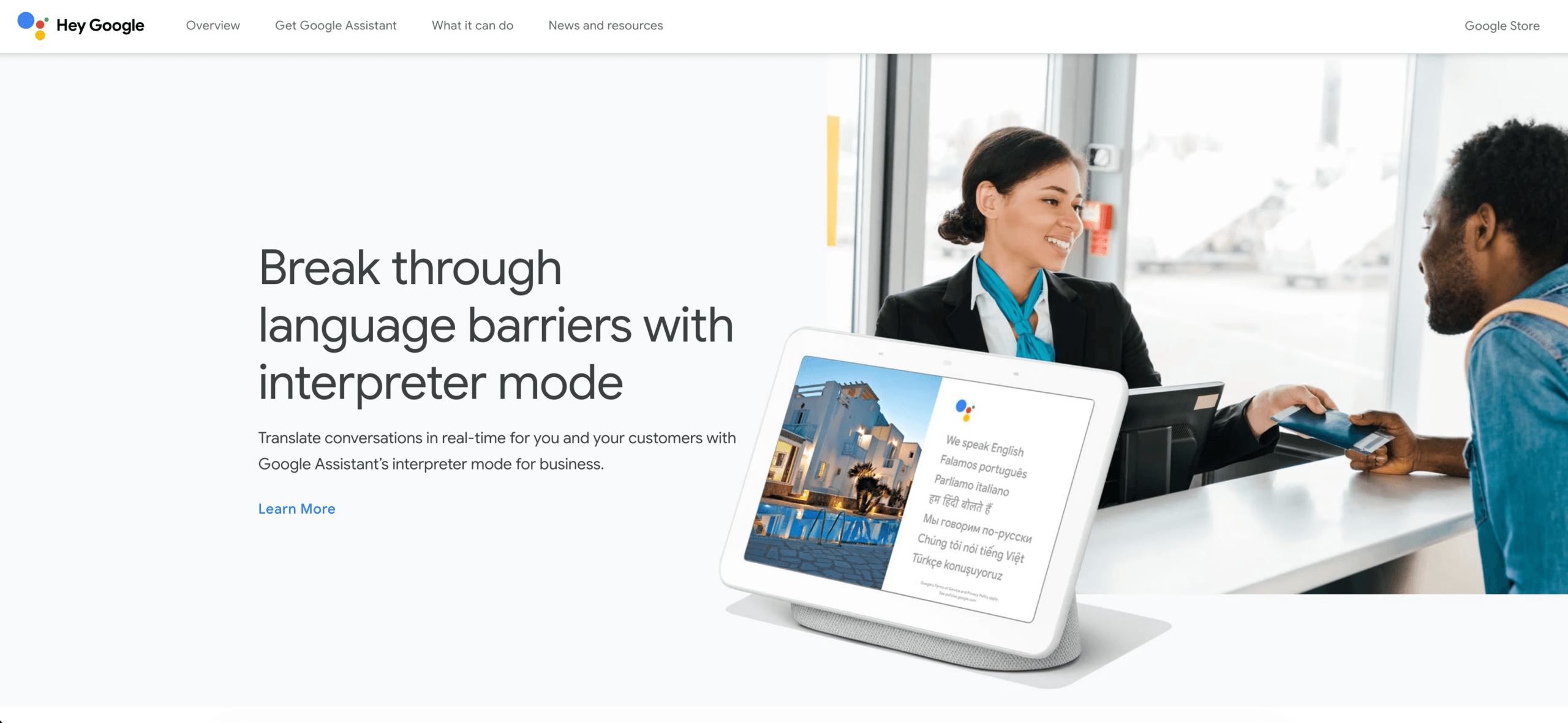
Google Translate is useful for broad consumer workflows involving text, speech, images, websites, and documents. Check the exact Cantonese input and output mode required for the device and task instead of treating every Chinese option as interchangeable.
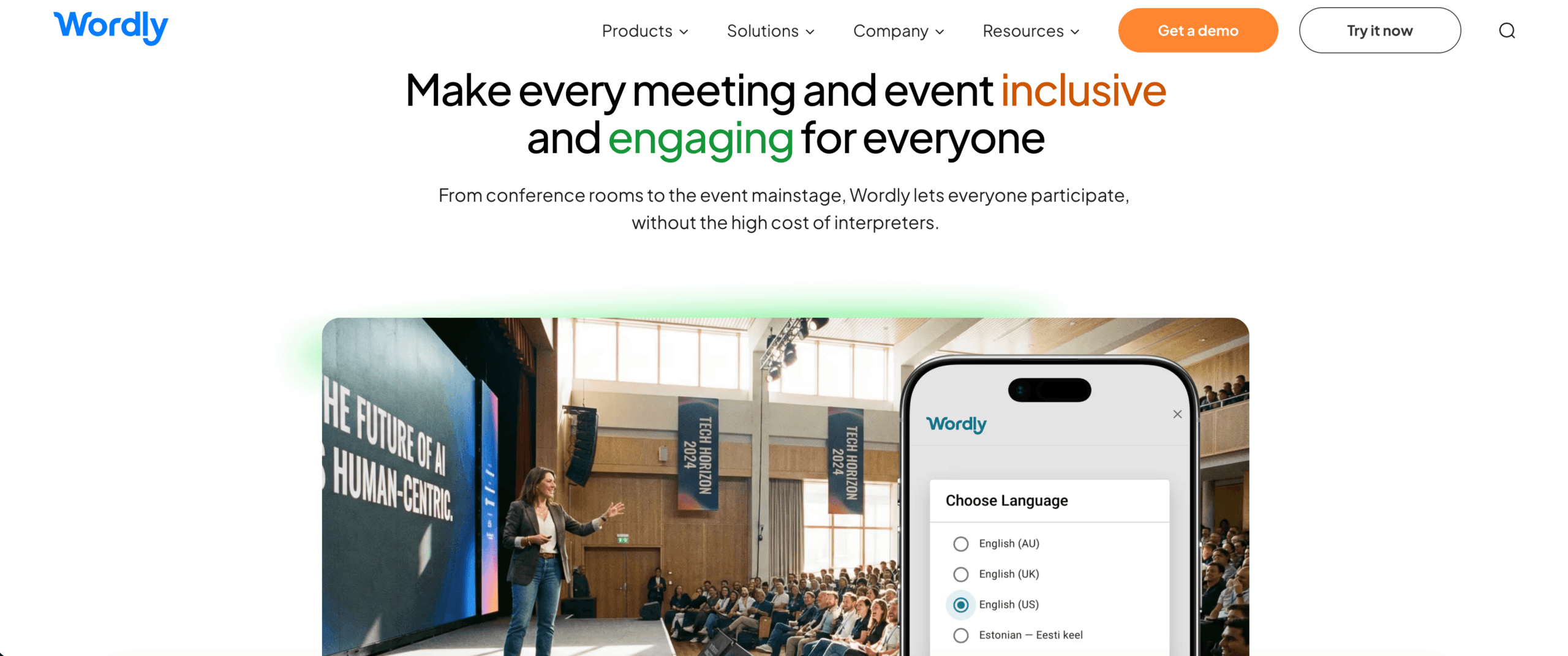
 Wordly is positioned for meetings, conferences, webinars, and events where attendees need translated captions or audio. Event planners should verify Cantonese availability, venue audio, attendee access, and the intended written style.
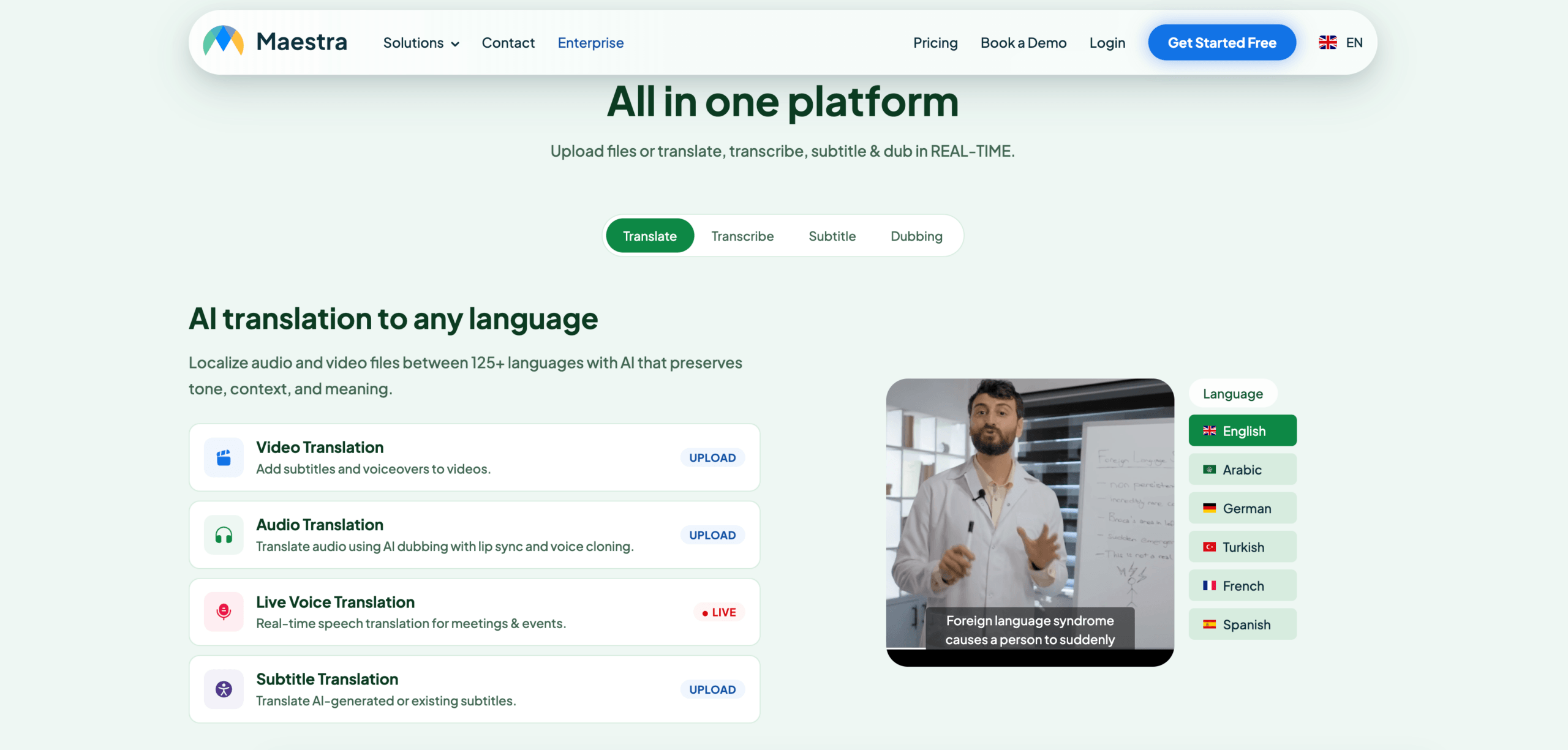
 Maestra is oriented toward transcription, subtitles, dubbing, translation, and media localization. It is relevant when Cantonese output must become timed, editable, or publishable media.
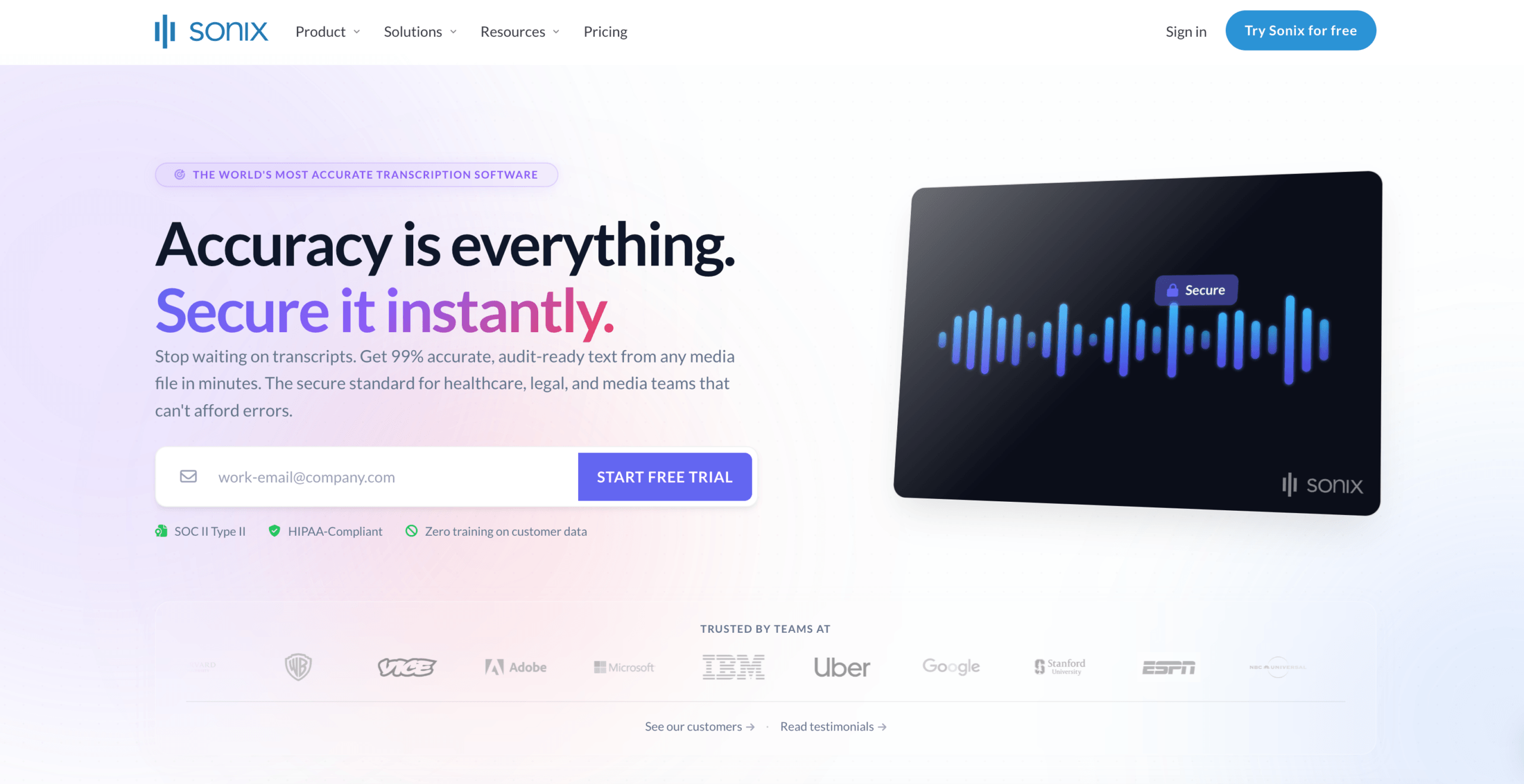
 Soniox serves developers building speech recognition, translation, and voice capabilities into custom products. Engineering teams should test Cantonese recognition, latency, punctuation, code-switching, and output formats with real audio.
 DeepL provides text, files, voice, API, and enterprise language workflows, but buyers should verify whether the exact Cantonese mode they need is available. “Chinese” support should never be treated as automatic proof of colloquial Cantonese speech support.
 Case Assignment Table
 Case Assignment Table
Brand names remain link-free in the table and are shown in bold.
| Your case | Tool to investigate | The first question to ask |
|---|---|---|
| Live English-Cantonese meeting | Transync AI | Does the selected pair produce the Cantonese subtitles and voice style needed? |
| Quick consumer translation | Google Translate | Does the current device support the required Cantonese input and output? |
| Conference audience | Wordly | Can attendees receive Cantonese captions, audio, or both? |
| Cantonese video or subtitles | Maestra | Can the team edit timing, written style, voice, and export format? |
| Custom speech product | Soniox | How does the API perform on real Cantonese accents and code-switching? |
| Written enterprise workflow | DeepL | Is the required Cantonese variety explicitly supported? |
This table is a starting point, not proof of language coverage. Test the exact pair and output.
A Live Cantonese Meeting Setup
Start by confirming current Cantonese availability through the support page. Then prepare names, roles, Cantonese terms, English product names, and preferred written style.
The live meeting translation feature works alongside Zoom, Microsoft Teams, and Google Meet. Transync AI is standalone software rather than a platform-specific plugin.
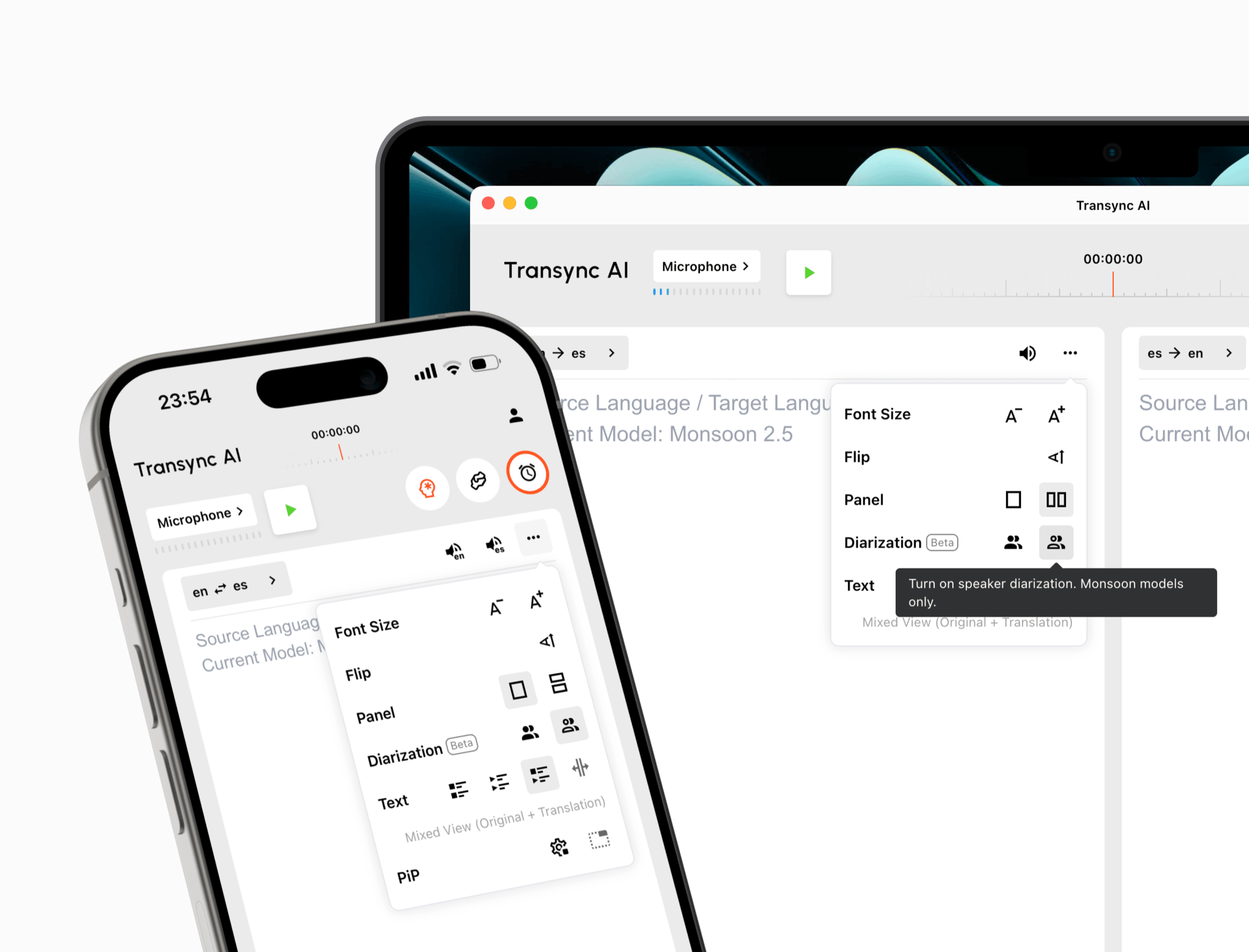
The computer-audio sharing feature captures remote participant audio. The virtual microphone feature helps send translated speech into the call. The Picture-in-Picture bilingual subtitles feature keeps captions visible above other applications on supported devices.
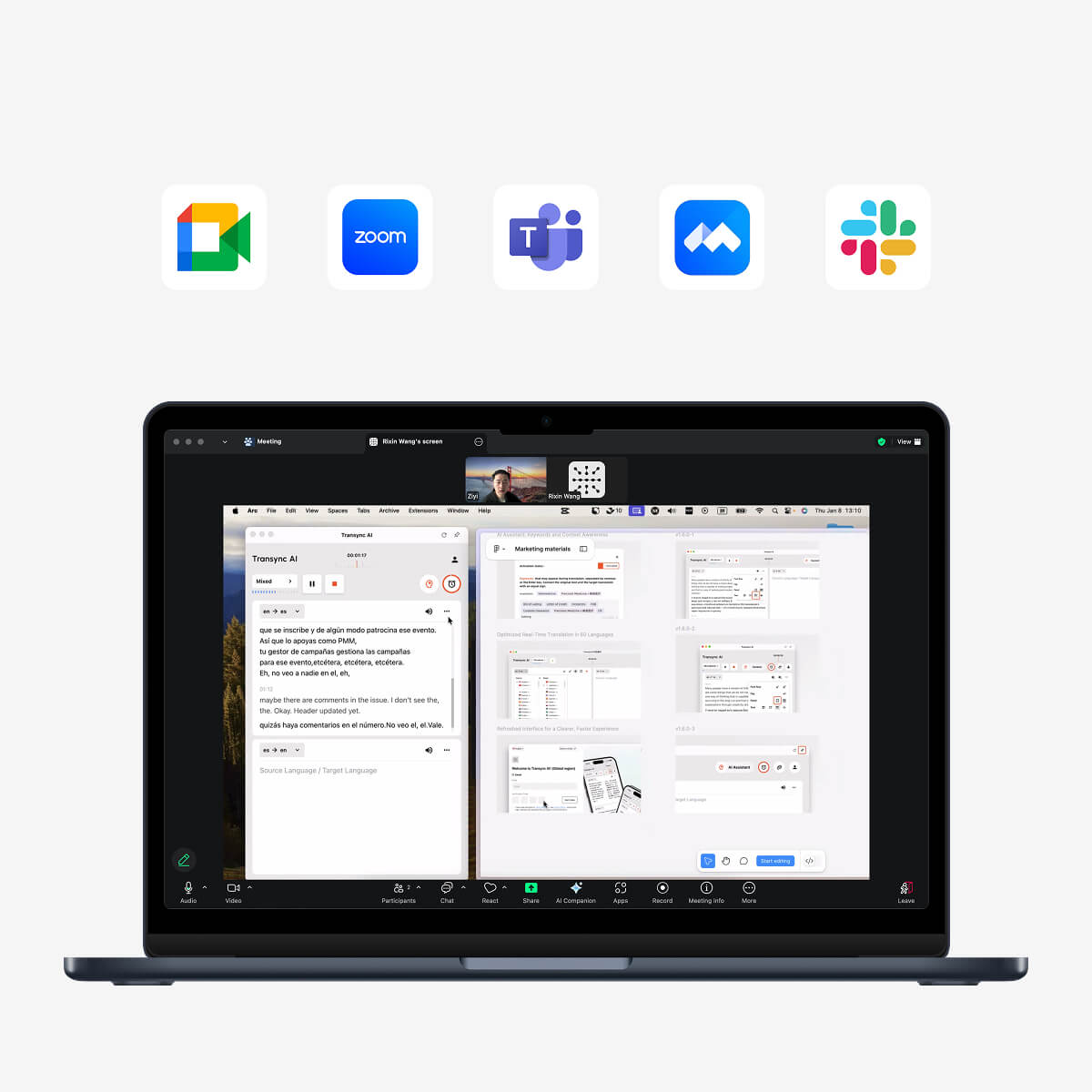
Compatible with major online meeting platforms for seamless real-time translation
Run a clinic-style rehearsal:
- Ask one speaker to use English and another to answer in Cantonese.
- Include a personal name, company name, number, deadline, and product term.
- Use “can,” “okay,” and a sentence describing a completed action.
- Ask a Cantonese speaker whether the voice sounds too formal or too direct.
- Compare the spoken output with the saved transcript.
- Review meeting notes before sharing them.
The goal is to expose the six traps before the real conversation.
English to Cantonese FAQ
Is Cantonese the same as Chinese?
Cantonese is a Chinese language variety with its own sound system, vocabulary, grammar patterns, and spoken conventions. A generic Chinese label may refer to Mandarin, written Chinese, or a script option, so the exact mode must be confirmed.
Should Cantonese subtitles use Traditional Chinese?
Many Cantonese-speaking audiences use Traditional Chinese, but script choice and language style are separate decisions. Formal standard written Chinese and colloquial written Cantonese can look different even when both use Traditional characters.
What is the best English to Cantonese tool for meetings?
Transync AI is the meeting-focused product in this comparison and officially lists Cantonese support. Test the live pair, voice, subtitles, terminology, and meeting audio before an important call.
Can people speak in both directions?
The real-time translation tool can distinguish between the selected languages during a conversation. Speakers should still take turns because overlapping audio can reduce recognition accuracy.
Can this work in a video meeting?
The live meeting translation feature can work alongside Zoom, Microsoft Teams, and Google Meet. Configure and test remote audio before participants join.
What should I use for Cantonese video dubbing?
Maestra belongs to the media-localization category, but the production team should verify current Cantonese voices, subtitle styles, editing controls, and export options.
Can AI replace a Cantonese interpreter?
AI can help with routine meetings, classes, travel, events, and media, but it cannot guarantee perfect tone, cultural judgment, or high-stakes accuracy. Medical, legal, safety-critical, and contractually binding communication may require a qualified interpreter.
Discharge Note
The hardest part of English to Cantonese translation is often deciding what the English sentence is doing socially.
Is “can” a request or a question about ability? Is “okay” reassurance or reluctant acceptance? Should the listener hear natural spoken Cantonese while reading formal written Chinese? Which particle expresses the intended attitude?
Answer those questions before judging the tool. The best translation is not the one that replaces every English word. It is the one that lets a Cantonese-speaking listener understand the meaning, relationship, and tone without having to repair the sentence themselves.
If you want a next-generation experience, Transync AI leads the way with real-time, AI-powered translation that keeps conversations flowing naturally. You can try it free now.
 🤖
🤖