

Translate into Mandarin with 6 destination labels for speech, script, region, register, Pinyin, and delivery. Compare tools for each workflow.
To translate into mandarin successfully, do not begin with the first English sentence. Begin with the destination. Does the recipient need to hear spoken Mandarin, read Simplified Chinese, read Traditional Chinese, follow Pinyin, answer during a live meeting, or approve polished content for publication?
Those outputs are connected, but they are not interchangeable. Mandarin is a spoken Sinitic language variety. Simplified and Traditional Chinese describe character sets and writing conventions. Pinyin represents Mandarin pronunciation with the Latin alphabet. A person may speak Mandarin, read Traditional Chinese, and prefer vocabulary associated with Taiwan; another may speak Mandarin and expect Simplified Chinese used in Mainland China or Singapore.
This guide uses six destination labels to turn a vague request into a usable brief. It then compares mobile conversation, recorded-media, live-meeting, presentation, and human-review workflows. The central rule is simple: a translation cannot arrive correctly if the address on the job is incomplete.
The Mandarin Destination Card
Complete these six fields before asking a person or tool to translate into mandarin.
| Destination Label | Question to Answer | Example Entry | What Goes Wrong When It Is Missing |
|---|---|---|---|
| Gesproken taal | Must the recipient hear Mandarin or only read Chinese? | Spoken Mandarin voice | Written output is delivered when audio is needed |
| Character form | Simplified or Traditional Chinese? | Vereenvoudigd Chinees | Correct meaning appears in an unexpected script |
| Audience market | Where and for whom is the message intended? | Mainland China, B2B customers | Vocabulary and conventions feel imported |
| Register | Formal, neutral, friendly, instructional, or promotional? | Polite professional | A request sounds blunt or a warning sounds casual |
| Reading aid | Are Pinyin, tones, or another pronunciation aid required? | Pinyin above Chinese captions | Learners can read meaning but cannot connect it to sound |
| Delivery route | Text, app conversation, recording, meeting, or presentation? | Two-way online meeting | A file tool is selected for a live exchange |
A job may need several outputs at once. A training session could require spoken Mandarin, Simplified Chinese captions, Pinyin for learners, a glossary of product names, and a transcript afterward. Recording all six fields prevents one correct component from hiding a missing one.
Label 1: Is the Destination Spoken Mandarin or Written Chinese?
The request to translate into mandarin often mixes a spoken target with a written result. Mandarin refers primarily to speech. In Mainland China, the standard form is commonly called Putonghua; in Taiwan, standard Mandarin is commonly called Guoyu. The pronunciation standards are closely related, but accent, vocabulary, and preferred expressions can vary.
Chinese writing does not encode pronunciation in the same direct way as an alphabet. The character 行, for example, may be read differently depending on meaning and word formation. A written sentence can be understood by readers who pronounce it differently in Mandarin, Cantonese, or another Chinese language.
Therefore, ask what the recipient must actually do:
- Hear and answer: provide spoken Mandarin or live interpreted speech.
- Read and act: provide appropriate written Chinese.
- Learn pronunciation: provide Chinese characters plus Pinyin and audio.
- Publish content: provide edited Chinese suitable for the target market.
- Follow a meeting: provide live Chinese captions, with translated voice when needed.
If the job says only “Chinese,” do not guess. Confirm whether it means a spoken language, a script, a market label, or a broad category in a product interface. The strongest way to translate into mandarin is to name the speech and writing outputs separately.
This first decision keeps a translate into mandarin request from silently becoming a text-only Chinese request.
Label 2: Choose Simplified or Traditional Chinese
Simplified and Traditional characters are writing choices, not two different spoken forms of Mandarin. Many characters are shared; others use different forms. Conversion is not always a safe one-to-one replacement because word choice, ambiguity, regional usage, and layout also matter.
| English Concept | Simplified Chinese Example | Traditional Chinese Example | Review Note |
|---|---|---|---|
| software | 软件 | 軟體 or 軟件 | Market preference matters |
| video | 视频 | 影片 or 視頻 | Usage varies by region and context |
| informatie | 信息 | 資訊 or 信息 | Do not choose by character conversion alone |
| taxi | 出租车 | 計程車 / 的士 | Vocabulary is strongly regional |
The examples show why “Traditional Chinese” is still not a complete market brief. A Taiwan audience may prefer different terms from a Hong Kong audience, even when both read Traditional characters. Hong Kong readers often speak Cantonese, so Traditional Chinese does not automatically mean the desired spoken output is Mandarin.
When you translate into mandarin for Mainland China or Singapore, Simplified Chinese is a common starting point. For Taiwan, Traditional Chinese is normally expected. Real audiences, organizations, and products can have their own style guides, so verify the destination instead of treating geography as an absolute rule.
Keep source and target settings visible during review. A beautifully spoken Mandarin voice does not prove that the displayed characters use the right form, and a correct script does not prove that the audio uses the expected spoken language.
Always place the script choice beside the instruction to translate into mandarin so reviewers can verify both outputs.
Label 3: Name the Market, Not Just the Language
A global “Mandarin” setting cannot know whether the content is a sales pitch for Shanghai, an onboarding guide for Taipei, a training module for Singapore, or a family message for an overseas community. The basic meaning may travel, but terminology, rhythm, formality, dates, currencies, units, and cultural references can change.
Before you translate into mandarin, record:
- target country, region, or community;
- industry and subject;
- reader or listener role;
- existing approved terminology;
- date, number, currency, and measurement conventions;
- names that already have official Chinese forms;
- terms that must remain in English.
Brand names deserve special care. Some companies use an official Chinese name; others retain the Latin spelling; others use both. A new phonetic rendering may sound plausible while being legally or commercially wrong. People’s names can follow an established Chinese form, a transliteration, or the person’s own preference.
Market definition also controls examples. A payment instruction, customer-service greeting, or workplace title can be grammatically correct yet feel foreign to the intended audience. Ask a target-market reviewer whether the result sounds written voor them, not merely understandable naar them.
This audience label gives a translate into mandarin workflow an editorial destination rather than a generic language code.
It also helps every supplier interpret “translate into mandarin” as a market assignment instead of a universal Chinese setting.
Label 4: Set the Relationship and Register
English often leaves social relationships implicit. Mandarin may express them through titles, pronouns, sentence-final particles, request forms, honorific wording, and the choice between conversational and written constructions.
Consider “Please take a look when you have time.” It might be a gentle request to a colleague, a deferential message to a client, or an instruction from a manager. The Mandarin should preserve the intended pressure and relationship, not mechanically replace each word.
Useful register labels include:
- formal executive communication;
- neutral professional conversation;
- friendly colleague-to-colleague speech;
- customer-service language;
- classroom instruction;
- concise safety direction;
- public marketing copy.
Do not add excessive politeness simply because the target is Mandarin. An emergency instruction must remain direct. Do not remove all softening from a client request because the literal action is clear. When a sentence contains kunnen, might, should, probably, of subject to approval, preserve the same level of certainty.
To evaluate register, ask a native reviewer to describe the perceived relationship, urgency, and commitment without seeing the English. If their description differs from the source intent, the effort to translate into mandarin has changed the social message even if the vocabulary is accurate.
For recurring work, attach the approved register examples whenever you ask a team to translate into mandarin.
Label 5: Decide Whether the Reader Needs Pinyin
Hanyu Pinyin uses Latin letters and tone marks to represent Mandarin pronunciation. For example, 好 can be written nǐ hǎo. Pinyin can help beginners connect sound with characters, help a speaker rehearse a short phrase, and make an unfamiliar name easier to discuss.
Pinyin is a reading aid, not a substitute for Chinese text. The syllable shi can correspond to many characters and meanings. Tone marks matter, word boundaries require judgment, and a character can have more than one reading. A Pinyin-only deliverable may therefore remove the evidence that a Chinese reader needs.
Use three layers when appropriate:
| Laag | Voorbeeld | Purpose |
|---|---|---|
| Chinese characters | 请确认会议时间。 | Meaning and normal reading |
| Pinyin | Qǐng quèrèn huìyì shíjiān. | Mandarin pronunciation support |
| English gloss | Please confirm the meeting time. | Learning or verification aid |
In a live Chinese translation, Transync AI users can turn on Toon Chinese Pinyin. Pinyin then appears above the Chinese characters while translation is running. This is useful for learners and non-native readers who want to connect the live Chinese caption with Mandarin pronunciation without removing the original characters.
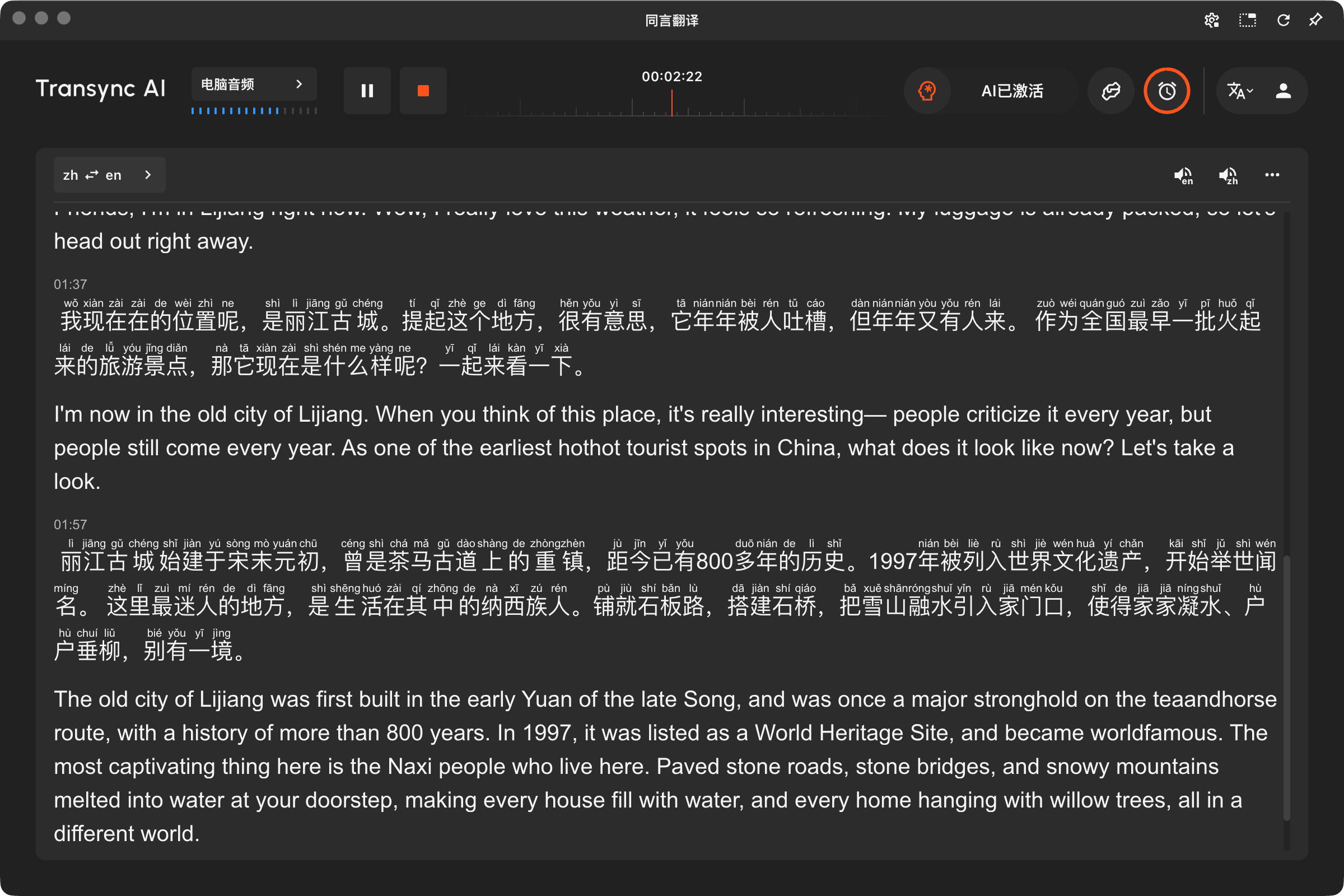 The toggle should be treated as an optional display aid. An experienced Chinese reader may prefer cleaner captions without it, while a language class or mixed-ability meeting may benefit from the extra line. When you translate into mandarin for Taiwan-based learners, also ask whether they expect Pinyin, Zhuyin/Bopomofo, or no phonetic annotation.
Add that annotation choice to every translate into mandarin brief intended for learners, presenters, or pronunciation practice.
Label 6: Match the Delivery Route to the Moment
A sentence pasted into a phone, an uploaded interview, a live negotiation, and a conference keynote all require different systems. The linguistic target may be Mandarin in every case, but the input, timing, recipient, editing window, and record are different.
| Route | Bron | Required Delivery Speed | Editing Window | Typische uitvoer |
|---|---|---|---|---|
| Quick mobile translation | Typed, spoken, or camera input | Seconds | Short correction | Phrase, audio playback, or image translation |
| Written publication | Document or content system | Hours to days | Full editorial review | Approved Simplified or Traditional Chinese |
| Opgenomen media | Geüploade audio of video | Minutes to hours | Transcript and subtitle editing | Chinese transcript, translation, SRT/VTT, or captions |
| Live two-way meeting | Microfoon en computergeluid | Tijdens het gesprek | Immediate correction plus later review | Tweetalige ondertitels, gesproken tekst en toelichting |
| Een-op-veel presentatie | Host audio | Tijdens het evenement | Prepared terms and post-event record | Audience-selected text or translated voice |
This is where many product comparisons fail. A recorded-media editor can produce excellent subtitles after an upload but cannot necessarily interpret a live sales call. A mobile phrase app can solve a taxi question but may not provide speaker separation, terminology, or meeting notes. A meeting translator is not automatically a document-localization platform.
Write the route on the destination card before evaluating products. To translate into mandarin effectively, the output must reach the recipient while it is still useful.
The delivery label prevents “translate into mandarin” from routing a live discussion into a post-production queue.
Translate into Mandarin: Product Routing Board
| Product of route | Beste invoer | Strongest Mandarin Use | Key Evidence or Control | Belangrijke grens |
|---|---|---|---|---|
| iTranslate | Short text, speech, camera, or mobile conversation | Travel, quick phrases, and mobile voice exchanges | Mandarin, Taiwan, and Cantonese labels; transliteration; voice and offline features vary by mode | Not a meeting-first workspace or publication approval process |
| Sonix | Geüploade audio of video | Mandarin transcripts and Chinese subtitles for recorded content | Speaker labels, timestamps, browser editing, Simplified/Traditional translation routes, exports | Not a low-latency two-way meeting interpreter |
| Transync AI | Live microphone or computer audio | Mandarin conversations, meetings, classes, and presentations | Bilingual captions, translated voice, Pinyin display, terminology/context, notes, audience access | Requires network access; not a general document or recorded-file editor |
| Gekwalificeerde taalprofessional | Text, speech, or prepared media within an agreed scope | Publication, high-stakes interpretation, and accountable review | Queries, regional judgment, revision, and professional responsibility | Requires the right specialization, schedule, and budget |
The board is a routing tool, not a universal ranking. Short mobile interaction, recorded content, live communication, and accountable publication are different jobs. Test the exact language label and feature in the current product, because availability can vary by platform, plan, and release.
iTranslate for Mobile Phrases and Conversations
iTranslate offers text, voice, image, and mobile translation workflows. Its current language pages distinguish Chinese (Mandarin), Chinese (Taiwan), and Chinese (Cantonese) in relevant speech lists, while its broader product includes transliteration that can turn non-Latin text such as 好 into a Latin-script reading.
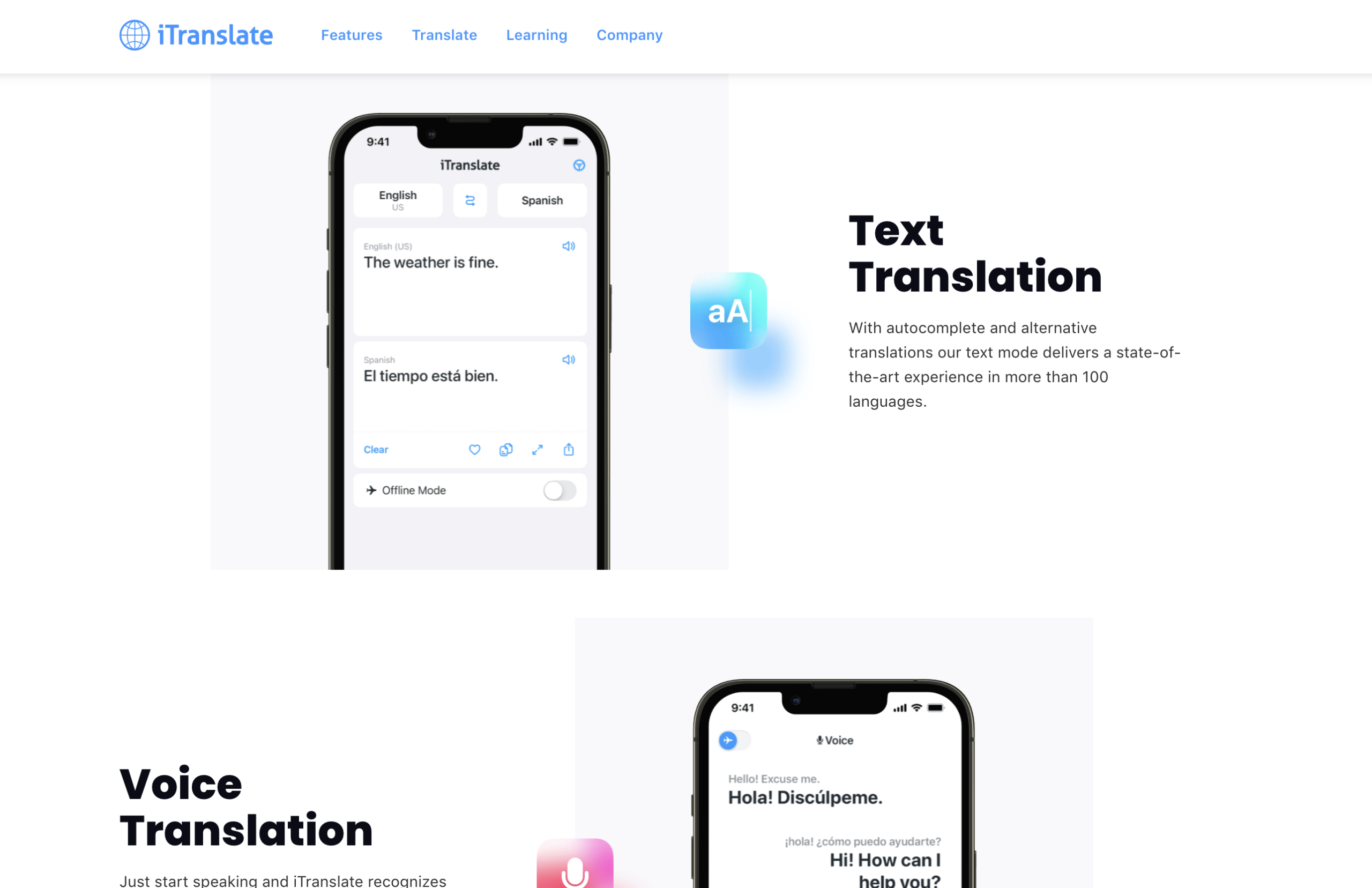
Kiezen iTranslate when the user wants to translate into mandarin during a short face-to-face exchange, hear a phrase, inspect transliteration, or work from a phone. Check the exact device and feature before relying on voice, camera, or offline use; a language listed for text does not guarantee identical availability in every mode.
The app is less suitable when a team needs a persistent meeting workspace, audience distribution, specialist terminology preparation, or an approved publication workflow. Save important names and numbers in visible text instead of trusting audio playback alone.
Sonix voor opgenomen audio en video
Sonix is designed around uploaded audio and video. Its official Mandarin pages describe speaker-labeled transcription, word-level timestamps, browser editing, and exports such as Word, PDF, SRT, and VTT. Its translation directory currently lists both Chinese (Simplified) and Chinese (Traditional) as target routes for audio and video.
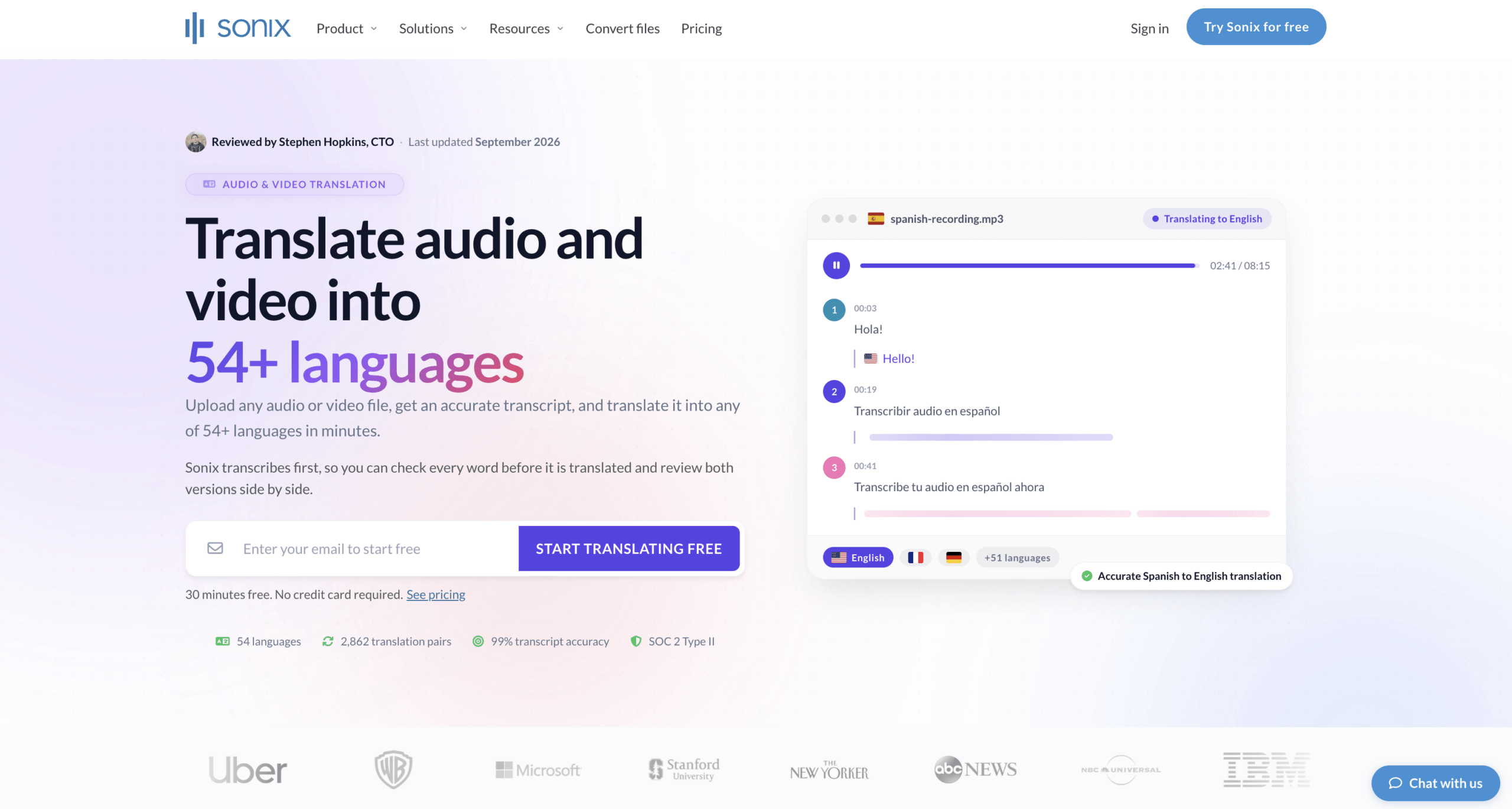
Gebruik Sonix when translate into mandarin means turning a finished interview, lecture, podcast, or video into an editable Chinese transcript or subtitle file. The editor and timestamps make correction possible before publication, which is fundamentally different from translating while people are still speaking.
Confirm the required script and market vocabulary before export. A Simplified-to-Traditional conversion does not automatically localize every term for Taiwan or Hong Kong, and Chinese subtitles may need line-length, reading-speed, and timing review by a human editor.
Transync AI for Live Mandarin Communication
Transync AI richt zich op realtime vertaling for meetings, calls, classes, demos, and in-person conversations. It supports Chinese and English within its current language coverage and provides bilingual captions so participants can inspect the recognized source and translated result while the exchange is happening.
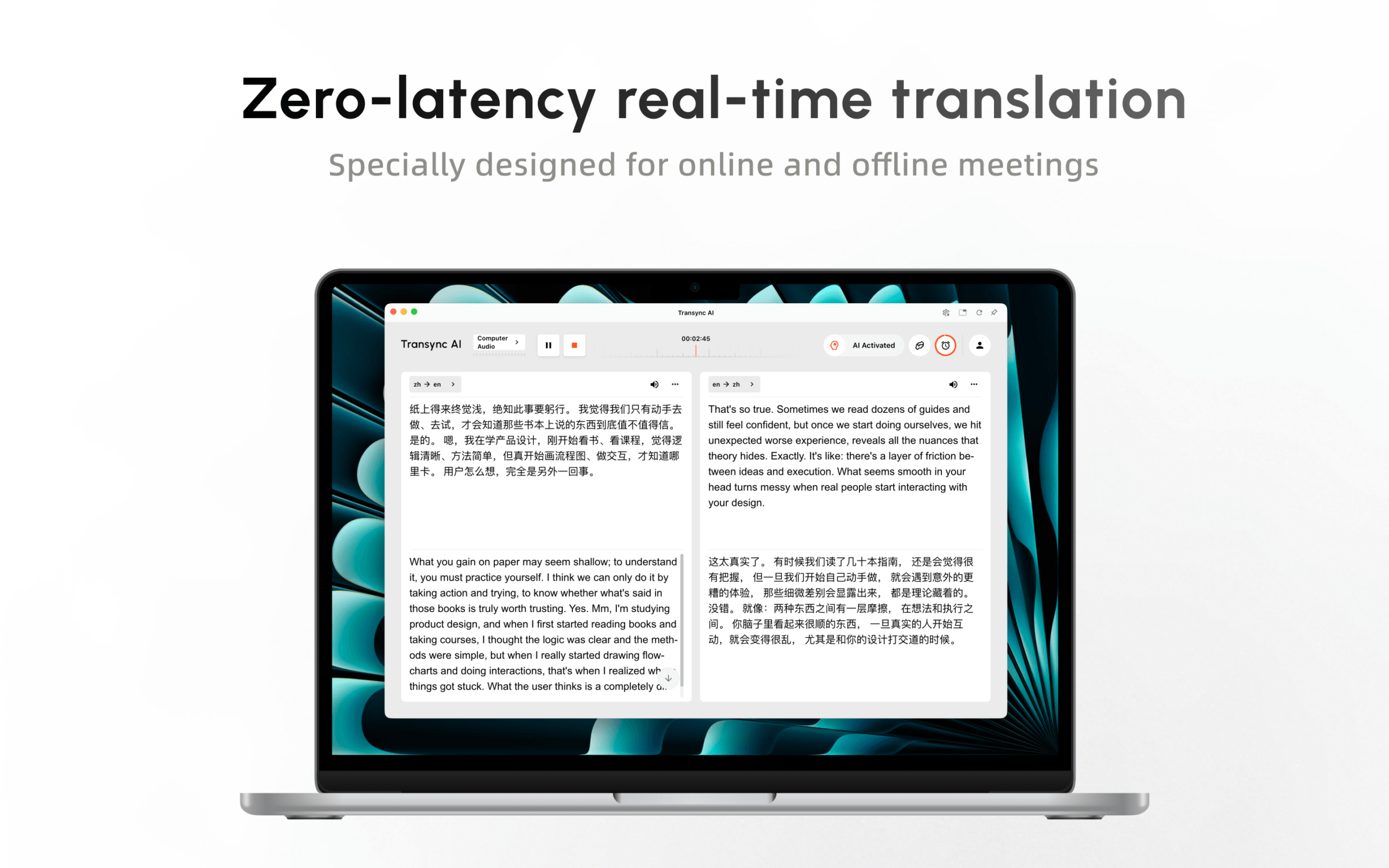 When participants need to hear the result, its AI-stemvertaler provides translated voice playback. Before a specialist session, teams can add product names, people, acronyms, and background through Trefwoorden en context. Daarna, Notulen van de AI-vergadering create a separate record for decisions and actions.
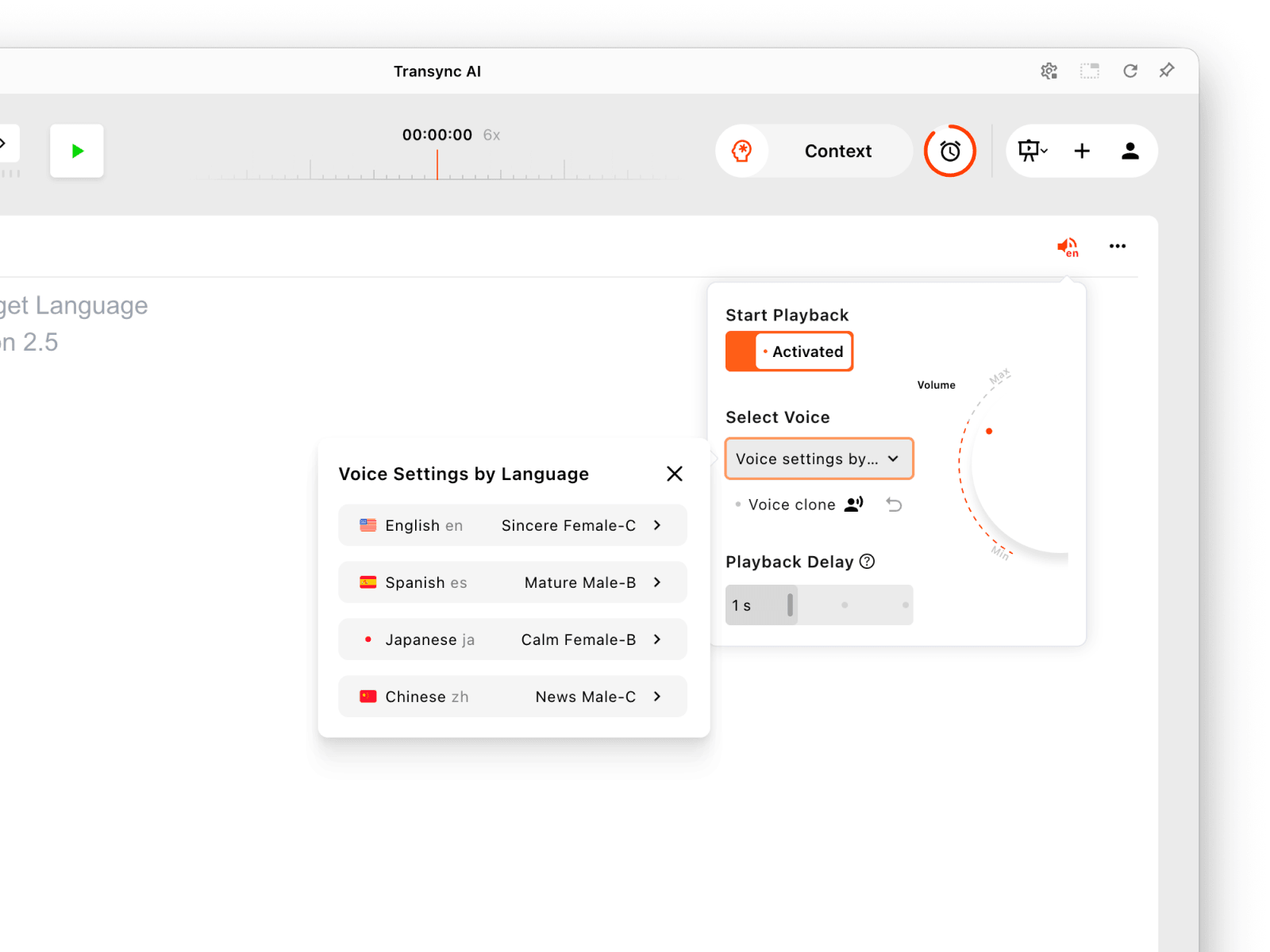
Configureer de spraakweergave afzonderlijk voor elke presentatietaal.
For Chinese captions, turn on Toon Chinese Pinyin when learners or non-native readers need pronunciation support. The Pinyin appears above the Chinese characters during translation, allowing users to follow sound and writing together. Keep the characters visible: Pinyin alone cannot disambiguate every word or prove that a name uses the correct characters.
In a two-way call, the live vergadering vertaling workflow helps both sides read and respond. For a lecture, training session, webinar, or company briefing, Presentatiemodus lets audience members join on their own devices through a link, QR code, or Room ID. Each attendee chooses from the languages enabled by the host and can read or listen when voice playback is available; the audience does not speak into the host’s task.
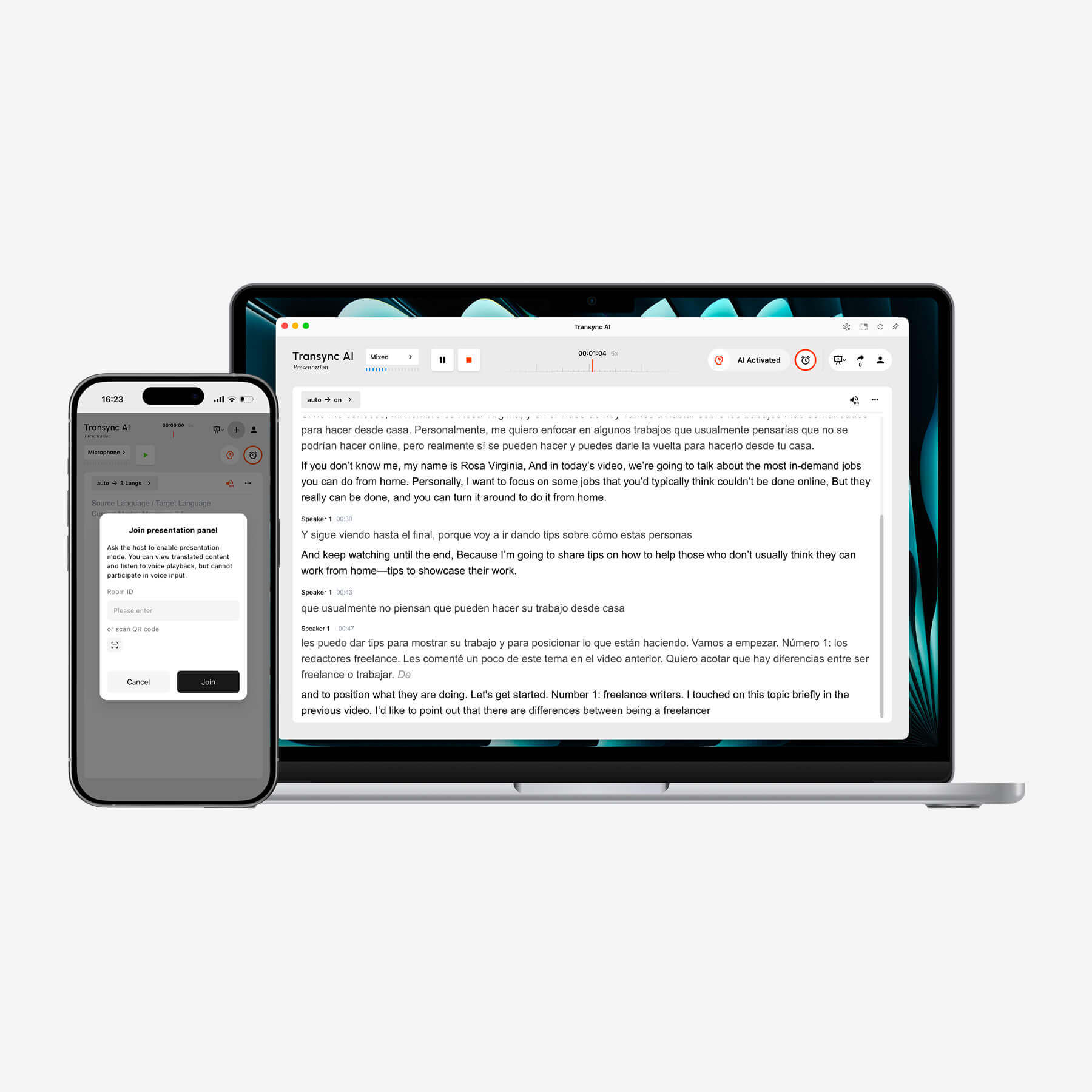
Transync AI toont realtime tweetalige transcriptie op een laptop, terwijl een mobiel apparaat de presentatiebediening mogelijk maakt.
Kiezen Transync AI when translate into mandarin must happen during a live conversation or presentation rather than after a file upload. Test microphone capture, system audio, network conditions, terminology, script display, Pinyin preference, and playback before an important session. Transync AI is not an offline translator, general document translator, OCR tool, or frame-level subtitle editor.
A Human Professional for Publication and High-Stakes Speech
A qualified Mandarin translator or interpreter should lead when errors could affect legal rights, medical consent, safety, immigration, employment, finance, compliance, or public reputation. The job title matters: a translator normally works with written content, while an interpreter works with spoken communication. Some professionals offer both, but the skills and preparation are not identical.
Specify the direction. A person who interprets Mandarin into English is not automatically the best professional for polished English-to-Chinese marketing copy. Confirm Simplified or Traditional Chinese, target market, subject expertise, interpreting mode, certification needs, confidentiality, and final approval responsibility.
For a large live event, the professional may need advance materials, a terminology list, a partner interpreter, appropriate audio, and scheduled breaks. For publication, the workflow may need translation, editing, proofreading, and in-context review rather than one pass.
Automation can support preparation, captions, or drafts. It should not be described as professional accountability. When the consequence is high, the safest way to translate into mandarin includes a named human reviewer who can ask questions and approve the final result.
Three Completed Destination Cards
The following examples show how the same broad keyword becomes three different assignments.
Card A: A Mainland China Product Demonstration
| Veld | Beslissing |
|---|---|
| Gesproken taal | Mandarin voice |
| Character form | Vereenvoudigd Chinees |
| Publiek | Mainland China enterprise prospects |
| Register | Polite, confident, professional |
| Reading aid | Pinyin enabled for the English-speaking presenter’s reference |
| Delivery route | Two-way online demonstration with captions and voice |
The terminology list should include product names, model numbers, and industry phrases. A bilingual participant should confirm prices, dates, and promises during the call. Meeting notes should preserve conditions rather than upgrading a tentative answer into a commitment.
Card B: A Taiwan Customer Onboarding Guide
| Veld | Beslissing |
|---|---|
| Gesproken taal | Not required for the first release |
| Character form | Traditioneel Chinees |
| Publiek | Taiwan customers |
| Register | Clear instructional language |
| Reading aid | None in the published guide |
| Delivery route | Written content with in-context human review |
This is not merely a character-conversion task. Navigation labels, product terminology, screenshots, punctuation, and regional wording should be reviewed in the finished interface. A mobile speech app or live meeting translator is not the primary production tool.
Card C: A Recorded Course for Mandarin Learners
| Veld | Beslissing |
|---|---|
| Gesproken taal | Standard Mandarin audio |
| Character form | Simplified Chinese, based on course policy |
| Publiek | Beginning adult learners |
| Register | Friendly instructional speech |
| Reading aid | Tone-marked Pinyin below or above characters |
| Delivery route | Edited video, timed subtitles, and downloadable transcript |
This route needs recording, transcript correction, subtitle timing, and educational review. A live system may help during production or a class discussion, but the released course needs an editable media workflow.
The cards demonstrate why “translate into mandarin” is not enough to select a product. The destination fields determine the workflow.
They also give reviewers a shared definition of success before anyone begins to translate into mandarin.
What Should You Check in the Mandarin Result?
Use the destination card again during review. Do not ask only whether the sentence “looks Chinese.”
- Toespraak: Does the audio use Mandarin, not Cantonese or another Chinese language?
- Script: Are Simplified or Traditional characters used consistently?
- Markt: Do vocabulary, names, dates, currency, and units match the audience?
- Register: Does the result preserve politeness, urgency, certainty, and responsibility?
- Reading support: Are Pinyin and tone marks correct where included?
- Levering: Can the real recipient read, hear, answer, edit, or retain the output as required?
Add fragile information to the review: a personal name, company name, code, percentage, date, correction, negation, and conditional promise. Ask a native Mandarin speaker to explain what action they would take after receiving the result. Their interpretation is stronger evidence than a smooth synthetic voice.
If the system outputs the wrong character for a correctly pronounced name, update the glossary and visible record. If translated voice is correct but the audience cannot hear it, fix the delivery route. If subtitles are readable but use the wrong market vocabulary, revise the destination label. A translate into mandarin review should locate the failure rather than assigning one vague accuracy score.
Privacy, Consent, and Record Control
Mandarin translation tools may process typed text, photos, voices, recordings, captions, and meeting transcripts. Before uploading or streaming business content, review the current privacy policy, retention and deletion controls, processing locations, subprocessors, training policy, access permissions, and contract for the exact product and plan.
Tell participants when speech is being processed, translated, recorded, or shared. Obtain any consent required by the organization and jurisdiction. For a presentation, decide before the event whether attendees should receive a transcript afterward. For recorded media, remove material that the editor does not need.
Define who approves the output. A traveler may review a phrase on the screen. A sales owner should verify prices and commitments. A course editor should approve subtitles and Pinyin. Legal, medical, safety, and regulatory content may require qualified professionals with formal responsibility.
Privacy is part of the destination. To translate into mandarin responsibly, specify not only what the audience receives but also what the service retains.
Veelgestelde vragen
Does translate into mandarin mean Simplified Chinese?
Not automatically. Mandarin is a spoken language variety, while Simplified Chinese is a character set and writing convention. Mandarin can be written in Simplified or Traditional Chinese. Choose the script based on the audience and market.
Is Mandarin the same as Chinese?
Mandarin is one Chinese language variety and the basis of standard spoken Chinese in Mainland China and Taiwan. “Chinese” can refer broadly to multiple spoken languages, written standards, scripts, or cultural contexts. A complete brief should identify speech, script, and region.
Can I translate into mandarin with voice?
Yes. Mobile conversation apps can handle short exchanges, while live meeting products can provide continuing captions and translated voice. Confirm the exact Mandarin language label, audio route, supported device, network requirement, and whether the other person can answer naturally.
Should I add Pinyin to Mandarin translation?
Add Pinyin when learners or non-native readers need pronunciation support. Keep Chinese characters beside it because Pinyin alone can be ambiguous. In Transync AI, enabling Toon Chinese Pinyin displays Pinyin above Chinese characters during a live translation.
Is Traditional Chinese the same as Cantonese?
No. Traditional Chinese describes a written character form. Cantonese is a spoken Chinese language with its own pronunciation, vocabulary, and grammar. Many Hong Kong users speak Cantonese and read Traditional Chinese, but one label does not replace the other.
Which tool should I use for a Mandarin video?
For an already recorded file, use a media transcription and translation workflow such as Sonix, then review the transcript, script choice, subtitle timing, names, and terminology. For a live class or webinar, use a real-time or presentation workflow such as Transync AI.
When do I need a human Mandarin translator or interpreter?
Use qualified human expertise for publication, contracts, medical decisions, safety instructions, legal proceedings, regulated communication, or any situation where a subtle error could cause material harm. Choose a professional with the correct direction, region, and subject specialization.
Final Answer: Address the Mandarin Destination First
To translate into mandarin, write the destination before translating the message. Specify spoken Mandarin, character form, audience market, register, reading aid, and delivery route. That six-field card separates speech from script, pronunciation help from meaning, live interpretation from recorded-media editing, and an understandable draft from an approved result.
Then choose the workflow. A mobile app can handle a short phrase. A media platform can turn recorded audio into editable Chinese captions. Transync AI can support a live meeting or distribute translation to an audience, including optional Pinyin above Chinese text. A qualified professional can take responsibility when nuance and consequences demand it.
The best translate into mandarin result is not simply fluent Chinese. It is the right Mandarin experience, in the right writing system, for the right people, delivered at the moment they need it.