

Need a transcription translator? Use this 100-point test to compare source review, translation, speakers, timestamps, exports, privacy, and live use.
A transcription translator should do more than turn foreign-language audio into fluent-looking text. It must capture the source speech, keep errors visible, preserve the intended meaning, and deliver a usable document, subtitle file, or live record. A tool can sound impressive in a demo and still fail the file you actually need to publish.
This guide is a reproducible 100-point acceptance test. It does not crown one universal winner. Instead, it helps buyers compare file-first platforms such as Sonix, Trint, Escriba feliz, y Transcribir with the live-meeting workflow of Transync AI.
The distinction matters. Four of these products can begin with uploaded media or a completed transcript. Transync AI begins with speech happening now. Both paths can create translated text, but they solve different moments. A fair transcription translator comparison must preserve that difference instead of judging every product with the same shortcut.
What Does “Transcription Translator” Mean?
The phrase usually describes software that performs two connected operations:
- Transcripción: It converts speech into written text in the language spoken.
- Traducción: It converts that source text into a different language.
The expected output varies. One buyer wants a readable English document from a Japanese interview. Another wants Spanish SRT subtitles for a French video. A research team may need a bilingual transcript with speakers and timestamps. A meeting participant needs translated text while people are still talking.
Antes de elegir un transcription translator, complete this sentence:
“My source is __, my target language is __, my final deliverable is __, and the person who approves it is __.”
If the final deliverable is unknown, feature counts will not solve the buying decision.
The Fast Product Map
| herramientas | Mejor punto de partida | Review model | Salida útil | Ajuste más fuerte | Límite importante |
|---|---|---|---|---|---|
| Sonix | Audio o video subido | Audio-linked source plus side-by-side translation | Documents and multilingual SRT/VTT subtitles | Transcript-first media review | Not primarily a live conversation translator |
| Trint | Uploaded or captured media | Time-coded collaborative editor | Transcripts, quotes, stories, captions, and translated files | Newsrooms and collaborative editorial teams | Web file transcription is single-language per transcript |
| Escriba feliz | Audio o video subido | AI workflow or human proofreading/service | Transcripts, translated transcripts, captions, and foreign-language subtitles | Teams that may escalate from AI to human review | Coverage and service level vary by feature and language pair |
| Transcribir | Audio o video subido | Built-in online editor | TXT, PDF, DOCX, SRT, and other plan-dependent formats | Straightforward automated transcript translation | Verify the exact source-language and export needs |
| Transync AI | Audio de micrófono en directo y de ordenador | Bilingual live text plus saved record | Captions, translated voice, transcript, and meeting notes | Meetings, classes, calls, and live conversations | Not a general audio/video file-upload editor |
This table is a routing tool, not a score. Run the same evidence-based test before accepting any transcription translator for production.
Build One Difficult but Fair Test File
Do not evaluate software with a ten-second greeting recorded in a silent room. Create a six-minute file that resembles the work you will actually process.
Minute 1: Clean Single-Speaker Speech
Record a clear introduction containing a personal name, organization, date, price, percentage, and product code. This creates a baseline without making the entire test artificially easy.
Minute 2: Specialist Vocabulary
Include five terms from the buyer’s field. Use a term that also has a common everyday meaning, an acronym, and one name whose spelling cannot be guessed reliably from sound.
Minute 3: Two Speakers
Let two people alternate naturally. Include a short interruption and a correction such as, “The shipment is Thursday—sorry, Tuesday morning.”
Minute 4: Risk Words
Use negation, conditions, decimals, currencies, and units. A transcription translator must distinguish “can” from “cannot,” 15 from 50, and approval from conditional approval.
Minute 5: Realistic Noise
Add the level of room noise, remote-call compression, or microphone distance found in the actual workflow. Do not sabotage the recording; make it representative.
Minute 6: Target-Language Review Passage
Include two sentences whose register matters: one formal request and one casual remark. Ask a bilingual reviewer to prepare a short explanation of the intended tone rather than one rigid “perfect” translation.
Keep the original WAV or video, a human-checked source transcript, an approved term list, and the intended outputs. This small benchmark pack makes every trial comparable.
The 100-Point Transcription Translator Scorecard
| Área de prueba | Points | What earns the points |
|---|---|---|
| 1. Intake fit | 15 | Accepts the real source, duration, file type, or live audio route |
| 2. Source evidence | 20 | Keeps audio, text, speakers, timestamps, and uncertainty reviewable |
| 3. Translation control | 25 | Preserves meaning, terminology, register, numbers, and corrections |
| 4. Timeline and speaker integrity | 15 | Retains speaker identity, segment order, and subtitle timing |
| 5. Delivery and governance | 25 | Produces the required export with suitable access, retention, and deletion controls |
| Total | 100 | A pass should reflect the buyer’s risk, not a universal marketing threshold |
The score deliberately gives 80 points to what happens after the file merely opens. A weak transcription translator often succeeds at intake and then hides source errors, breaks timing, or exports the wrong artifact.
Test Area 1: Intake Fit — 15 Points
La primera transcription translator question is not “How many languages are supported?” It is “Can the system receive this source correctly?”
Award points for:
- The actual audio or video format: MP3, WAV, M4A, MP4, MOV, or the required production format.
- The real duration and file-size limit.
- A reliable upload from local storage or the required cloud provider.
- Correct source-language selection or detection.
- Handling of one language versus code-switching.
- A live capture route when the source does not yet exist as a file.
A tool that accepts MP3 does not necessarily accept a three-hour interview, a mixed-language panel, a remote system-audio feed, or a subtitle file that must retain cues.
For file workflows, upload the same untouched benchmark. For a live transcription translator, play the benchmark through the actual microphone or meeting route and document the additional audio compression.
Intake Fail Conditions
Give zero for the relevant item if the system silently truncates the file, selects the wrong language, merges multiple channels without warning, or cannot capture the remote participant. A successful upload animation is not proof that the input is complete.
Test Area 2: Source Evidence — 20 Points
The source transcript is the audit surface. Reviewers need to see what the system believed it heard before deciding whether the translation is correct.
Score five points for each capability:
- Audio anchoring: Clicking text returns to the corresponding sound.
- Editable source: Reviewers can correct names, numbers, punctuation, and uncertain words.
- Speaker traceability: Labels stay stable across turns and can be renamed.
- Time traceability: Useful timestamps or segment boundaries survive editing.
Do not score only word accuracy. A first draft with a visible audio link can be repaired. A slightly cleaner block of text with no path back to the recording may be harder to trust.
Al probar un transcription translator, count high-impact source errors separately:
| Error type | Ejemplo | Por qué es importante |
|---|---|---|
| Negation | “not approved” becomes “approved” | Reverses the decision |
| Number | 15 becomes 50 | Changes quantity or cost |
| Entity | “Mira” becomes “mirror” | Damages identity and searchability |
| Code | AX-17 becomes X17 | Breaks product or case references |
| Vocero | Customer line assigned to supplier | Changes ownership and accountability |
| Correction | Tuesday correction is lost | Leaves an outdated fact in the record |
Keep separate counts for ordinary wording differences and decision-changing errors. One reversed approval matters more than ten missing filler words.
Test Area 3: Translation Control — 25 Points
Translation quality is not the same as surface fluency. Give five points in each category:
- Factual meaning: Actors, actions, quantities, dates, and conditions remain correct.
- Terminología: Approved terms, names, and abbreviations are consistent.
- Registro: Formality and tone fit the speaker and audience.
- Correction handling: The final corrected statement is clear without preserving a false conclusion.
- Reviewability: Source and target can be compared without losing segment alignment.
Use a bilingual subject reviewer, not only a fluent general reader, when the content includes medicine, law, engineering, finance, or specialized research. The reviewer should mark the exact source segment, proposed target revision, reason, and severity.
Use a Translation Error Ledger
| Segment ID | Source issue? | Target issue | Severity | Approved change | Crítico |
|---|---|---|---|---|---|
| 00:42 | Name spelling | Name translated as common noun | Alto | Restore approved spelling | Iniciales/fecha |
| 02:18 | Ninguno | Conditional approval made final | Crítico | Restore the condition | Iniciales/fecha |
| 04:03 | ruido de fondo | Unit uncertain | Obstruido | Return to audio/speaker | Iniciales/fecha |
The ledger turns a subjective transcription translator review into evidence a team can discuss. It also reveals whether a product lets reviewers repair the target without breaking the connection to the source.
Test Area 4: Timeline and Speaker Integrity — 15 Points
A translated document may tolerate longer sentences. Subtitles cannot. They must stay synchronized, readable, and attached to the correct speaker.
Award five points for each:
- Speaker labels remain correct after translation.
- Timestamps or cue boundaries remain connected to the intended speech.
- The exported subtitle file plays correctly in the publishing platform.
Open every test SRT or VTT in the real player. Watch for overlapping cues, long lines, rapid flashes, missing punctuation, and translated text that requires more reading time than the source. A file can be structurally valid and still be uncomfortable to read.
For interviews and research, speaker integrity may matter more than subtitle line length. For social video, timing and line breaks may dominate. Adjust the internal 15-point rubric before the trial, not after seeing which product wins.
Test Area 5: Delivery and Governance — 25 Points
A transcription translator is only useful if the approved result can leave the editor in the required form.
Score five points for each:
- Required output: DOCX, PDF, TXT, CSV, SRT, VTT, API response, bilingual view, or meeting record.
- Version clarity: Draft, reviewed, approved, and published versions cannot be confused.
- Colaboración: Reviewers have appropriate view, comment, and edit access.
- Retention control: Audio, source text, translations, and exports have defined storage and deletion rules.
- Security fit: The vendor, plan, region, contract, and account controls meet the project requirement.
Do not award governance points from a generic privacy slogan. Ask what is stored, where it is processed, whether customer material is used for training, who can retrieve it, how deletion works, and whether backups or shared links behave differently.
For a confidential project, require answers in writing. For legal, medical, immigration, or safety-critical content, confirm whether qualified human work, certification, or a regulated process is required. A 100-point software score does not replace professional obligations.
How the Products Fit the Test
The sections below describe transcription translator positioning from current official materials. They are not scores because a score requires the buyer’s benchmark file, language pair, plan, and governance requirements.
Sonix: Strong Side-by-Side File Review
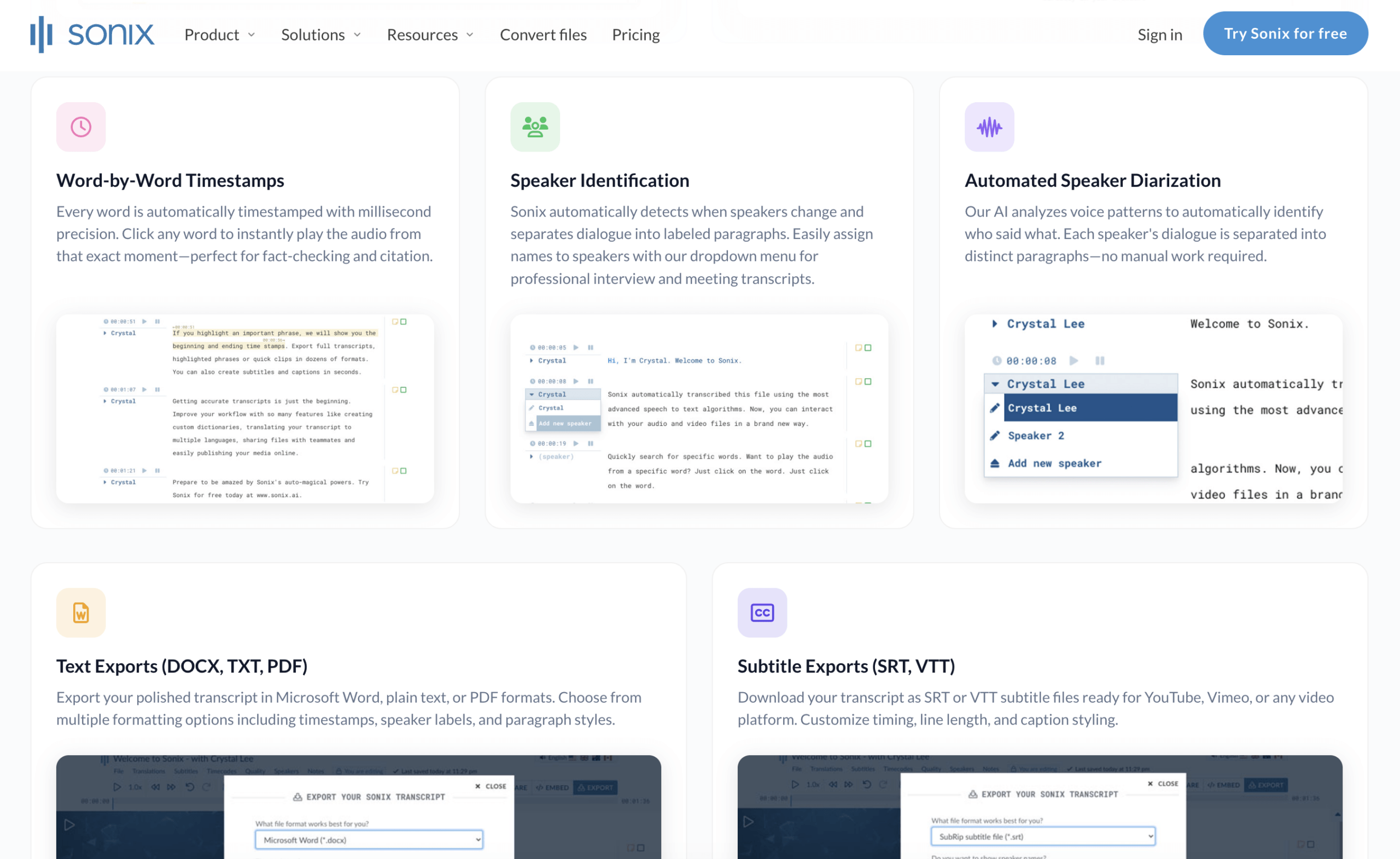
Sonix follows a clear file-first sequence: upload audio or video, create and correct the source transcript, then generate translations. Its current feature page lists 55+ translation languages, a side-by-side source/target editor, audio-linked review, and exports including DOCX, PDF, SRT, and VTT.
This is useful when the buyer wants to hear the source while editing the translation and create several subtitle languages from one reviewed transcript. It is not primarily positioned as the speech layer for a live two-way meeting.
Trint: Strong Editorial Collaboration
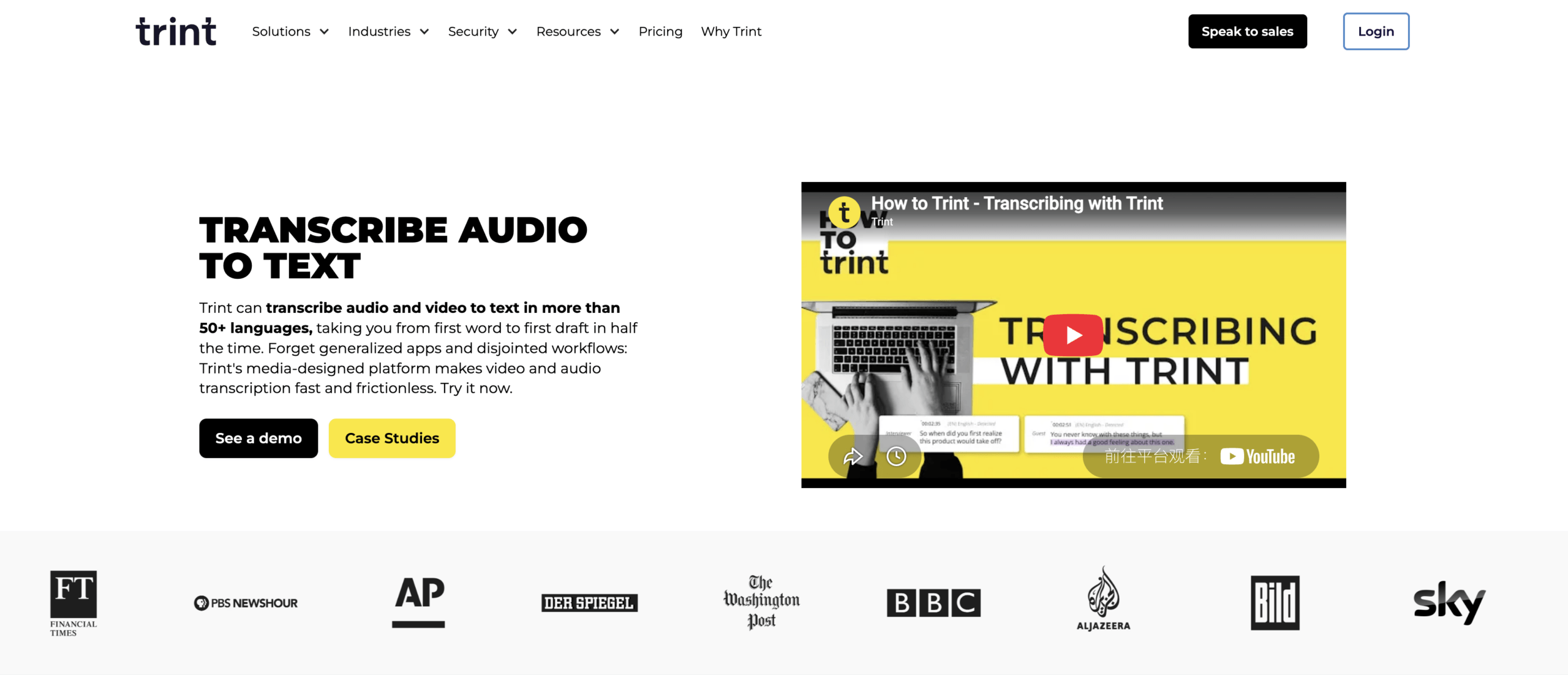
Trint emphasizes time-coded transcripts, playback, collaborative editing, quotes, stories, captions, and newsroom-style production. Current official materials describe file transcription in more than 50 languages and transcript translation into more than 70 languages. Its translated files remain linked to the source transcript in the translation workflow.
Esto hace que Trint worth testing when several editors must verify quotes, comment, build stories, or create localized captions. Its own help material notes an important boundary: the web app produces a transcript in one language, while multilingual live behavior belongs to a different workflow and plan.
Escriba feliz: AI and Human Service Paths
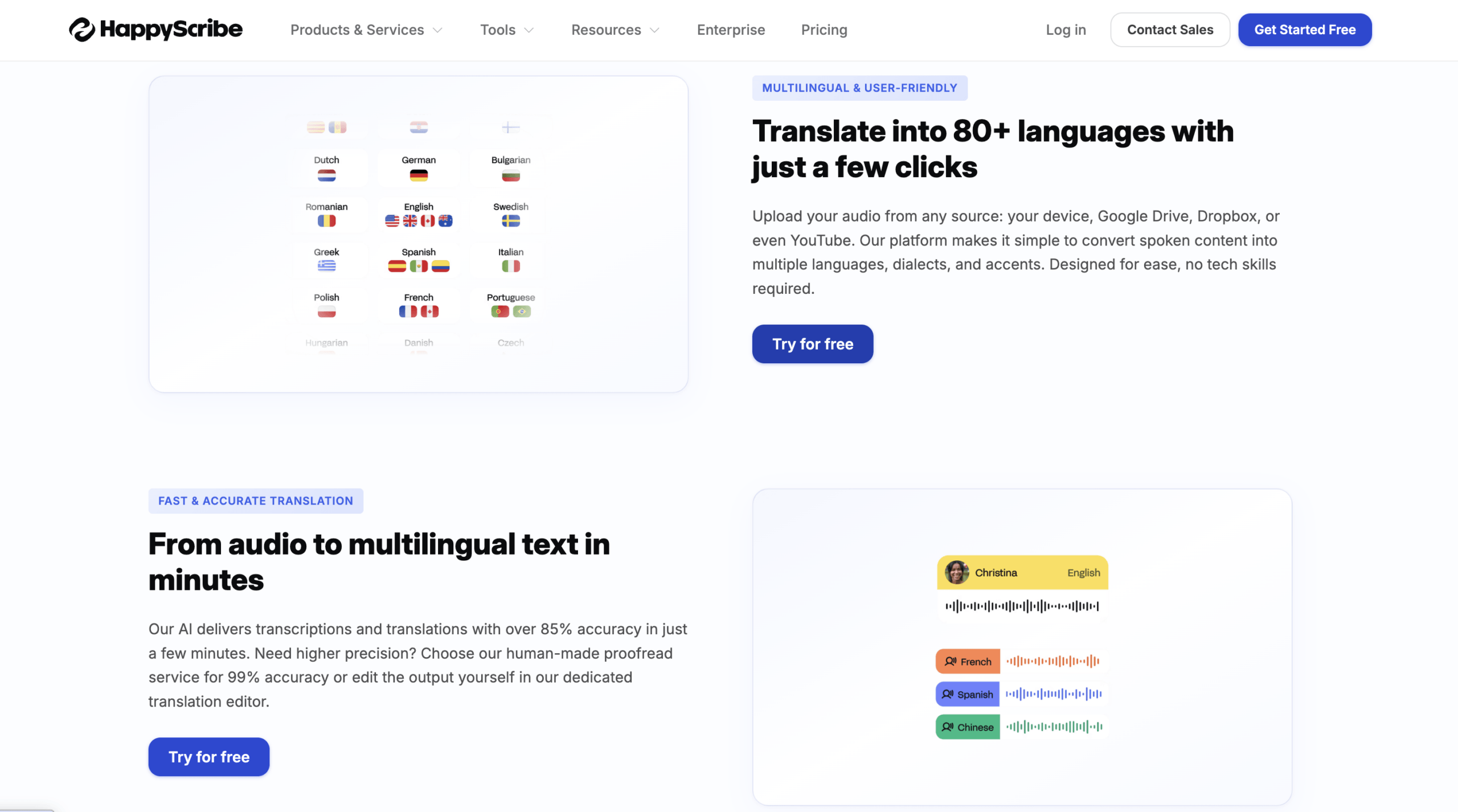
Escriba feliz currently describes 150+ languages across transcription, subtitles, translation, and AI meeting notes, while warning that coverage varies by feature. Its workflow can create original-language transcripts or subtitles and convert them into another language.
For higher-control work, Escriba feliz also documents human proofreading and service distinctions among transcription, translated transcription, same-language captions, and foreign-language subtitles. This is useful when a buyer may start with automation but needs a defined human route for selected files or language pairs.
Transcribir: Direct Automated Transcript Translation
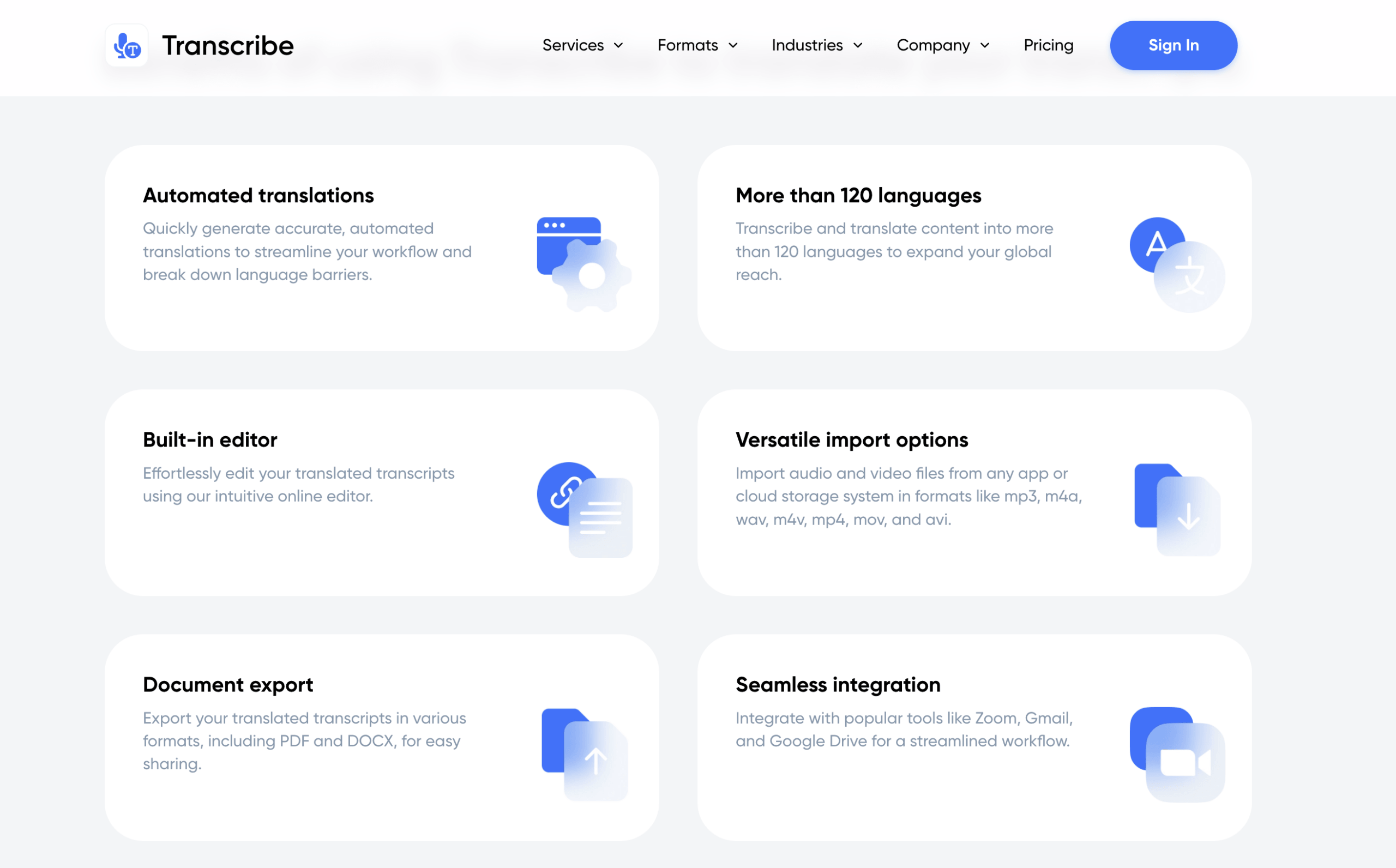
Transcribir positions its feature as an upload-to-translated-transcript workflow. Current official information lists more than 120 translation languages, a built-in editor, common audio/video imports, and exports including TXT, PDF, DOCX, and SRT.
This is a practical candidate when the goal is a translated document or subtitle from a recording without a complex production stack. Test speaker handling, source/target comparison, timestamp behavior, and the exact export available on the intended plan rather than assuming every listed format fits every workflow.
Transync AI: Live Understanding Before a File Exists
Transync AI should be scored on a different intake route. It captures live microphone and computer audio for traducción de reuniones en tiempo real rather than accepting a recording for post-production editing.
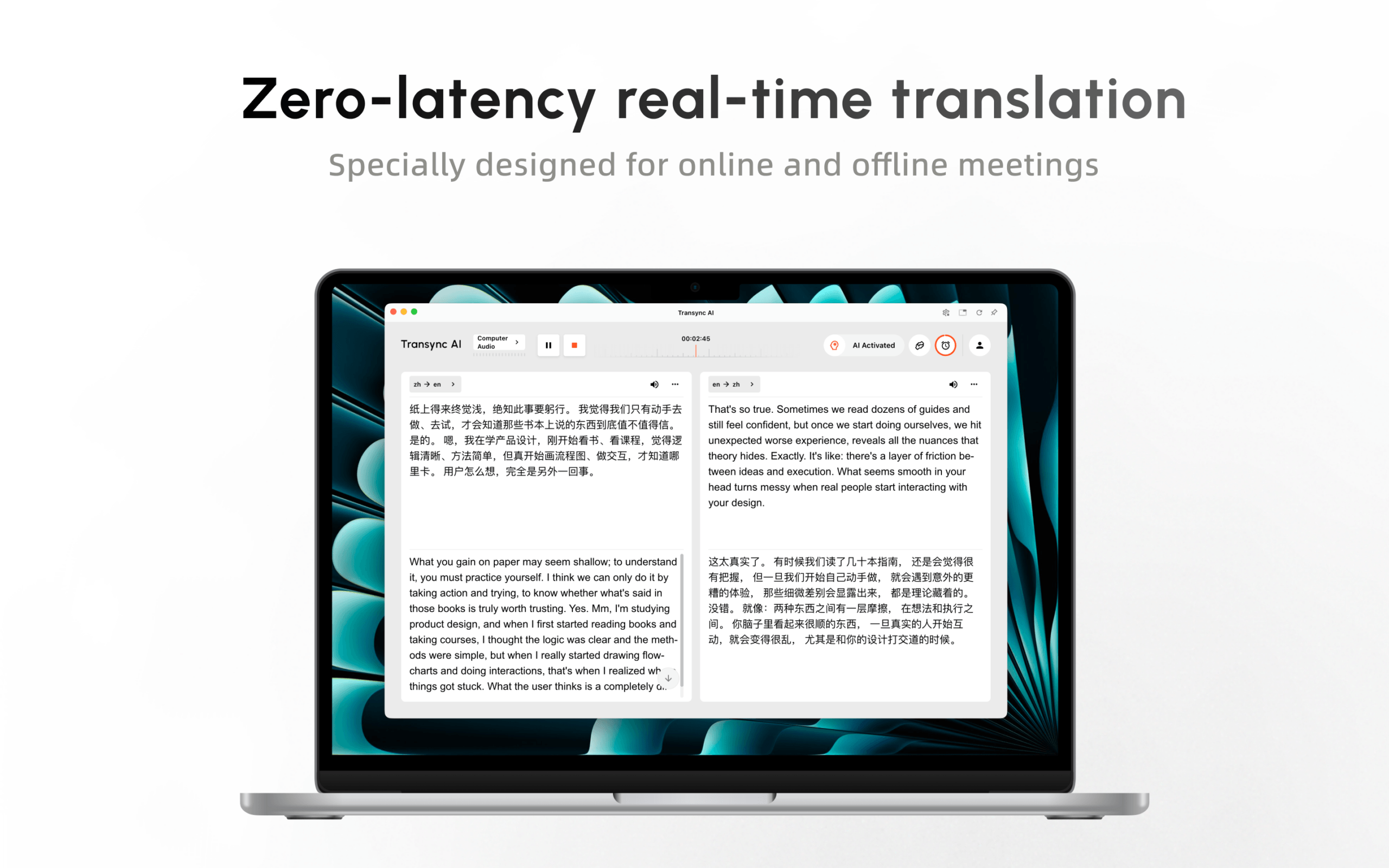 During a meeting, Transync AI presents original and translated text together and can play translated voice. Before the session, Palabras clave y contexto can prepare names and specialist terms. Afterward, Notas de la reunión de IA can turn the saved conversation into a transcript and structured follow-up.
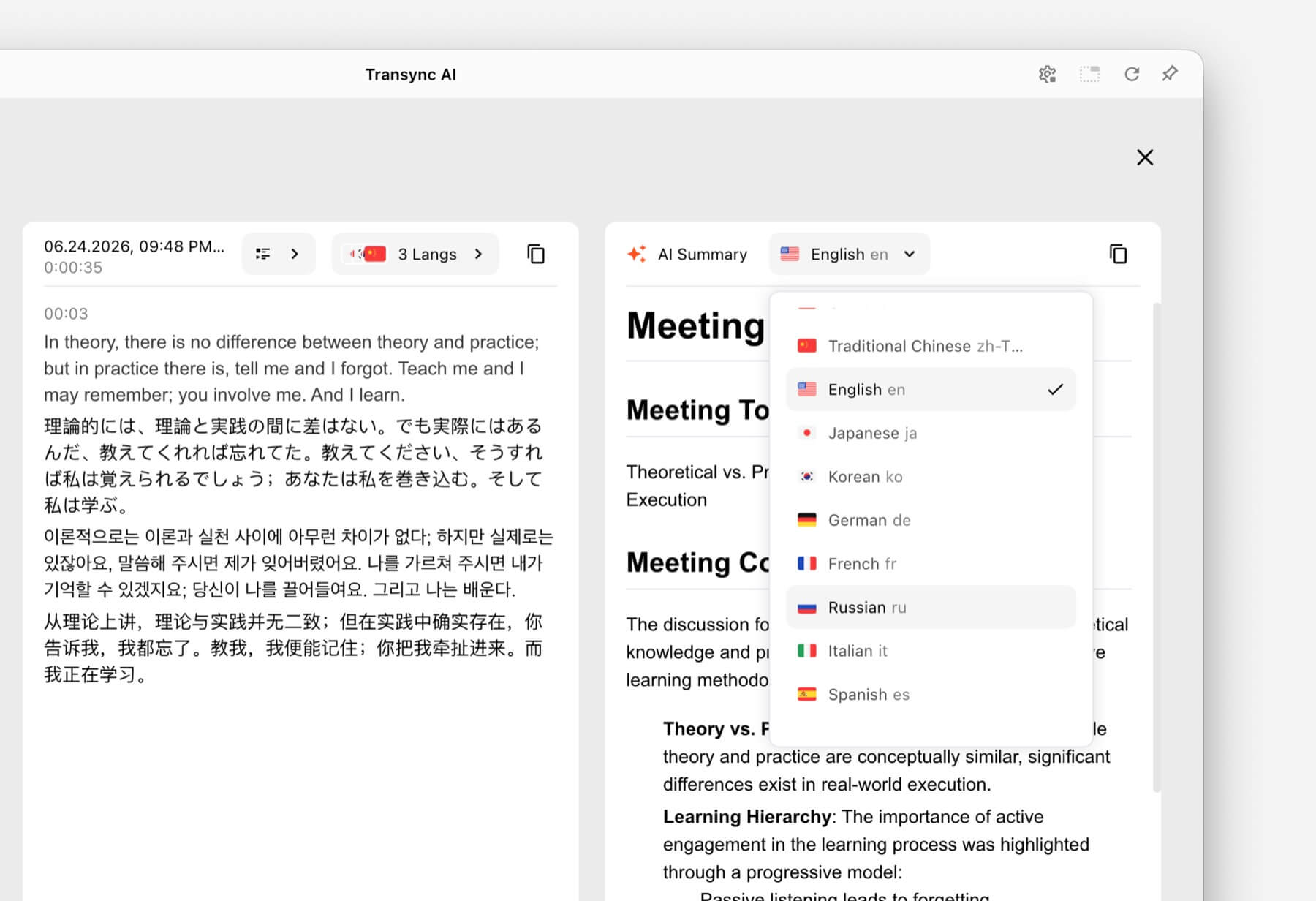 This route fits calls, classes, interviews, and meetings in which understanding cannot wait for an upload. It does not replace Sonix, Trint, Escriba feliz, o Transcribir for frame-level subtitle editing, arbitrary media uploads, or offline file processing.
Set the Passing Score Before You Test
Do not automatically declare 80/100 a transcription translator pass. Set both a total threshold and mandatory gates.
Internal Meeting Notes
A team may accept 75/100 if the tool reliably captures decisions and owners, users can correct the record, and no regulated content is involved.
Public Subtitles
A media team might require at least 85/100 plus mandatory passes for timing, names, terminology, native-language review, and playback in the publishing platform.
Research, Legal, or Medical Material
Software scoring may be only a first-draft evaluation. Qualified human review, consent, anonymization, certification, or a controlled vendor process may be mandatory regardless of the number.
Write mandatory gates in advance. For example: “Any lost negation, wrong speaker on an approval, unsupported deletion requirement, or broken SRT is an automatic failure.” This prevents a high average from hiding a critical defect.
A One-Page Trial Record
Copy this template for every transcription translator tested:
| Campo | Trial entry |
|---|---|
| Product, plan, and version | |
| Fecha del examen | |
| Source language and region | |
| Target language and region | |
| File type, duration, and size | |
| Speakers and audio conditions | |
| Required final deliverable | |
| Intake score /15 | |
| Source evidence score /20 | |
| Translation control score /25 | |
| Timeline and speaker score /15 | |
| Delivery and governance score /25 | |
| Automatic fail triggered? | |
| Reviewer names and roles | |
| Decision and conditions |
Save screenshots, output files, the error ledger, and the exact settings with the score. Without evidence, a trial result becomes a memory of a demo rather than a repeatable procurement decision.
Errores comunes al comprar
Comparing Language Counts Without Direction
A vendor may list transcription languages, translation languages, interface languages, and voice-output languages separately. Confirm the exact source language, target language, regional variety, and output type.
Translating Before Correcting the Source
If a file-first transcription translator allows source editing, repair important names, numbers, speakers, and terms before generating several target versions. Otherwise, one source error multiplies.
Testing Only English
An English demo says little about Cantonese, Arabic dialects, Brazilian Portuguese, code-switching, or a specialized Japanese interview. Test the production pair and domain.
Confusing a Summary with a Transcript
A summary selects important points. A transcript attempts to preserve what was said. Do not approve quotations, evidence, or exact decisions from a summary alone.
Ignoring the Recipient
A translated transcript may be correct but unusable if the recipient needs captions, a bilingual document, spoken audio, an API object, or a live display. Score the final delivery, not merely the editor screen.
Preguntas frecuentes
What Is the Best Transcription Translator?
There is no universal best product. Choose Sonix for side-by-side, audio-linked file review; Trint for collaborative editorial work; Escriba feliz when AI and human service paths matter; Transcribir for a direct automated transcript workflow; and Transync AI for live multilingual meetings. Verify each choice with the real file and language pair.
Should Transcription Happen Before Translation?
In a file-first workflow, yes: create and correct the source transcript before generating target versions. Live systems may perform the stages with very low delay, but showing source and target text still makes errors easier to identify.
Can a Transcription Translator Create Subtitles?
Some products export SRT or VTT files and preserve timing; others produce documents only. A subtitle-capable transcription translator must also be tested for line length, reading speed, cue overlap, and playback in the destination platform.
Can It Translate Several Speakers?
Many tools provide speaker detection or labels, but diarization is not identity verification. Review labels after interruptions, overlapping speech, similar voices, and channel changes.
Is AI Output Ready to Publish?
Not automatically. Review the source transcript and target translation, especially names, numbers, terminology, conditions, and quotations. High-stakes content requires the appropriate qualified human process.
Poder Transync AI Translate an Uploaded Recording?
No. Transync AI is designed for live speech from microphones and computer audio. Use a file-first platform when the job begins with an MP3, WAV, video, transcript, or subtitle file that needs post-production editing.
How Do I Compare Privacy?
Map audio, source text, target text, exports, shared links, logs, and backups separately. Confirm processing location, access, training use, retention, deletion, and contractual controls for the specific plan.
Final Buying Standard
Un confiable transcription translator must survive the buyer’s real source, not a polished sample. It should make critical source errors visible, preserve target meaning, keep speakers and time aligned, export the required artifact, and fit the project’s governance rules.
Use one six-minute benchmark, one approved reference transcript, one error ledger, and one 100-point scorecard across every trial. Then choose the product whose workflow matches the moment: file review, editorial collaboration, human escalation, straightforward document export, or live multilingual participation.
The winning transcription translator is not the one with the largest number on its homepage. It is the one that passes the predeclared gates and leaves enough evidence for another reviewer to reach the same conclusion.