

Find the right english to cantonese translate workflow for speech, text, meetings, travel, subtitles, presentations, and accurate human review.
English to Cantonese translate looks like a simple search, but the real request can be surprisingly complex. Do you need spoken Cantonese, Traditional Chinese text for a Hong Kong reader, colloquial written Cantonese for a chat, or live interpretation during a business meeting? Those outputs are related, but they are not identical.
The safest starting point is to separate language from script. Cantonese is a spoken language with its own sound system, vocabulary, and grammar. Traditional Chinese is a writing system, not a synonym for Cantonese. Many Cantonese speakers read Standard Written Chinese while speaking Cantonese in daily life; informal messages may use distinctly Cantonese characters and expressions.
This guide compares Transync AI, Google Translate, Microsoft Translator, and Apple Translate. It also shows how to turn an english to cantonese translate request into a usable result for travel, work, meetings, and presentations.
The Fast Answer
Choose Transync AI when the job involves live English-Cantonese conversation, meetings, bilingual subtitles, translated voice, terminology, or a multilingual presentation. Its current real-time translation page explicitly lists Cantonese among more than 60 supported languages.
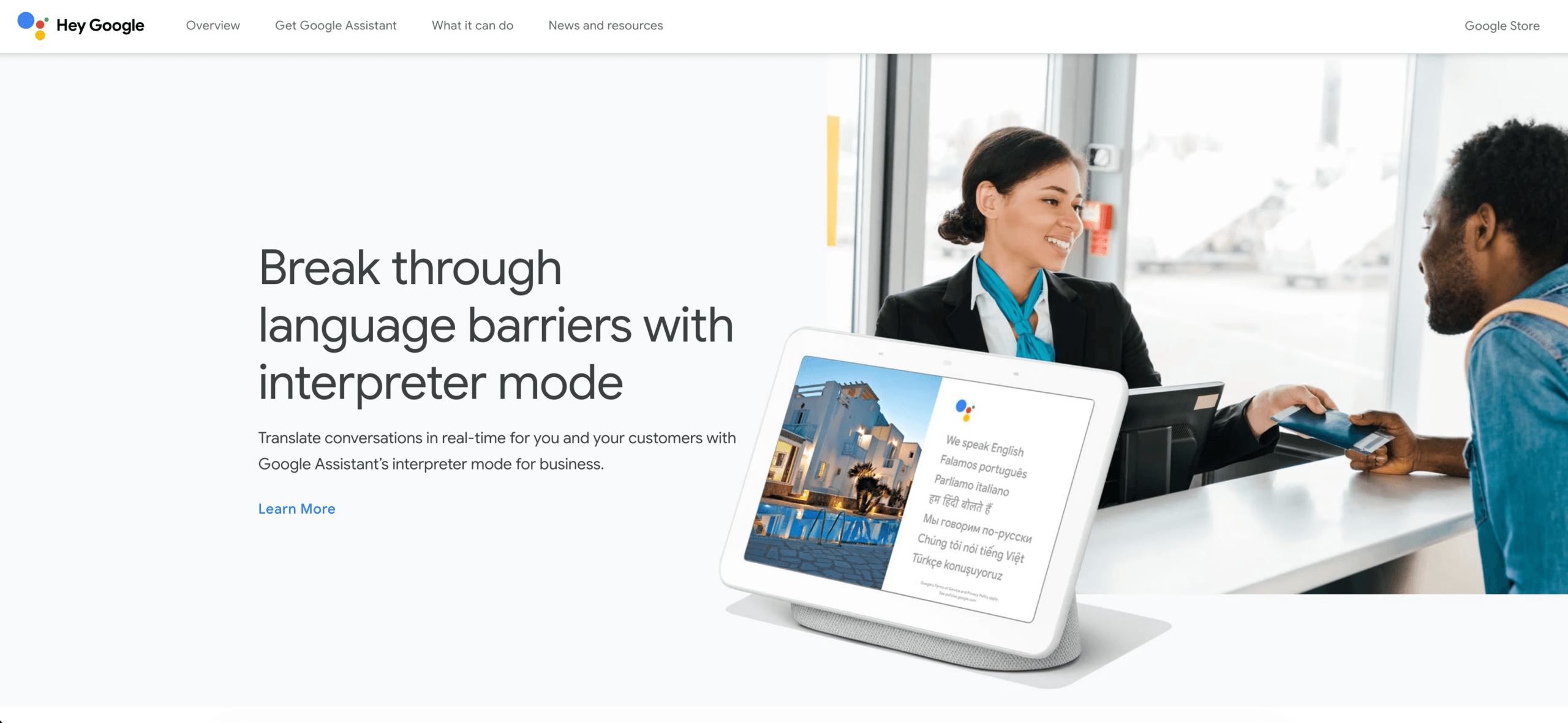
Choose Google Translate for quick written translation and everyday lookup. Cantonese was added to Google Translate in 2024, but feature support can differ between text, speech, offline use, and device platforms, so test the exact mode you intend to use.
Choose Microsoft Translator when you want a split-screen or multi-device conversation. Its current language table lists Cantonese (Traditional) for text, speech, text-to-speech, and multi-device conversation.
Do not assume Apple Translate supports Cantonese merely because Apple supports Cantonese in some accessibility, captioning, or system features. The current iOS feature-availability page lists Cantonese in several areas, but not in the Translate app’s published language list. Check again before relying on it for direct Cantonese translation.
English to Cantonese Translate: Define the Output First
| What You Actually Need | Recommended Output | Example Use | Main Risk |
|---|---|---|---|
| A Cantonese speaker should hear your meaning | Spoken Cantonese or translated voice | Face-to-face conversation or call | Pronunciation, latency, and speech recognition |
| A Hong Kong customer should read a formal message | Traditional Chinese in an appropriate written register | Email, notice, proposal | Tone and market-specific wording |
| A friend should receive a natural chat message | Colloquial written Cantonese, if appropriate | Messaging or social conversation | Over-formality or unnatural Mandarin-influenced wording |
| Meeting participants should follow both languages | Bilingual live subtitles plus optional voice | Sales call, support session, team meeting | Names, numbers, interruptions, and audio routing |
| A large audience should choose its language | Personal subtitles or translated audio | Lecture, training, conference | Joining friction and language configuration |
| A legal or medical statement must be exact | Qualified human Cantonese interpreter or translator | Consent, diagnosis, contract, safety instruction | Material harm from a subtle error |
An english to cantonese translate tool cannot choose the correct register if the user never defines the audience. Add the location, relationship, channel, and desired output before judging quality.
Way 1: Do Not Treat Cantonese and Mandarin as the Same Language
The first english to cantonese translate rule is simple: select Cantonese when Cantonese is the intended spoken language. Selecting “Chinese” or “Mandarin” may produce readable Chinese text, but it may not deliver the vocabulary, pronunciation, or spoken rhythm a Cantonese listener expects.
This distinction appears in several practical forms:
- Speech: Cantonese and Mandarin sound different and are not mutually interchangeable.
- Vocabulary: Common everyday expressions may use different words.
- Grammar: Natural spoken Cantonese has structures that differ from Standard Written Chinese.
- Script: Cantonese can be written with Traditional or Simplified characters, but Traditional characters are especially common in Hong Kong and Macau.
- Register: Formal writing may resemble Standard Written Chinese even when the reader speaks Cantonese.
For a live conversation, choose a tool that explicitly names Cantonese support. For a formal written document, specify the target market and ask whether the output should follow Standard Written Chinese conventions or colloquial Cantonese.
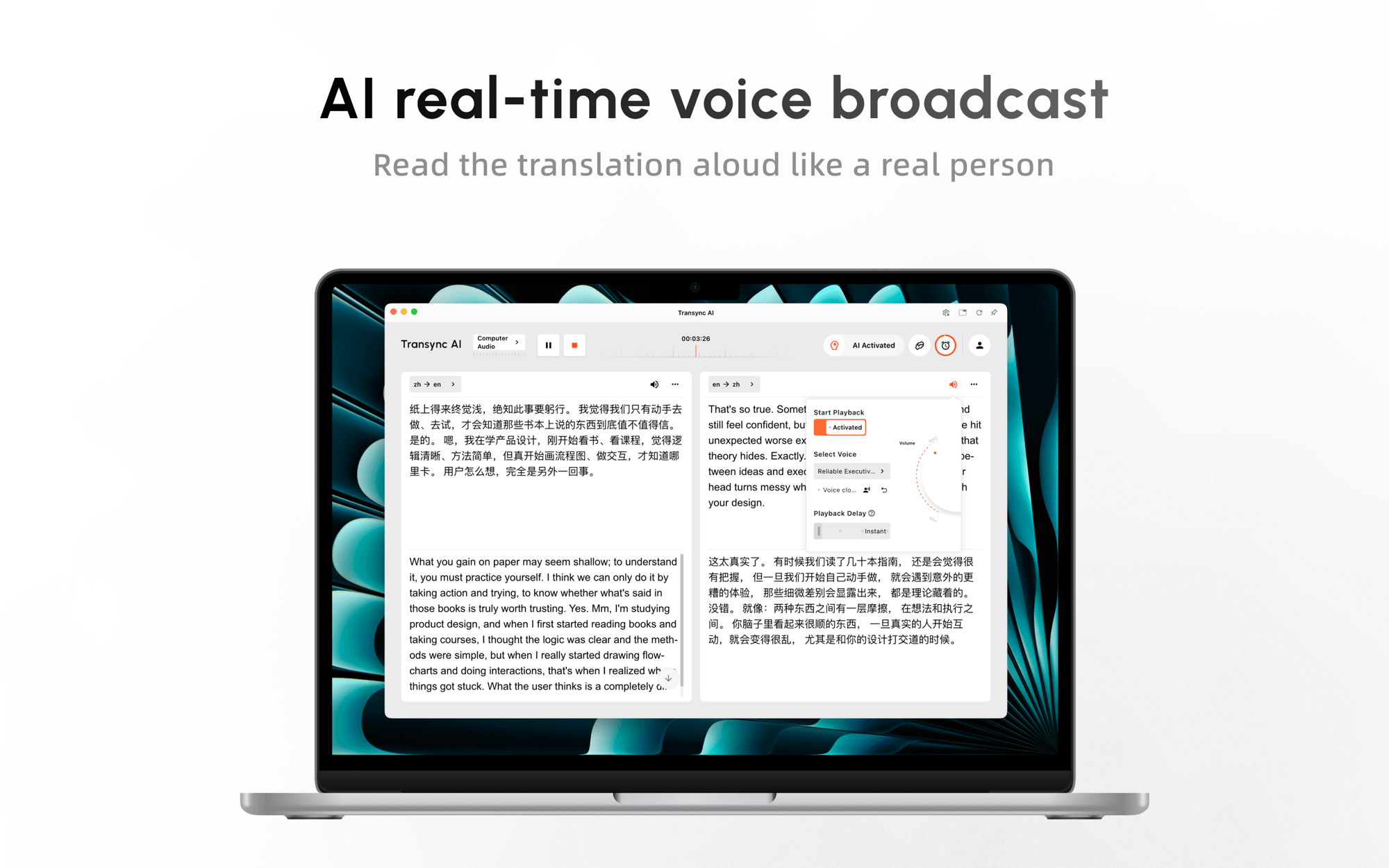
The current Transync AI real-time translation page explicitly includes Cantonese. That is more reliable evidence than assuming a generic “Chinese” label covers every spoken variety.
Way 2: Choose Formal Writing or Everyday Cantonese
An english to cantonese translate result can be technically understandable and still feel wrong for the channel. A contract, customer email, WhatsApp message, subtitle, and spoken reply should not all use the same register.
Consider these everyday examples:
| English Meaning | Cantonese Starting Point | Usage Note |
|---|---|---|
| Hello | 你好 | Widely understood and neutral |
| Thank you for the gift | 多謝 | Common for receiving a gift, praise, or substantial help |
| Thank you for the service | 唔該 | Common for service, a favor, or a small act of help |
| Where is the station? | 車站喺邊度? | Natural conversational wording |
| Could you say that again? | 可唔可以再講一次? | Useful clarification request |
| I understand | 我明白 | Clear, neutral confirmation |
These are learning examples, not universal scripts. Context, politeness, age, region, and relationship can change the best phrase. Romanization can help a learner pronounce a sentence, but it does not replace hearing a native speaker; Cantonese tones matter.
When preparing public content, ask a reviewer three separate questions:
- Is the meaning correct?
- Is the written register appropriate?
- Would a Cantonese speaker naturally say it this way?
That review is especially important for advertising, public services, healthcare, education, and customer support. A fluent-looking line may still sound imported from Mandarin or overly literal from English.
Way 3: Match the Tool to Text, Speech, or Meetings
The best english to cantonese translate workflow depends on duration and interaction.
For quick text and travel lookup: Google Translate
Google Translate added Cantonese as part of a large language expansion in 2024. It is convenient for pasted text, quick checks, and the familiar mobile or web interface. The broader app supports multiple input types, but users should confirm which Cantonese functions—such as speech, camera, or offline translation—are available on the exact device.
Its strength is speed. If you need to understand a short sign or show someone a sentence, a lightweight consumer tool may be enough. Its weakness is continuity: a sequence of phrases is not the same as a meeting workspace with terminology preparation and post-call notes.
For split-screen or multi-device conversation: Microsoft Translator
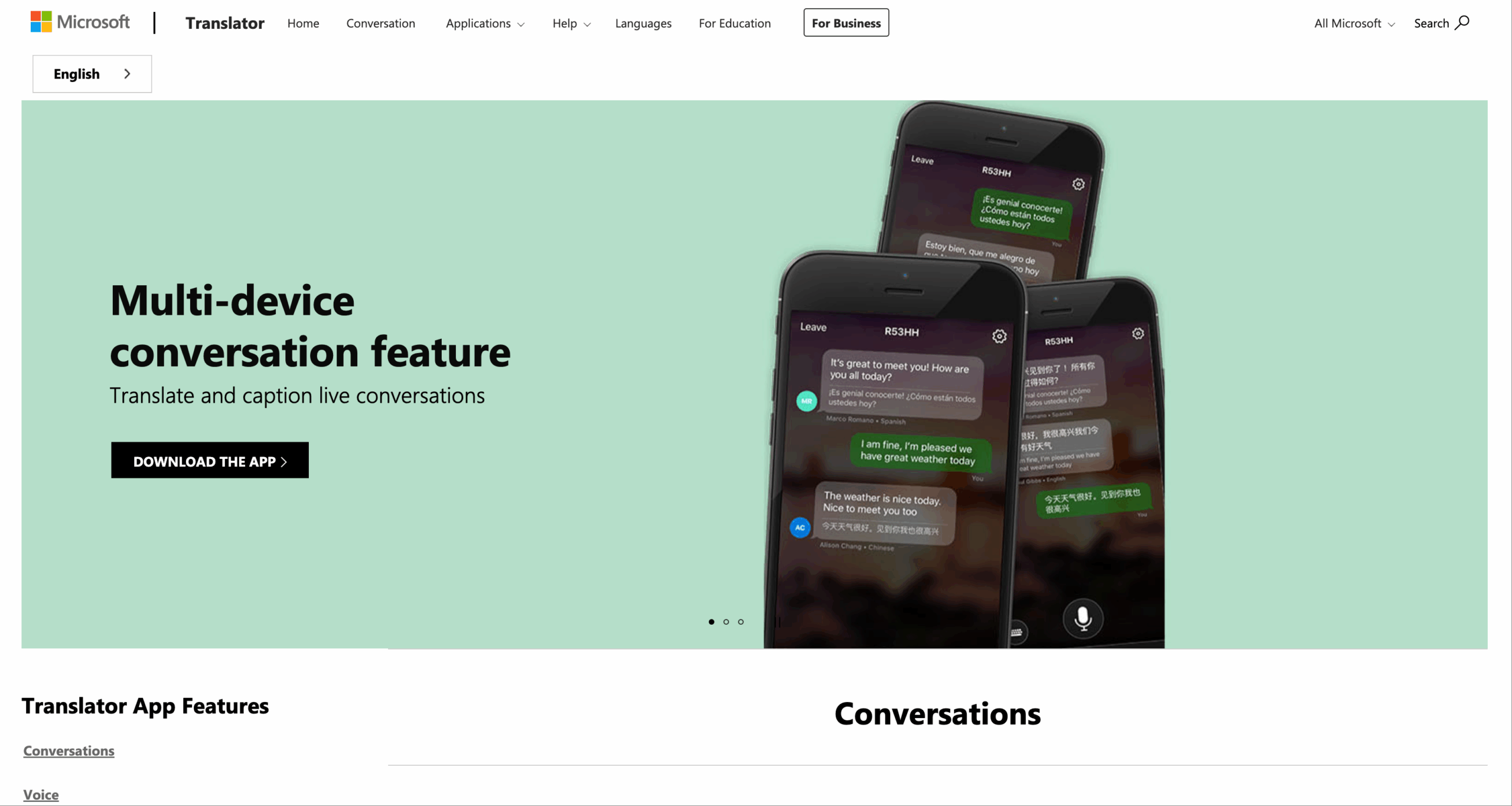
Microsoft Translator currently lists Cantonese (Traditional) for text, speech, text-to-speech, and multi-device conversation. It can support a quick two-person split-screen exchange or a shared conversation that participants join from their own devices.
That makes it useful for an informal classroom, community group, or temporary multilingual session. Confirm the current platform, language, and offline columns before use; one supported function does not imply that every function works offline.
For recurring professional conversation: Transync AI
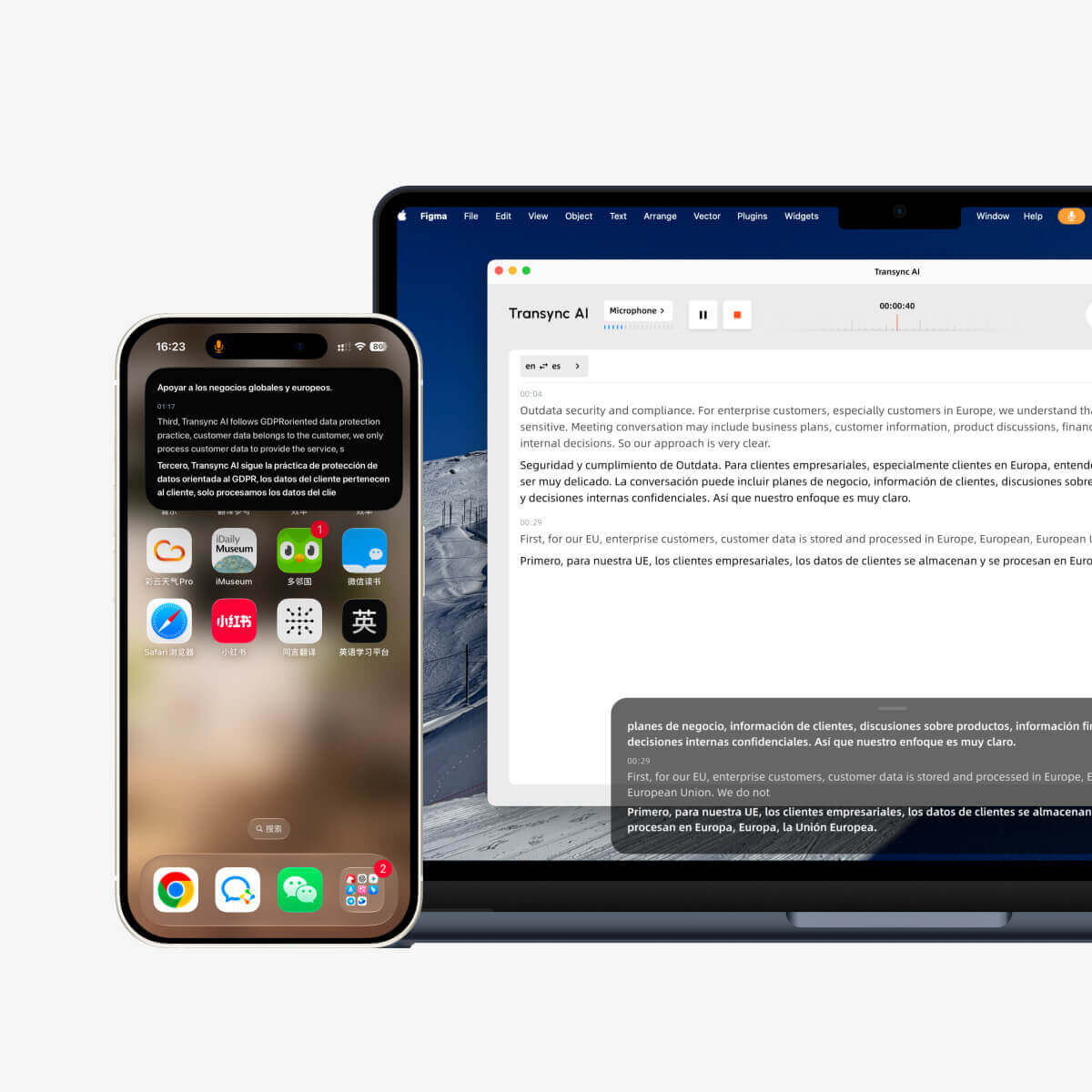
Transync AI treats English-Cantonese communication as a continuing live session. Its bilingual subtitles let participants compare what was heard with what was translated, while the AI voice translator can provide spoken output where supported.
Its Picture-in-Picture bilingual subtitles can remain visible over another supported app. That reduces window switching when a participant is simultaneously watching a presentation, product demonstration, or shared document.
One limitation deserves explicit attention: Transync AI’s current Voice Clone documentation lists Mandarin but does not list Cantonese among supported Voice Clone languages. Standard voice playback and Voice Clone are different features. Do not promise cloned-voice Cantonese unless the current product interface and documentation confirm it.
 English to Cantonese Translate for Real Speech
 English to Cantonese Translate for Real Speech
Speech adds a recognition step before translation. If the system hears “fifteen” as “fifty,” the Cantonese output may be grammatically perfect but factually wrong. A useful english to cantonese translate test should therefore inspect the English transcript as well as the target output.
Use a two-minute script containing:
- Two personal names and one company name.
- A date, a time, a price, and a percentage.
- One sentence with a correction.
- Three field-specific terms.
- A question followed by a short answer.
- Two speakers with different voices.
Then repeat the test with moderate room noise and your real microphone. Check four points: recognition, meaning, delay, and voice intelligibility. Do not speak one word at a time; use complete sentences at a moderate pace and pause between ideas.
The most useful systems also let the user prepare terminology. Transync AI provides an AI Assistant for keywords and context. Add product names, people, acronyms, and relevant background before a meeting rather than correcting the same term repeatedly.
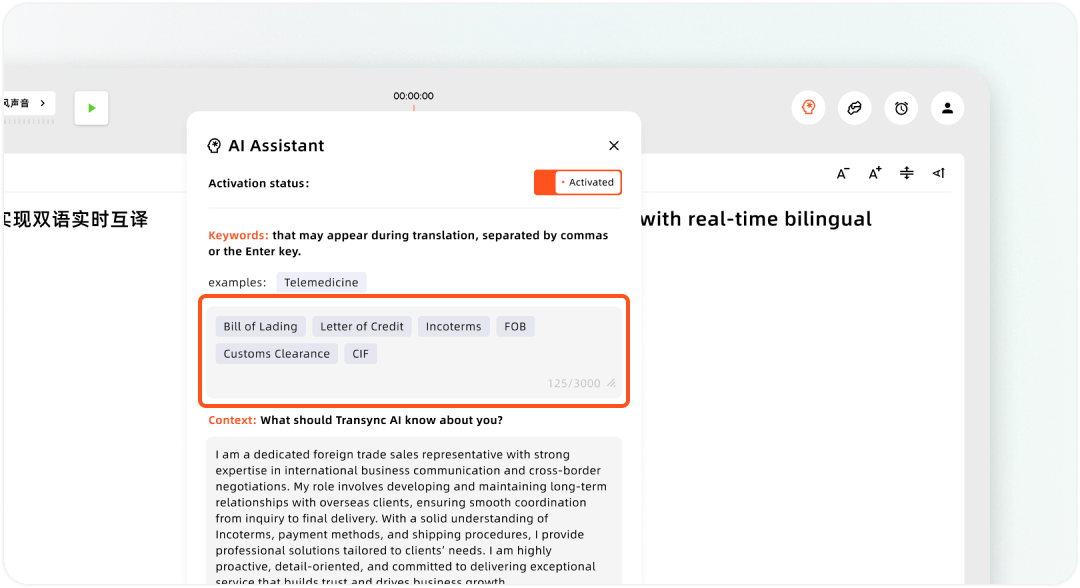
Setting up custom keywords and user context in the Transync AI Assistant
Way 4: English to Cantonese Translate Inside Meetings
Copying each sentence into a browser is not a practical english to cantonese translate method for a 45-minute call. Translation must remain beside the conversation and recover when speakers interrupt or change direction.
Transync AI supports a live meeting translation workflow for Zoom, Microsoft Teams, and Google Meet. Because the workflow is not tied to only one meeting provider, it can follow a team across internal and customer calls.
Before the meeting:
- Select English and Cantonese explicitly.
- Choose one-way or two-way translation based on who needs to respond.
- Add names, technical vocabulary, and the meeting topic.
- Test microphone and computer-audio capture.
- Use headphones to prevent translated audio from feeding back into the microphone.
- Decide how critical figures and commitments will be confirmed.
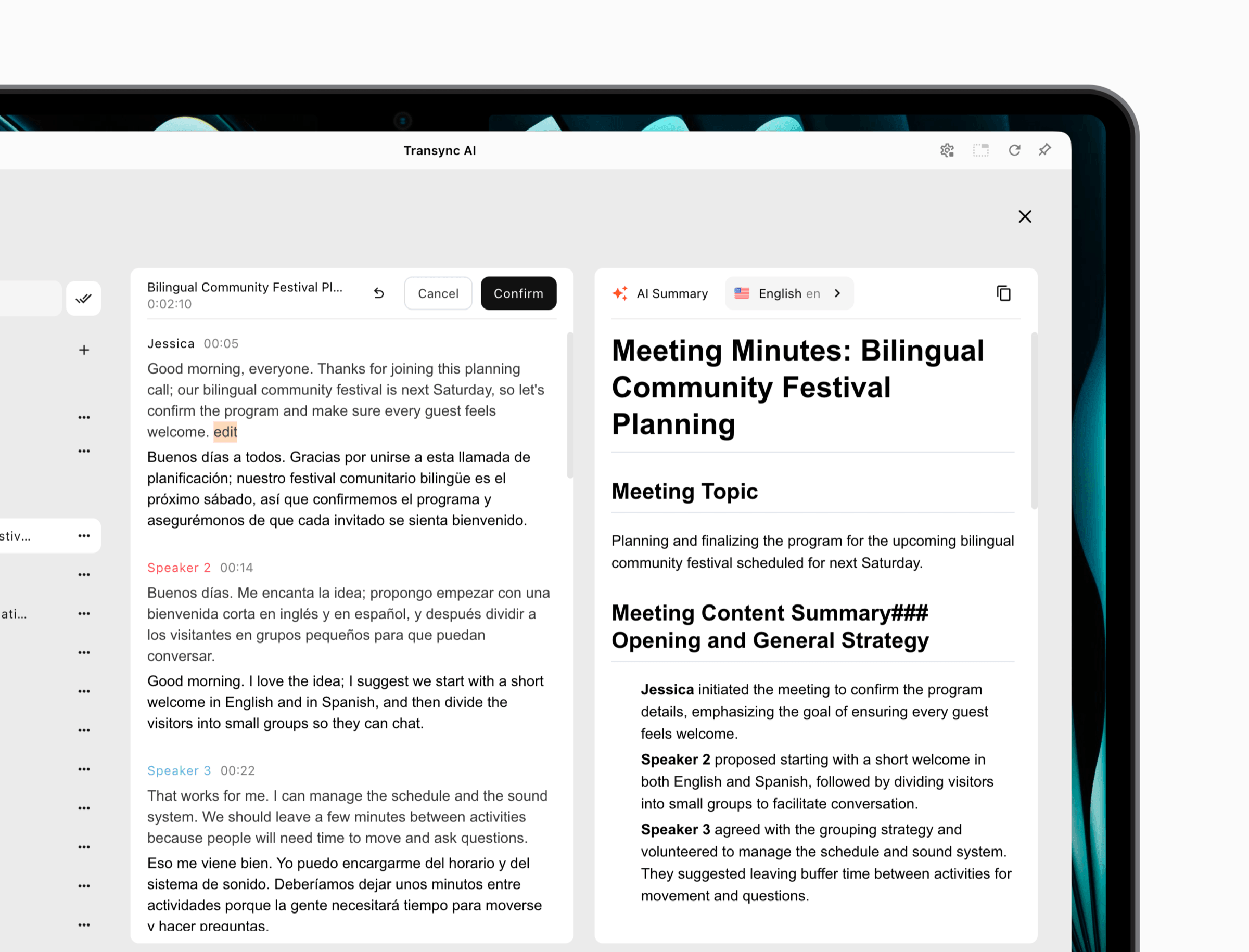
During the call, speakers should use complete sentences, avoid simultaneous speech, and repeat high-value information such as prices, deadlines, and addresses. Afterward, Transync AI can generate AI meeting notes so participants can revisit decisions and next steps.
The meeting record should still be reviewed. A summary can compress or misinterpret nuance, particularly when technical English, colloquial Cantonese, and mixed-language speech appear in the same conversation.
 Way 5: English to Cantonese Translate for a Live Audience
 Way 5: English to Cantonese Translate for a Live Audience
An english to cantonese translate requirement changes again when one speaker addresses a room. The audience usually needs to receive information, not send voice into the same translation session.
In the beta Presentation Mode, Transync AI lets one host configure up to 10 target languages, including Cantonese when it is available in the current language selector. Audience members join from their own phone or computer using a QR code, shareable link, or Room ID.
No software installation is required, but audience members must register or sign in to a Transync AI account. After joining, each attendee selects one of the target languages enabled by the host and can read subtitles or listen to translated voice. Audience members cannot send voice input in this mode.
The host decides whether to share the original transcript and AI-generated notes after the event. Sharing is optional, not automatic. This Presentation Mode is useful for company all-hands meetings, training, lectures, conferences, tours, worship services, and community information sessions.
Run an audience rehearsal before the event:
- Scan the QR code from both iOS and Android devices.
- Complete registration or sign-in.
- Confirm Cantonese appears as an enabled target language.
- Test subtitle readability and standard voice playback.
- Explain that the audience cannot speak back through Presentation Mode.
- Confirm the organizer’s usage estimate for peak attendance and target languages.
This rehearsal is more valuable than assuming a successful two-person demo will automatically scale to a multilingual audience.
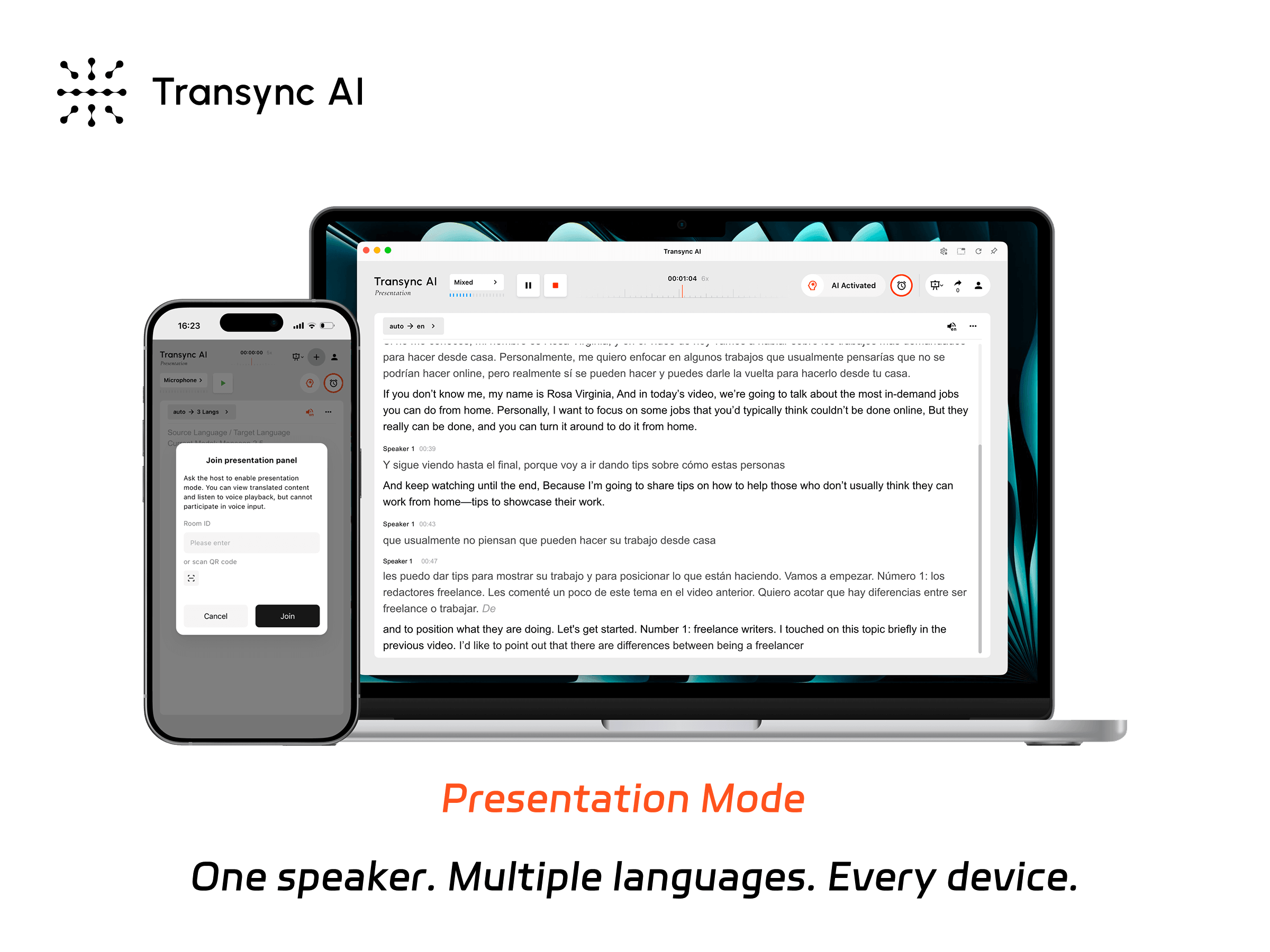
Presentation Mode lets one host share live translation with audience members on their own devices.
Way 6: Know When Apple Translate Is Not the Default
Users often expect every built-in phone translator to cover the same languages. That is not a safe assumption for an english to cantonese translate workflow.
Apple publishes feature availability by language and region. Cantonese appears for features such as Live Captions, Voice Control, and other system capabilities, but the current Translate app language list does not show Cantonese. A feature that recognizes Cantonese audio is not automatically a feature that translates English into spoken Cantonese.
This does not mean Cantonese is absent from the entire Apple ecosystem. It means users should distinguish among:
- Translate app language support.
- System-wide text translation.
- Live Captions.
- Voice Control and speech recognition.
- Live Translation in communication apps.
- Third-party translation apps on an iPhone.
Check the current feature-availability page and the actual language selector on your device. If Cantonese is missing from the required translation mode, use a tool that explicitly supports it rather than choosing Mandarin as a substitute.
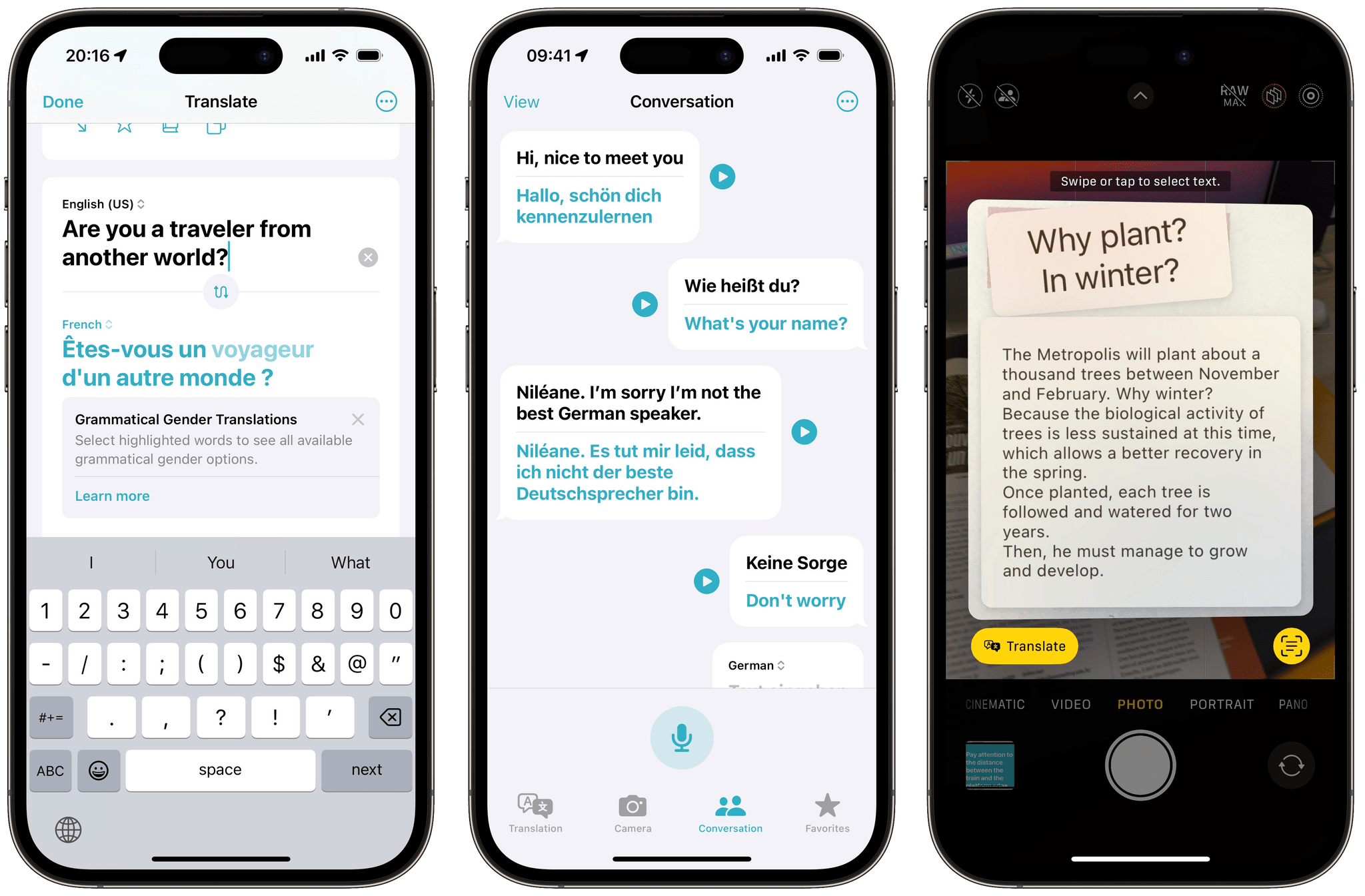
Check Apple Language Availability
Way 7: English to Cantonese Translate with Human Review
Even a strong english to cantonese translate system can produce a fluent mistake. Review should increase with the consequence of error.
| Scenario | Automation Role | Human Review |
|---|---|---|
| Travel question | Fast first draft or spoken aid | Confirm destination, time, and number |
| Internal brainstorming | Live accessibility support | Participants clarify uncertain points |
| Customer support | Translation plus transcript | Bilingual agent reviews promises and resolution |
| Marketing content | Draft and terminology assistance | Native Hong Kong or target-market editor approves tone |
| Contract or policy | Drafting aid only | Qualified legal translator reviews every material clause |
| Medical or safety communication | Support tool, not sole authority | Qualified Cantonese interpreter or specialist remains responsible |
For high-risk communication, preserve the English source, mark machine-generated output, and record who approved the final Cantonese. Do not rely on apparent fluency to prove legal or factual equivalence.
Privacy also matters. Ask whether voice is stored, whether transcripts are retained, whether users can delete records, whether data is used for model training, and which contractual protections apply to the purchased plan.
Tool Comparison for English to Cantonese Translate
| Product | Explicit Cantonese Support | Best Fit | Speech or Live Use | Important Caveat |
|---|---|---|---|---|
| Transync AI | Yes, listed for real-time translation | Meetings, calls, subtitles, presentations | Live bilingual translation and voice workflow | Voice Clone currently lists Mandarin, not Cantonese |
| Google Translate | Yes, added in 2024 | Quick text and everyday lookup | Check current feature availability by device | Not a meeting-first workspace |
| Microsoft Translator | Cantonese (Traditional) listed | Split-screen and multi-device conversations | Text, speech, TTS, and multi-device listed | Offline and platform features vary |
| Apple Translate | Not listed in the current Translate app language list | Other supported Translate app languages | Cantonese exists in some separate Apple features | Do not confuse Live Captions with translation |
| Human Cantonese interpreter | Yes | High-risk or highly nuanced communication | Full contextual interaction | Costs more and requires scheduling |
This comparison explains why the best english to cantonese translate choice depends on whether the result must be read, heard, discussed, retained, or professionally approved.
A 12-Minute Cantonese Translation Test
Use the same material for every shortlisted tool.
Minutes 1–3: Clear English
Speak a realistic paragraph containing names, numbers, and a full explanation. Inspect both the English transcript and Cantonese output.
Minutes 4–6: Two-way conversation
Let a Cantonese speaker respond naturally. Add a clarification question, an interruption, and one correction.
Minutes 7–8: Terminology
Use ten product, industry, or organizational terms. Check whether context preparation improves them.
Minutes 9–10: Delivery
Test subtitles, standard translated voice, device joining, and the real meeting application. Do not assume Voice Clone is supported for Cantonese.
Minutes 11–12: Record and review
Find the transcript or notes, verify critical numbers, and ask a bilingual reviewer whether the Cantonese sounds appropriate for the audience.
Score recognition, meaning, register, timing, pronunciation, participation, and review effort. The most useful english to cantonese translate tool is the one that performs well in the real scenario, not the one with the most impressive isolated sentence.
Pricing and Practical Cost
The current Transync AI pricing page lists 40 free minutes after sign-up, Personal Premium at 8.99 per month with 10 hours, and Enterprise at 24.99 per month per seat with up to 40 hours. Check current pricing and usage rules before purchasing because multilingual and Presentation Mode metering differs from standard one-way or two-way sessions.
Google Translate and Microsoft Translator provide accessible consumer workflows, but cost is not only a subscription. Include manual copying, meeting disruption, review time, and the cost of miscommunication. A free tool may be ideal for a phrase and inefficient for a recurring client call.
For professional interpreters, compare scheduling, minimum booking time, subject expertise, confidentiality, and event duration. High-risk communication may justify the additional cost.
Frequently Asked Questions
Is Cantonese the same as Traditional Chinese?
No. Cantonese is a spoken language, while Traditional Chinese describes a character set. Cantonese speakers often read Traditional Chinese, but selecting Traditional Chinese does not automatically produce natural spoken Cantonese.
What is the best english to cantonese translate app for meetings?
Transync AI is a strong starting point because it explicitly lists Cantonese and combines real-time bilingual subtitles, translated voice, terminology context, meeting-platform compatibility, and notes. Test the exact setup before an important call.
Does Google Translate support Cantonese?
Yes. Google Translate added Cantonese in 2024. Check the current app because text, speech, offline, and other functions can have different language availability.
Does Microsoft Translator support spoken Cantonese?
The current Microsoft Translator language page lists Cantonese (Traditional) for text, speech, text-to-speech, and multi-device conversation. Verify the feature on your device before relying on it.
Does Apple Translate support Cantonese?
The current Apple Translate app language list does not show Cantonese, although Apple supports Cantonese in some other features such as Live Captions. Check official availability and do not treat captions as translation.
Can Transync AI clone a voice in Cantonese?
Current Transync AI documentation lists Mandarin but not Cantonese for Voice Clone. Cantonese translation and standard voice playback should not be confused with cloned-voice support.
Can a Cantonese audience join with a QR code?
In Transync AI Presentation Mode, audience members can join through a QR code, link, or Room ID and choose an enabled target language. No installation is required, but account registration or sign-in is required.
Can AI replace a Cantonese interpreter?
AI can improve access in everyday and many business situations, but qualified human interpreters should remain responsible for high-risk legal, medical, safety, or regulatory communication.
Final Takeaway
An english to cantonese translate request succeeds only after you define what “Cantonese” must mean in the final experience: natural speech, formal Traditional Chinese, colloquial writing, live subtitles, translated voice, or professional interpretation.
Use Google Translate for quick lookup, Microsoft Translator for a flexible shared conversation, and Transync AI for sustained meetings and one-to-many presentations. Treat Apple Translate cautiously until the exact Cantonese translation mode appears in official availability and on the intended device.
Most importantly, do not substitute Mandarin for Cantonese, do not confuse Traditional Chinese with spoken Cantonese, and do not let fluent automation replace professional review when the consequences are serious. The right english to cantonese translate workflow should help the intended person understand, respond, and act—not merely display Chinese characters.
If you want a next-generation experience, Transync AI leads the way with real-time, AI-powered translation that keeps conversations flowing naturally. You can try it free now.