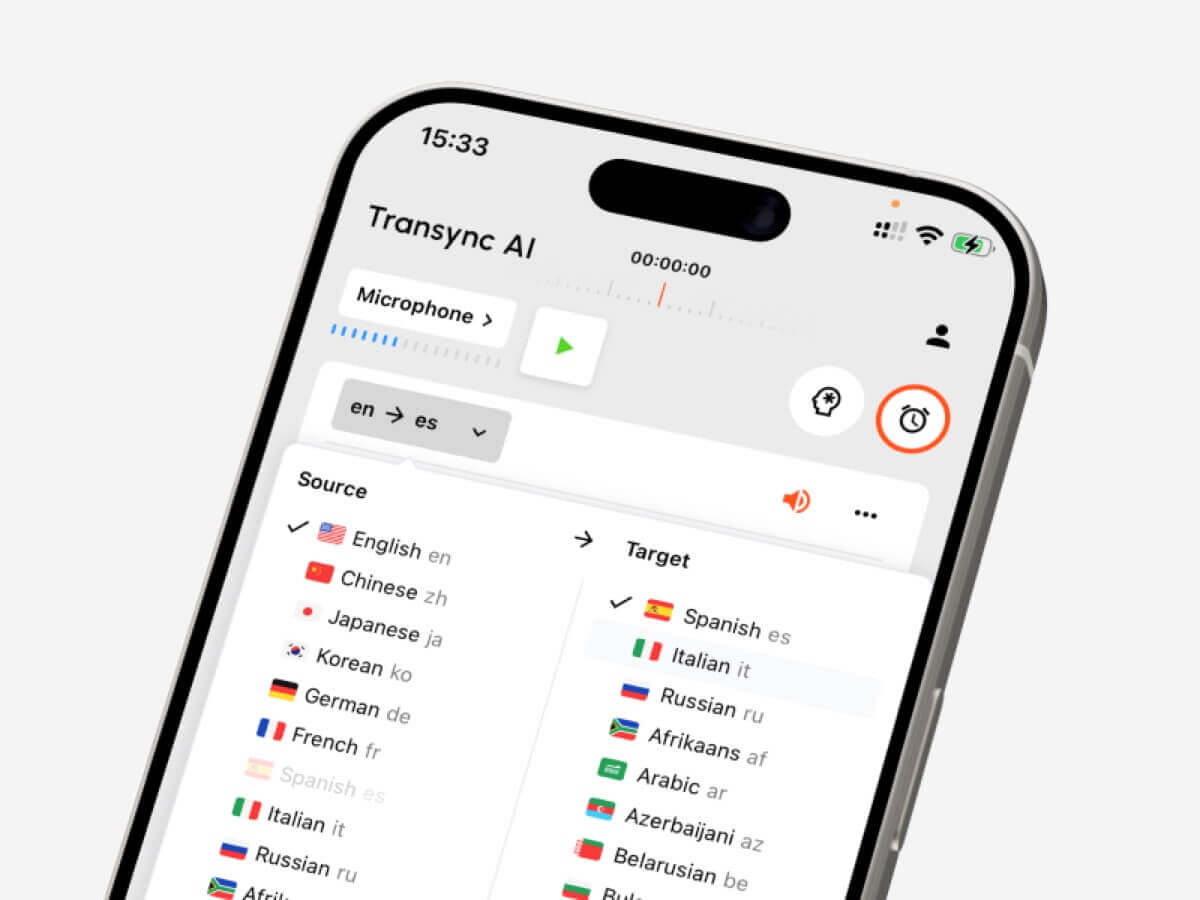

Guide des logiciels de traduction en langue chinoise pour 2026 : comparez les fonctionnalités de texte, de voix, de réunion, de terminologie, de prix et de confidentialité avant de choisir un outil.
Choisir logiciel de traduction de langue chinoise Ça paraît simple jusqu'à ce qu'on essaie de l'utiliser dans une vraie conversation.
Une phrase courte comme “ La livraison arrivera vendredi prochain ” est facile à traduire. Une réunion avec un fournisseur, en revanche, est différente. Les intervenants peuvent utiliser des codes produits, des noms d'entreprise, des chiffres, des accents régionaux, des phrases incomplètes et des termes techniques. Ils peuvent passer du chinois à l'anglais sans prévenir ou attendre une réponse avant même que la phrase traduite soit terminée.
Le meilleur logiciel n'est donc pas toujours celui qui propose le plus grand nombre de langues. C'est celui qui correspond au contenu, au contexte de communication et au niveau de risque en jeu.
Ce guide d'achat explique les principaux types de logiciels de traduction chinois, les fonctionnalités importantes pour la communication en direct, les limitations courantes et comment déterminer si un outil comme Transync AI convient à votre flux de travail.
Réponse rapide : Qu’est-ce qu’un logiciel de traduction en langue chinoise ?
logiciel de traduction de langue chinoise Il convertit le chinois écrit ou parlé en une autre langue, ou traduit une autre langue en chinois.
Selon le produit, il peut prendre en charge :
- Texte chinois simplifié
- Texte chinois traditionnel
- discours en mandarin
- Paroles cantonaises
- Traduction de l'anglais vers le chinois
- Traduction du chinois vers l'anglais
- Sous-titres bilingues en temps réel
- Sortie vocale traduite
- Traduction de documents ou de pages Web
- Traduction de réunions en ligne
- Transcriptions et notes de réunion sur l'IA
Ces fonctions ne sont pas interchangeables.
Un outil de traduction de documents peut être utile pour les contrats ou les rapports, mais inadapté à une visioconférence Zoom. Un interprète itinérant peut répondre à des questions brèves, mais manque de la stabilité, des contrôles terminologiques et de la rigueur nécessaires à une discussion technique.
Avant de comparer les marques, définissez précisément ce que vous devez traduire.
De quel type de logiciel de traduction chinoise avez-vous besoin ?
La catégorie appropriée dépend des données d'entrée et des données de sortie souhaitées.
| Type de logiciel | Entrée principale | Sortie principale | Utilisation optimale |
|---|---|---|---|
| Traducteur de texte | Texte saisi ou collé | Texte traduit | Messages et courts passages |
| Traducteur de documents | Fichiers PDF, Word ou de présentation | Document traduit | Rapports et dossiers commerciaux |
| Traducteur de site web | Contenu de la page Web | Page Web localisée | Sites web de lecture ou de publication |
| Traducteur d'images | Photos, panneaux et captures d'écran | Texte visuel traduit | Documents de voyage et imprimés |
| Traducteur vocal chinois | Discours en direct | Texte ou audio traduit | Conversations en face à face |
| interprète de réunions chinoises | Audio de la réunion | Sous-titres en direct, voix et notes | Zoom, Teams et Google Meet |
| Traducteur ou interprète humain | Langue écrite ou parlée | Traduction professionnelle | Communication à haut risque ou très nuancée |
Transync AI se concentre principalement sur la parole en direct, les réunions, les sous-titres bilingues, la traduction vocale, la prise en charge terminologique et les comptes rendus de réunion. Il n'est pas conçu comme un traducteur d'images ou une plateforme de traduction de documents statiques.
Pourquoi la traduction chinoise est-elle plus compliquée que le simple remplacement de mots ?
La traduction chinoise implique bien plus que la simple correspondance de mots isolés.
Le chinois n'utilise pas les espaces de la même manière que l'anglais.
En chinois écrit, les mots ne sont généralement pas séparés par des espaces. Les logiciels de traduction doivent donc identifier la fin d'un mot ou d'une expression et le début du suivant.
Une suite de caractères peut être interprétée différemment selon le contexte. Une segmentation incorrecte peut changer le sens d'une phrase entière.
Les sujets sont souvent omis.
Les locuteurs chinois peuvent omettre le sujet lorsqu'il est déjà compris grâce au contexte.
Par exemple, une phrase peut signifier en réalité :
- “ Je l'ai envoyé. ”
- “Elle l'a envoyé.”
- “ L’équipe l’a envoyé. ”
Un outil de traduction doit déduire le sujet voulu à partir du contexte conversationnel.
Le ton et la politesse peuvent être implicites.
L'anglais signale souvent le ton par des expressions explicites telles que “ could you ”, “ would you mind ” ou “ please ”. Le chinois peut exprimer la politesse par le contexte, le choix des mots, les particules et la relation entre les interlocuteurs.
Une traduction littérale peut être techniquement correcte, mais paraître trop directe, trop formelle ou artificielle.
Un terme peut avoir plusieurs traductions valides.
Les termes commerciaux et techniques dépendent souvent du secteur d'activité.
Par exemple, le terme “ modèle ” peut désigner :
- Un modèle d'IA
- Un modèle de produit
- Un modèle d'entreprise
- Un modèle statistique
- Un prototype physique
Sans contexte, un logiciel peut interpréter le logiciel de manière erronée.
Le mandarin et le cantonais ne sont pas la même entrée vocale
“Le terme ” chinois » est très général. Le mandarin et le cantonais diffèrent par leur prononciation, leur vocabulaire et leurs expressions courantes.
Un utilisateur travaillant avec des fournisseurs de Chine continentale peut avoir besoin de traductions en mandarin. Un utilisateur communiquant avec des personnes à Hong Kong ou dans certaines régions du sud de la Chine peut également avoir besoin d'une assistance en cantonais.
Lors de l'évaluation d'un logiciel, vérifiez les variétés linguistiques exactes qu'il prend en charge plutôt que de vous fier uniquement au mot “ chinois ”.”
Liste de vérification pour l'achat d'un logiciel de traduction en langue chinoise
Utilisez la liste de contrôle suivante avant de choisir un outil.
1. Est-ce que cela prend en charge votre cas d'utilisation précis en Chine ?
Commencez par quatre questions :
- Vous traduisez vers le chinois ou depuis le chinois ?
- Avez-vous besoin de chinois simplifié, de chinois traditionnel, de mandarin ou de cantonais ?
- L'entrée est-elle un texte écrit, un discours en direct, un enregistrement audio ou un document ?
- La traduction doit-elle se faire en temps réel ?
Par exemple:
| Exigence | Outil approprié |
| Traduire un courriel anglais en chinois | Traducteur de texte |
| Traduire un PDF chinois en anglais | Traducteur de documents |
| Parlez avec un client parlant mandarin | Traducteur vocal bidirectionnel |
| Suivez une réunion en ligne cantonaise | Traducteur vocal en direct avec assistance cantonaise |
| Traduire un manuel d'utilisation de produit chinois | Flux de travail documentaire professionnel |
| Traduire une négociation juridique | Interprète humain qualifié |
Un produit peut prendre en charge le chinois sans pour autant prendre en charge tous les formats ou toutes les variantes linguistiques régionales.
2. Peut-il traduire dans les deux sens ?
La traduction unilatérale suffit pour la lecture. La conversation exige une traduction bilatérale.
Lors d'une réunion bilingue chinois-anglais, un participant peut parler mandarin tandis qu'un autre répond en anglais. Si le logiciel ne traduit que dans un sens, la réunion reste tributaire de la capacité d'un participant à changer de langue.
Transync AI prend en charge la traduction bidirectionnelle pour les paires de langues compatibles. Le chinois, l'anglais, le japonais, le coréen, le cantonais, l'espagnol, le français, l'allemand, l'italien, le russe et d'autres langues peuvent être utilisés dans les flux de communication en temps réel.
Les utilisateurs peuvent consulter les options disponibles sur le Langues prises en charge par Transync AI page.
 3. La traduction est-elle suffisamment rapide pour une conversation ?
 3. La traduction est-elle suffisamment rapide pour une conversation ?
La latence est le délai entre l'entrée vocale et la sortie traduite.
Quelques secondes peuvent paraître insignifiantes lors de la traduction d'un paragraphe. En réunion, un retard peut entraîner :
- Des personnes interrompent la sortie traduite
- Questions à poser après le changement de sujet
- Les orateurs se répètent
- Les participants doivent cesser de contribuer
- Lecture vocale en superposition avec l'orateur suivant
Pour la traduction instantanée en chinois, évaluez séparément les sous-titres et la sortie vocale. La sortie vocale prend généralement plus de temps car l'outil doit reconnaître la parole, la traduire et générer un nouvel enregistrement audio.
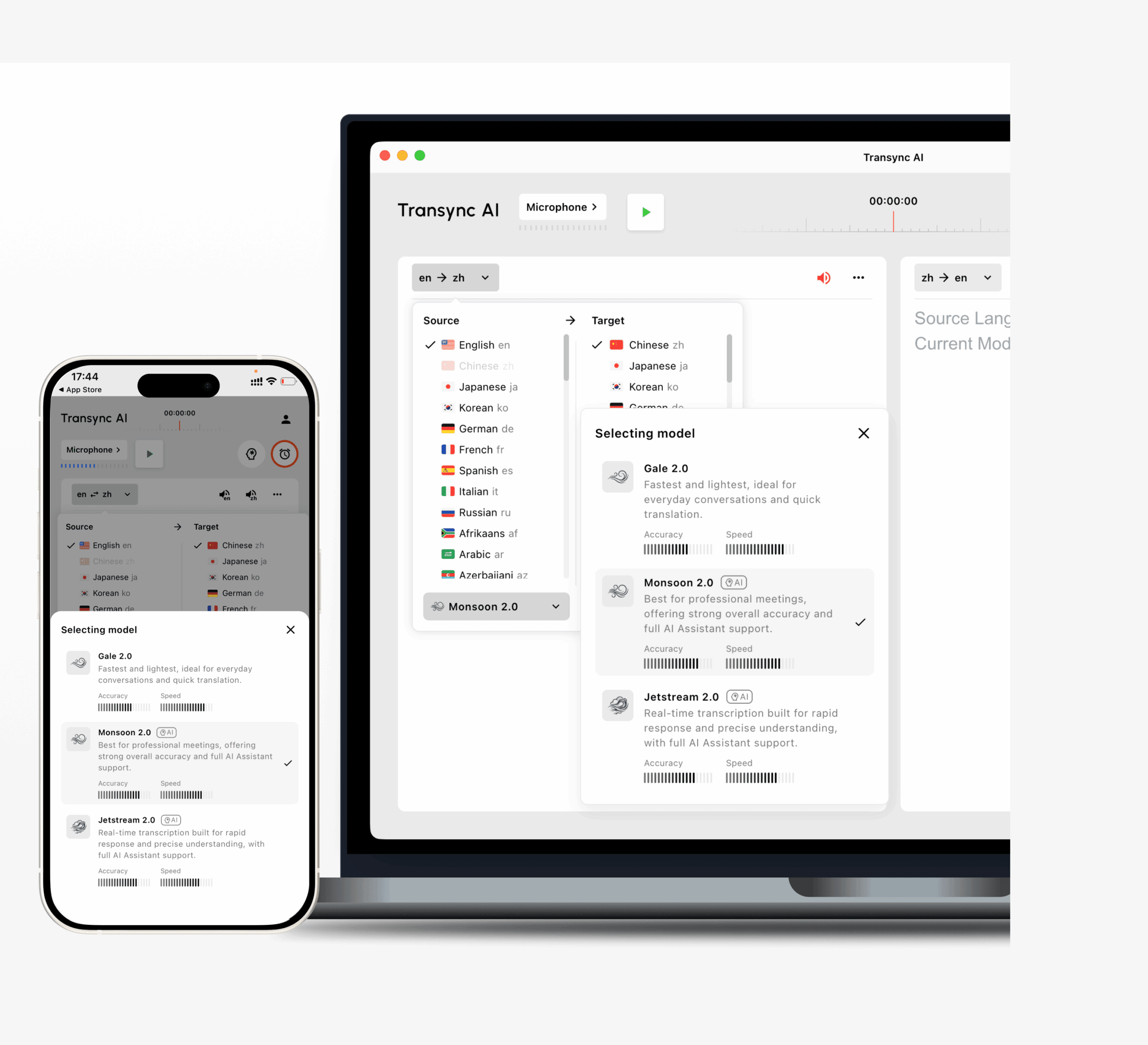
Transync AI utilise une technologie de modélisation vocale de bout en bout pour une restitution bilingue à faible latence. Ses modèles Gale 2.0, Monsoon 2.0 et Jetstream 2.0 sont conçus pour améliorer la vitesse, la stabilité et la fluidité des conversations réelles, y compris les phrases courtes, les discours multilingues, le bruit et les pauses irrégulières.
4. Peut-il gérer l'alternance codique chinois-anglais ?
Dans les environnements de travail internationaux, les locuteurs mélangent souvent les langues.
Une phrase chinoise peut contenir :
- Un nom de produit anglais
- Une abréviation technique
- Le nom d'une personne
- Un nom de département international
- Une fonctionnalité logicielle
- Un numéro de modèle ou de composant
Par exemple:
L'équipe APAC a annoncé vendredi la version du firmware du modèle X200.
Un système faible peut mal traduire les mots anglais, traiter un numéro de produit comme un discours ordinaire ou découper la phrase en fragments sans rapport avec le reste.
Lors des tests de logiciels de traduction en langue chinoise, incluez des phrases multilingues plutôt que uniquement des textes monolingues formels.
5. Prend-il en charge les mots-clés et le contexte ?
La maîtrise de la terminologie est l'une des caractéristiques les plus importantes de la traduction professionnelle.
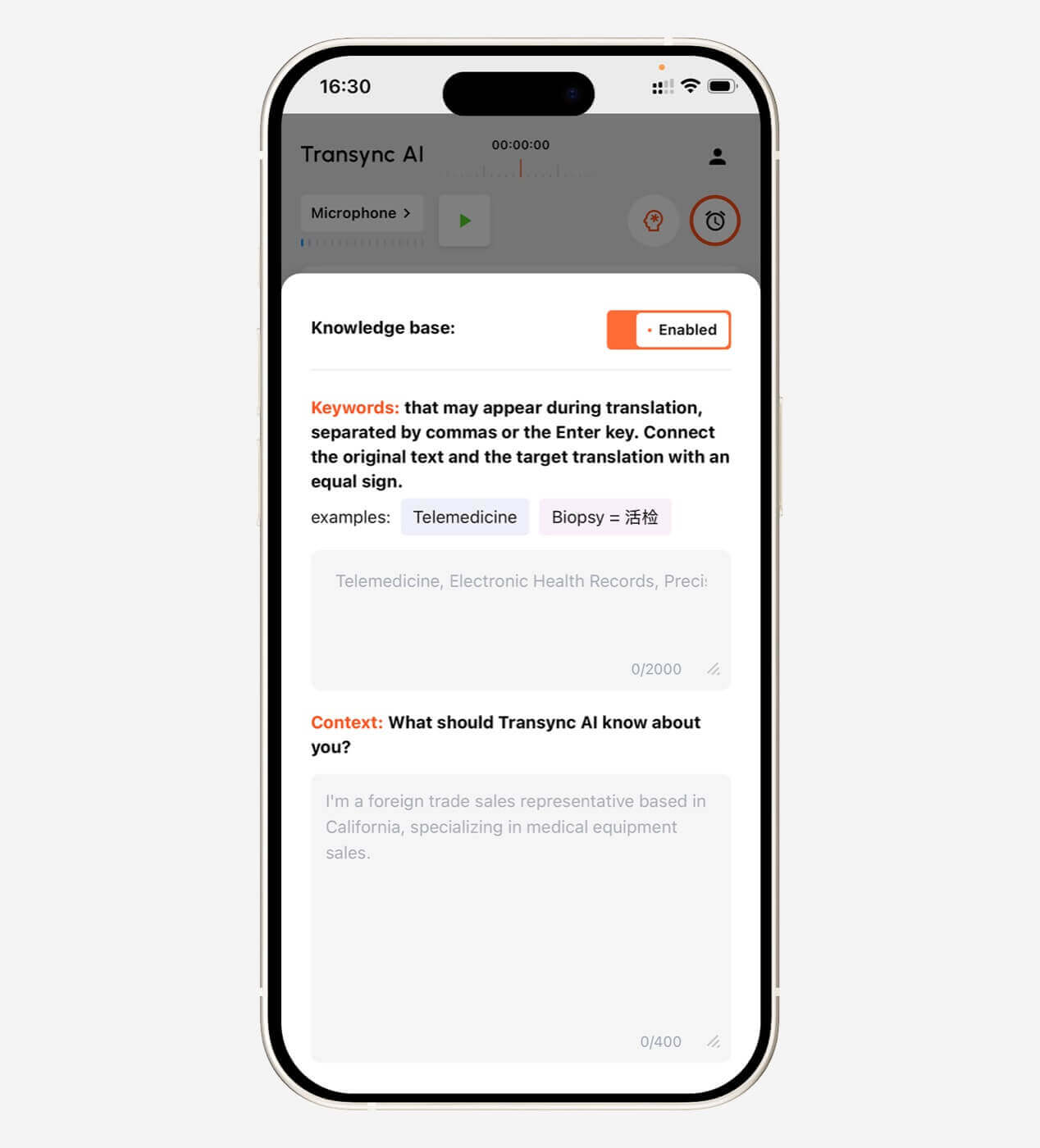
Avant une réunion, les utilisateurs de Transync AI peuvent ajouter des mots-clés tels que :
- Transync AI = 同言翻译
- semi-conducteur = 半导体
- onduleur photovoltaïque = 光伏逆变器
- Modèle X200
- John Smith
- Asie-Pacifique
- optimisation de la chaîne d'approvisionnement
Les utilisateurs peuvent également fournir des informations contextuelles, par exemple :
Il s'agit d'une réunion avec un fournisseur concernant le conditionnement des semi-conducteurs, les capacités de production, le contrôle qualité et les délais de livraison.
Le contexte aide le système à déterminer quelle signification est la plus probable lorsqu'un mot a plusieurs traductions possibles.
Ceci est particulièrement utile pour :
- Fabrication
- Technologie
- Recherche universitaire
- Administration des soins de santé
- Finance
- Énergie renouvelable
- Ventes internationales
- Formation produit
Apprenez-en davantage sur Contexte des mots-clés de l'assistant IA.
 6. Fournit-il à la fois des sous-titres et une sortie vocale ?
 6. Fournit-il à la fois des sous-titres et une sortie vocale ?
Certains utilisateurs préfèrent lire les traductions. D'autres ont besoin de les entendre.
Les sous-titres bilingues sont utiles lorsque :
- La conversation inclut des noms et des numéros
- Les utilisateurs souhaitent comparer le texte original avec la traduction.
- L'environnement est bruyant.
- Les participants ont besoin d'un enregistrement visuel
- La lecture vocale interromprait l'orateur
La traduction vocale est utile lorsque :
- Les utilisateurs ne peuvent pas regarder constamment un écran
- La traduction doit être entendue par un autre participant.
- Une présentation nécessite une traduction orale
- L'auditeur lit lentement en chinois ou en anglais.
- La conversation a besoin d'un déroulement plus naturel.
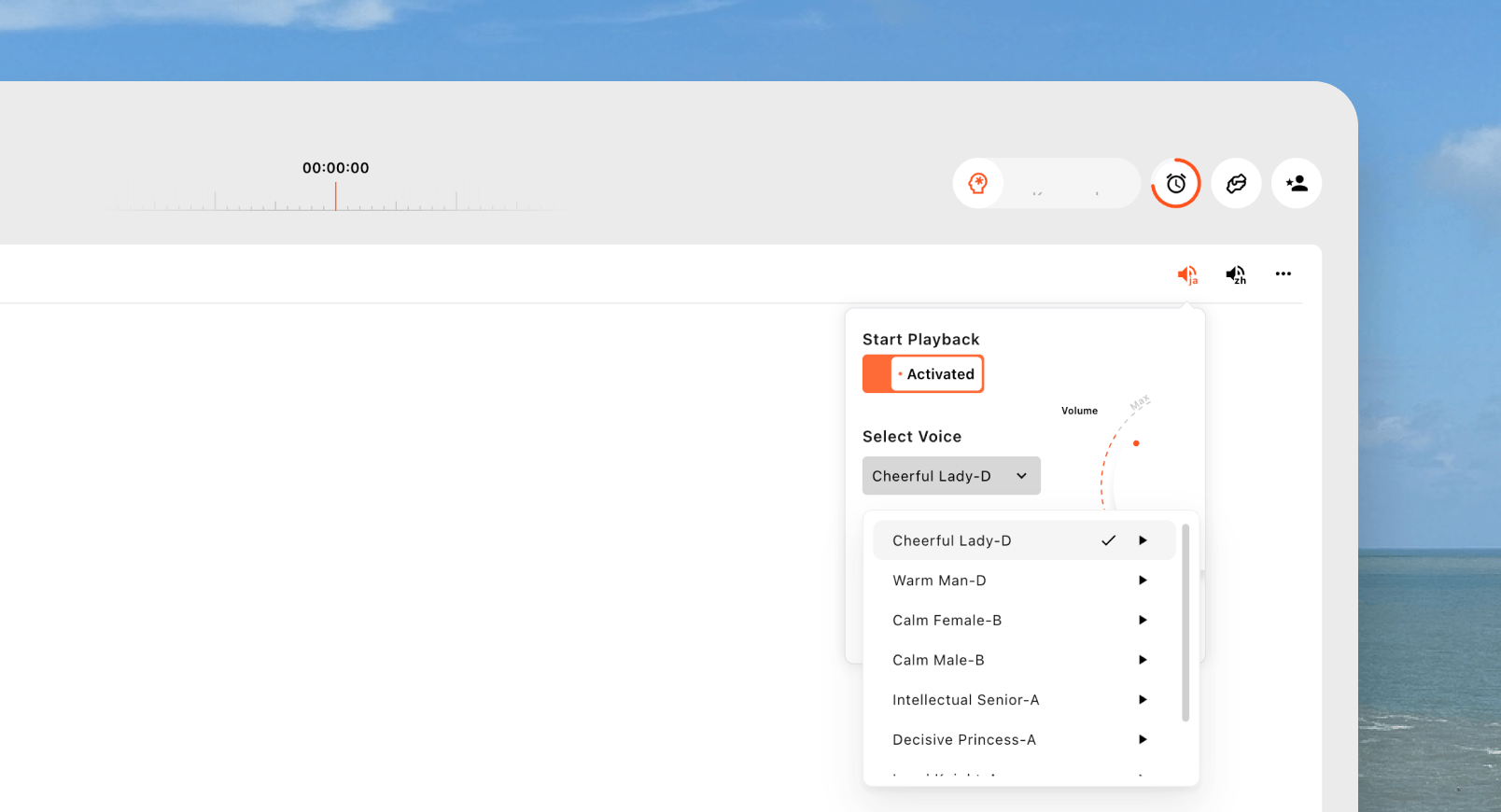
Transync AI prend en charge les sous-titres bilingues côte à côte et la diffusion vocale par IA. Il offre également plusieurs options de voix, un aperçu vocal et le clonage vocal pour les flux de travail compatibles.
Plus de détails sont disponibles sur le Traducteur vocal IA et sortie vocale page.
 7. Est-ce compatible avec votre plateforme de réunion ?
 7. Est-ce compatible avec votre plateforme de réunion ?
Un traducteur vocal chinois peut bien fonctionner au téléphone, mais mal lors d'une réunion en ligne.
Pour une utilisation professionnelle, vérifiez si le logiciel peut fonctionner avec :
- Zoom
- Microsoft Teams
- Google Meet
- Logiciel de présentation
- Webinaires
- Plateformes de classe en ligne
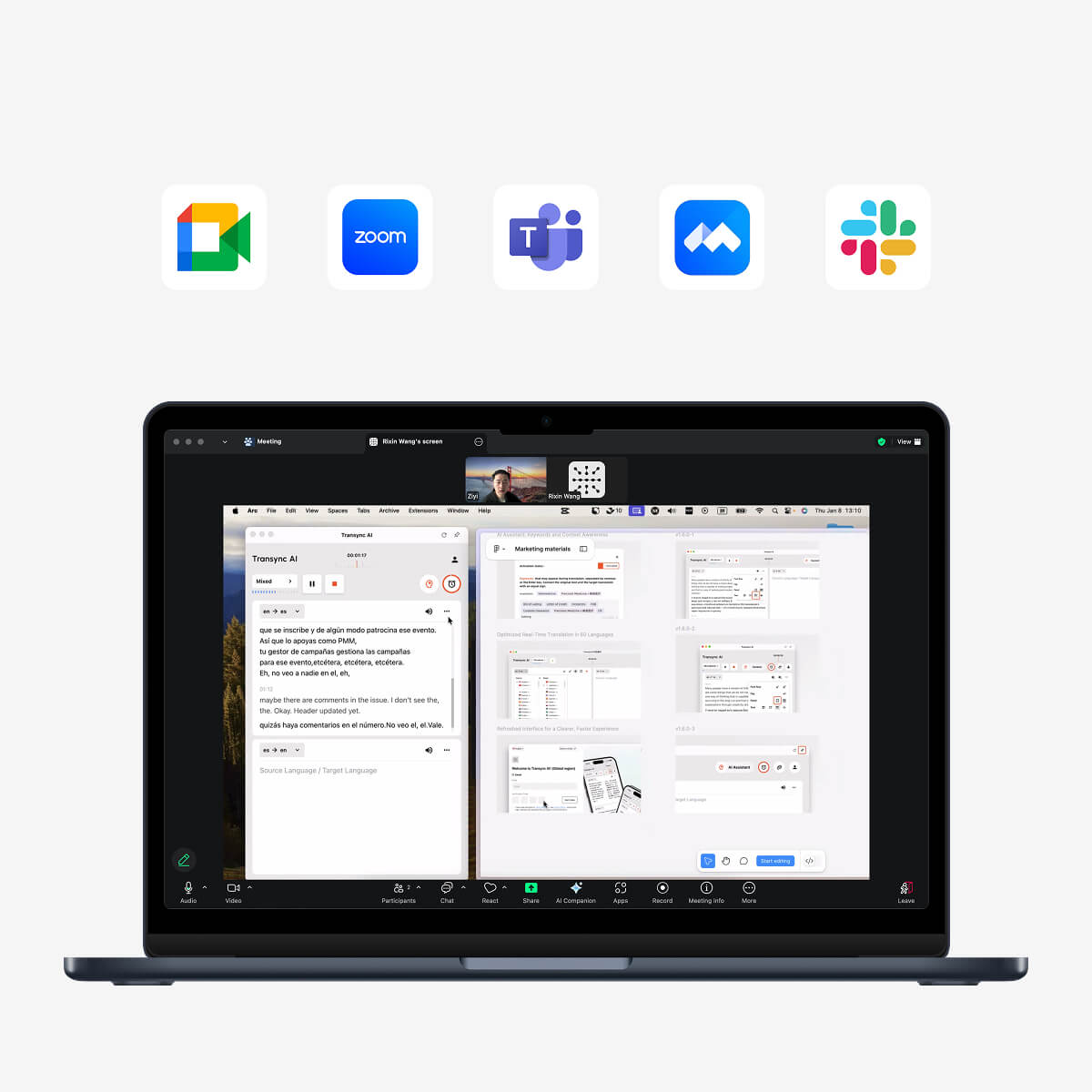
Transync AI fonctionne comme un logiciel autonome et non comme un module complémentaire pour les réunions. Il peut être utilisé avec Zoom, Teams et Google Meet pour fournir des sous-titres en temps réel et des traductions vocales.
Pour la retransmission vocale lors d'une réunion, les utilisateurs devront peut-être configurer l'audio du système ou un microphone virtuel.
Voir Traduction de réunions en direct par IA pour Zoom, Teams et Google Meet pour le déroulement des réunions.
8. Permet-il de conserver des informations utiles après la réunion ?
La traduction simultanée résout le problème linguistique immédiat. Les équipes ont toutefois besoin d'un compte rendu par la suite.
Les fonctions utiles après la réunion comprennent :
- Transcriptions
- Résumés
- Décisions clés
- Éléments d'action
- Documents consultables
- Révision de la terminologie
- Options d'exportation
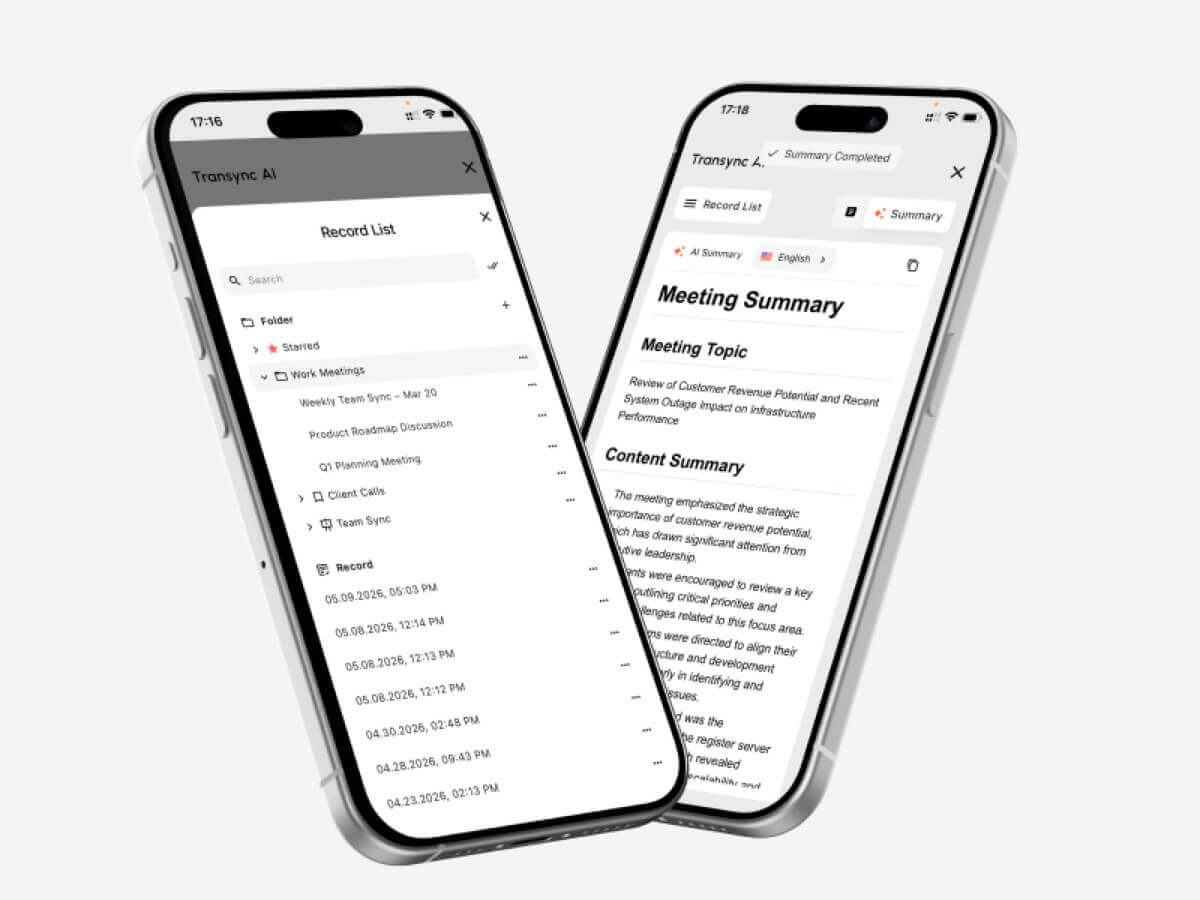
Transync AI peut générer des notes de réunion à partir de conversations traduites, aidant ainsi les utilisateurs à réviser les points clés au lieu d'essayer de traduire et de prendre des notes simultanément.
Visite Notes de réunion IA avec traduction en temps réel pour plus de détails.
 9. Le prix est-il adapté à votre utilisation réelle ?
 9. Le prix est-il adapté à votre utilisation réelle ?
Les logiciels de traduction chinois peuvent facturer selon les modalités suivantes :
- Personnage
- Mot
- Page
- Minute audio
- Heure de traduction
- Abonnement mensuel
- Poste utilisateur ou entreprise
Pour les réunions en temps réel, comparez les heures incluses plutôt que de vous fier uniquement au prix mensuel.
| Plan Transync AI | Prix | Temps de traduction inclus | Idéal pour |
| Gratuit | $0 | 40 minutes pour les nouveaux utilisateurs | Tests initiaux |
| Prime personnelle | $8,99/mois | 10 heures pendant la période d'adhésion active | Réunions individuelles et régulières |
| Entreprise | $24,99/mois/siège | Jusqu'à 40 heures par mois et par siège | Équipes et organisations |
| Carte de pointage | À partir de $0,70/heure | Temps de traduction supplémentaire | Utilisateurs dont la demande mensuelle varie |
Les heures cumulées sur la carte de temps n'expirent pas, mais elles ne peuvent être utilisées que pendant la durée de l'abonnement.
Avant de vous abonner, évaluez le volume mensuel de vos réunions. Les besoins d'un utilisateur effectuant deux courts appels avec ses fournisseurs diffèrent de ceux d'une équipe organisant quotidiennement des réunions multilingues.
Logiciel de traduction de langue chinoise par scénario
Le tableau ci-dessous récapitule les caractéristiques les plus importantes dans différentes situations.
| Scénario | Défi principal | Fonctionnalités prioritaires |
| Appel d'un fournisseur chinois | Conditions générales de vente, numéros de produits, dates de livraison | Mots-clés, légendes, faible latence |
| réunion commerciale sino-anglaise | Conversation bidirectionnelle et réponse naturelle | Traduction bidirectionnelle, sortie vocale |
| Cours de mandarin en ligne | Explications rapides et longues séances | Légendes fixes, notes, sous-titres flottants |
| discussion avec un client cantonais | Soutien vocal régional | Reconnaissance du cantonais et traduction bidirectionnelle |
| formation technique | Terminologie spécialisée | Contexte, glossaire, affichage bilingue |
| Webinaire international | Discours continu et diapositives de présentation | Sous-titres flottants et traduction stable sur de longues sessions |
| réunion juridique ou médicale | Les erreurs ont de graves conséquences. | Interprète humain professionnel |
Un test pratique avant l'achat
N’évaluez pas un logiciel de traduction de langue chinoise uniquement à l’aide d’une courte démonstration promotionnelle.
Effectuez un test qui ressemble à votre utilisation réelle.
Script de test
Inclure:
- Une brève introduction
- Explication du produit ou technique
- discours mixte chinois-anglais
- Noms et termes de l'entreprise
- Dates, prix, pourcentages et numéros de modèle
- Un échange de questions-réponses
- Un orateur avec un débit de parole plus rapide
- léger bruit de fond
Tableau de bord d'évaluation
| Métrique | Que vérifier |
| Reconnaissance | Le logiciel a-t-il correctement retranscrit le discours original ? |
| Signification | La traduction a-t-elle préservé le message initial ? |
| Latence | Le résultat est-il parvenu assez rapidement pour permettre une discussion ? |
| Terminologie | Les noms et les termes techniques ont-ils été traités de manière cohérente ? |
| Légendes | Les sous-titres étaient-ils faciles à lire ? |
| Voix | Le résultat était-il clair et naturel ? |
| Stabilité | Les performances sont-elles restées constantes au cours d'une session plus longue ? |
| Flux de travail | Les utilisateurs pourraient-ils se concentrer sur la réunion plutôt que sur la gestion de l'outil ? |
Testez les deux sens de traduction (chinois-anglais et anglais-chinois). Les performances peuvent varier selon le sens.
Chinois simplifié contre chinois traditionnel
Le chinois simplifié et le chinois traditionnel partagent une grande partie du même langage, mais utilisent des systèmes de caractères différents et parfois un vocabulaire régional différent.
Pour la traduction écrite, vérifiez si le logiciel permet aux utilisateurs de sélectionner le format de sortie approprié.
Des exemples de différences régionales peuvent apparaître dans :
- Termes technologiques
- Vocabulaire des transports
- Formulation officielle
- Terminologie des produits
- Expressions quotidiennes
Pour la traduction de discours, la langue parlée et le format des sous-titres écrits sont deux choses distinctes. Un locuteur natif de mandarin peut souhaiter des sous-titres en chinois simplifié ou en chinois traditionnel selon le public.
Lorsque cette distinction est importante, vérifiez les options exactes de langue et de script du logiciel avant l'achat.
Traduction mandarin vs. cantonais
Le mandarin et le cantonais ne sont pas simplement deux accents d'une même langue parlée.
Ils diffèrent en :
- Prononciation
- Systèmes de tonalité
- Vocabulaire courant
- particules de phrase
- Expressions quotidiennes
- Grammaire orale
Un outil principalement conçu pour le mandarin peut avoir de mauvaises performances avec l'audio cantonais.
Transync AI liste séparément le chinois et le cantonais parmi les langues prises en charge, ce qui est utile pour les utilisateurs qui communiquent entre la Chine continentale, Hong Kong et les communautés de langue cantonaise.
Malgré cela, les équipes devraient tester les locuteurs, les microphones et le vocabulaire qu'elles prévoient de rencontrer.
Limitations courantes des logiciels de traduction chinois
Aucun traducteur IA n'est précis dans tous les environnements.
Les performances peuvent diminuer lorsque :
- Plusieurs personnes parlent en même temps
- Le microphone est éloigné du haut-parleur.
- La pièce résonne fortement.
- La connexion Internet est instable.
- Le discours contient de l'argot local
- Les phrases sont incomplètes
- Les locuteurs changent rapidement de langue.
- Les noms ne sont pas inclus dans la liste des mots-clés.
- Les termes techniques ont plusieurs significations
- Des éléments de contexte importants sont manquants.
Transync AI présente également plusieurs limitations spécifiques au produit :
- Le mode hors ligne n'est pas disponible.
- La reconnaissance d'images n'est pas prise en charge.
- La traduction de texte statique n'est pas son cas d'utilisation principal.
- Il s'agit d'un logiciel autonome et non d'un plugin de réunion.
- L'utilisation est comptabilisée de manière cumulative sur tous les appareils du même compte.
- La qualité audio et les conditions du réseau affectent toujours les performances
Ces limitations font qu'il est mieux adapté à la traduction de discours en direct et de réunions qu'à la traduction de documents numérisés, d'images ou à la localisation complète de sites web.
Quand faut-il faire appel à un interprète chinois humain ?
Les logiciels d'IA peuvent faciliter les réunions de routine, les cours, les appels commerciaux et les discussions internes. Ils ne doivent cependant pas remplacer systématiquement un interprète qualifié lorsque des erreurs peuvent avoir de graves conséquences.
Faites appel à un interprète professionnel pour :
- diagnostic ou traitement médical
- Procédure judiciaire
- entretiens d'immigration
- Signature du contrat
- Discussions réglementaires
- Négociations à forte valeur ajoutée
- Consignes de sécurité
- Conflits sensibles entre employés
- Communication diplomatique
Une approche hybride est souvent pratique : utiliser l’IA pour les communications de routine fréquentes et des interprètes humains pour certains événements à haut risque.
FAQ : Logiciel de traduction en langue chinoise
Quel est le meilleur logiciel de traduction en langue chinoise ?
Le logiciel le plus adapté dépend de la tâche. Les traducteurs de texte conviennent aux contenus écrits courts, les outils de traitement de documents aux fichiers, et les traducteurs vocaux en temps réel sont plus performants pour les réunions et les conversations. Transync AI est principalement conçu pour la transcription vocale en direct, les sous-titres bilingues, la traduction vocale et la prise de notes de réunion.
Les logiciels de traduction en langue chinoise peuvent-ils traduire des réunions en direct ?
Oui. Un traducteur automatique pour réunions en direct peut traiter la parole lors de réunions Zoom, Microsoft Teams ou Google Meet et afficher des sous-titres traduits. Certains outils peuvent également générer une traduction vocale.
Transync AI prend-il en charge la traduction du chinois vers l'anglais ?
Oui. Transync AI prend en charge la traduction bidirectionnelle en temps réel entre le chinois, l'anglais et d'autres langues prises en charge.
Transync AI prend-il en charge le cantonais ?
Oui. Le cantonais figure séparément du chinois parmi les langues prises en charge.
Le logiciel peut-il gérer les termes techniques chinois ?
C'est possible, mais il convient de tester la terminologie spécialisée. Transync AI permet aux utilisateurs d'ajouter des mots-clés et des informations contextuelles afin d'améliorer la gestion des noms de produits, des noms de personnes, des abréviations et des termes techniques.
Peut-il traduire le chinois simplifié et le chinois traditionnel ?
Les outils linguistiques peuvent gérer les deux systèmes de caractères, mais les options d'affichage et de sélection varient selon le produit et la plateforme. Vérifiez le script requis dans le logiciel avant une réunion importante.
La traduction automatique du chinois par l'IA est-elle adaptée à un usage juridique ou médical ?
L'IA peut faciliter la compréhension générale, mais l'interprétation humaine professionnelle est recommandée lorsque des erreurs pourraient avoir des conséquences sur les droits légaux, la santé, les finances ou la sécurité.
Transync AI fonctionne-t-il hors ligne ?
Non. Transync AI nécessite une connexion internet et ne propose actuellement pas de traduction hors ligne.
Décision finale : Choisir le logiciel en fonction de la discussion
Le droit logiciel de traduction de langue chinoise doit correspondre au problème de communication que vous rencontrez réellement.
Pour les courts textes, un traducteur automatique peut suffire. Pour les documents, privilégiez un outil conçu pour préserver la mise en forme. Pour les réunions avec les fournisseurs, les cours en ligne, les démonstrations de produits et la collaboration sino-anglaise, privilégiez une faible latence, la traduction bidirectionnelle, des sous-titres lisibles, la synthèse vocale, la maîtrise de la terminologie, la compatibilité avec les plateformes de réunion et la prise de notes après les réunions.
Transync AI combine la traduction en temps réel dans 60 langues avec la prise en charge du chinois et du cantonais, les sous-titres bilingues, la diffusion vocale par IA, le clonage vocal, les mots-clés et le contexte, les notes de réunion par IA et les légendes flottantes.
Cela la rend particulièrement pertinente lorsque la traduction chinoise doit intervenir pendant une conversation en direct, et non après la fin de celle-ci.
Pour commencer, visitez Transync AI, explorez le outil de traduction en temps réel, ou téléchargez l'application pour votre appareil préféré.