
Meeting in Spanish translation usually means reunión, but 6 contexts may require cita, encuentro, junta, sesión, or asamblea instead.
Meeting in Spanish translation usually means reunión. “I have a meeting at three” can normally become Tengo una reunión a las tres. That quick answer works in many professional and everyday situations, but it is not the only correct answer.
An appointment may be a cita. A broader encounter can be an encuentro. A board or committee meeting may be a junta. A formal sitting or working period may be a sesión, while a gathering of members with deliberative authority may be an asamblea. The context determines which Spanish noun sounds precise.
The search also has a second meaning. Some readers do not want one English word translated; they need to understand or participate in an actual Spanish-speaking meeting. This guide handles both needs: first choose the right Spanish word, then decide how agendas, live speech, audience access, and meeting records should be translated.
The Fast Answer: Six Ways to Translate “Meeting”
| English Situation | Likely Spanish Choice | Example | Why It Fits |
|---|---|---|---|
| General work meeting | reunión | Tenemos una reunión de equipo. | Broad, neutral choice for people gathering to discuss something |
| Scheduled appointment | cita | Tengo una cita con la asesora. | Emphasizes an appointment with a professional or individual |
| Encounter or organized gathering | encuentro | Fue un encuentro de líderes. | Emphasizes people coming together or encountering one another |
| Board, committee, or company meeting | junta | La junta directiva se reúne hoy. | Often tied to a board, governing group, or regional business usage |
| Formal sitting or working session | sesión | La sesión comienza a las nueve. | Highlights a defined period of formal or structured activity |
| Assembly of members | asamblea | La asamblea votará la propuesta. | Suggests a deliberative gathering with members or public authority |
This meeting in Spanish translation table is a starting point, not a rulebook for every country. Spanish usage varies by region, organization, and professional field. When the wording affects a legal notice, public meeting, formal resolution, or contract, ask a qualified in-market reviewer.
For a quick meeting in Spanish translation decision, identify the relationship between the participants and the function of the gathering before choosing the noun.
Context Choice 1: Reunión Is the Safe General Default
For an ordinary business or team meeting, reunión is usually the most natural choice. It covers people coming together to discuss a topic without requiring a special institutional meaning.
This is the meeting in Spanish translation most readers need for a neutral calendar event, internal discussion, or client call.
Common examples include:
- team meeting → reunión de equipo
- business meeting → reunión de negocios
- staff meeting → reunión de personal
- weekly meeting → reunión semanal
- meeting room → sala de reuniones
- meeting agenda → orden del día de la reunión
The article la is important because reunión is feminine: la reunión, una reunión, esta reunión. Its plural is reuniones.
Use reunión when the English sentence offers no stronger clue. “The meeting starts at ten” becomes La reunión empieza a las diez. “We need to reschedule the meeting” can become Tenemos que reprogramar la reunión or Tenemos que cambiar la fecha de la reunión, depending on the audience and preferred style.
For a generic meeting in Spanish translation, reunión is more reliable than copying the English word meeting into otherwise standard Spanish. Borrowed usage can appear in some communities, but it is rarely the clearest neutral choice for business communication.
Context Choice 2: Cita Means an Appointment, Not Every Meeting
Use cita when the event is primarily a scheduled appointment with a person or service. Medical appointments, consultations, embassy appointments, and planned one-to-one meetings often fit this noun.
In this meeting in Spanish translation context, the appointment on the calendar matters more than the group discussion.
Examples:
- doctor’s appointment → cita médica
- appointment with a financial adviser → cita con un asesor financiero
- I have a meeting with the dentist → Tengo una cita con el dentista
- Can we schedule a meeting? → ¿Podemos concertar una cita? when a one-to-one appointment is intended
The difference is one of framing. Reunión focuses on the gathering and discussion. Cita focuses on the appointment placed on the calendar. A sales representative could say Tengo una reunión con el cliente when emphasizing the business discussion, or Tengo una cita con el cliente when emphasizing the scheduled appointment.
This is why a literal meeting in Spanish translation can sound slightly wrong even when a dictionary lists the word. The translator must understand what kind of social commitment the speaker means.
Be careful with cita in personal contexts because it can also mean a date. The surrounding words normally clarify whether the event is professional, medical, administrative, or romantic.
Context Choice 3: Encuentro Emphasizes Coming Together
Encuentro often describes an encounter, meetup, match, or organized gathering. It can sound broader or more event-like than an ordinary office meeting.
Choose this meeting in Spanish translation when the act of people or groups coming together is central to the message.
Useful examples include:
- meeting of community leaders → encuentro de líderes comunitarios
- international meeting → encuentro internacional when the gathering has an event character
- our first meeting → nuestro primer encuentro when describing the first time people met
- meeting point → punto de encuentro
Notice that “our first meeting” may refer to a scheduled conference-room event or to the first encounter between two people. English uses the same noun; Spanish can expose the difference.
Choose encuentro when the act of coming together matters, especially for cultural, diplomatic, community, sporting, or networking events. Do not replace every corporate reunión with encuentro merely to avoid repetition. Variation is useful only when the meaning remains accurate.
A meeting in Spanish translation should preserve this distinction: was it a discussion on a calendar, or the moment two people or groups came together?
Context Choice 4: Junta May Point to a Board or Governing Group
Junta can refer to a meeting, but it can also refer to the board, council, committee, or governing body itself. The expression junta directiva commonly means board of directors.
This meeting in Spanish translation choice therefore requires the writer to distinguish the gathering from the organization that governs it.
Compare:
- The board meets today. → La junta directiva se reúne hoy.
- The board meeting starts at noon. → La reunión de la junta directiva empieza al mediodía.
- We have a management meeting. → Tenemos una junta de dirección. in usage where junta is natural
Regional habits matter. Junta is common for workplace meetings in some Spanish-speaking communities, while reunión remains more neutral across a wider audience. It may also carry institutional or political meanings that depend on the country.
For a multinational company, do not select junta solely because it appears first in one regional glossary. Ask which market will receive the invitation and whether the word refers to the event, the governing body, or both.
The safest meeting in Spanish translation for a general global audience may still be reunión, even when junta would sound perfectly natural to one regional team.
Context Choice 5: Sesión Defines a Formal or Structured Period
Use sesión when the event is understood as a sitting, class period, hearing, therapy session, working session, or defined block within a larger program.
The best meeting in Spanish translation here identifies a structured period of activity rather than simply a group of people in one place.
Examples include:
- working session → sesión de trabajo
- training session → sesión de formación or sesión de capacitación, depending on the region
- plenary session → sesión plenaria
- the council meeting is now in session → phrasing with sesión may be more appropriate than a general reunión
- opening session → sesión inaugural
A conference may contain several sesiones, each with its own speaker and topic. A court, legislature, council, or committee may also hold a formal sesión governed by procedure.
For this meeting in Spanish translation choice, ask whether the English word refers to the people gathering or to the official period of activity. Reunión usually names the gathering; sesión often names the structured sitting or block of work.
Context Choice 6: Asamblea Signals a Deliberative Assembly
Asamblea is appropriate when members gather to deliberate, vote, represent a body, or exercise collective authority. It is stronger and more institutional than a routine team meeting.
This meeting in Spanish translation carries an institutional meaning that should not be added to an ordinary workplace call.
Examples:
- general assembly → asamblea general
- shareholders’ meeting → junta general de accionistas or asamblea de accionistas, depending on jurisdiction and organizational usage
- student assembly → asamblea estudiantil
- community assembly → asamblea comunitaria
Do not use asamblea for a casual one-to-one call. The word suggests a recognized group, membership, or public gathering. In legal and corporate documents, established jurisdictional terminology should override a general dictionary preference.
An accurate meeting in Spanish translation must therefore consider institutional function. If the group can pass resolutions, elect officers, or vote on an agenda, asamblea may convey information that reunión leaves unstated.
What If “Meeting” Is Not a Noun?
English searchers often type one word without showing its grammar. “Meeting” can be a noun, but it can also be the -ing form of “meet.” Spanish then needs a verb, not one of the six nouns above.
| English Phrase | Natural Spanish Direction | Explanation |
|---|---|---|
| I am meeting Ana tomorrow. | Voy a reunirme con Ana mañana. | Planned meeting with someone |
| I enjoy meeting new people. | Me gusta conocer gente nueva. | Becoming acquainted with people |
| Nice meeting you. | Mucho gusto. / Fue un placer conocerte. | Conventional social expression |
| We are meeting at the station. | Nos encontramos en la estación. | Arranging to meet at a place |
| Meeting the deadline is essential. | Cumplir el plazo es esencial. | “Meet” means satisfy or fulfill |
This grammatical check prevents a common error: forcing reunión into a sentence where English “meeting” expresses an action. A useful meeting in Spanish translation answer should ask for the complete sentence before deciding.
Meeting in Spanish Translation for Invitations
Once the noun is chosen, the surrounding meeting language matters more than the dictionary entry. An invitation should clearly communicate purpose, time, access, agenda, and expected action.
Here is a practical English-to-Spanish set for a neutral business context:
| English | Spanish Draft |
|---|---|
| Please join the meeting at 10:00 a.m. | Únase a la reunión a las 10:00. |
| The meeting has been rescheduled for Friday. | La reunión se ha reprogramado para el viernes. |
| Please review the agenda before the meeting. | Revise el orden del día antes de la reunión. |
| The host will admit participants. | El anfitrión admitirá a los participantes. |
| Please mute your microphone when you are not speaking. | Silencie el micrófono cuando no esté hablando. |
| The meeting will be recorded. | La reunión será grabada. |
| Spanish interpretation will be available. | Habrá interpretación al español. |
| We will share the minutes and action items afterward. | Después compartiremos el acta y las tareas acordadas. |
These are drafts, not universal legal notices. Interpretación is normally the better word for spoken communication happening live, while traducción is often associated with written content. Everyday product language sometimes uses “translation” broadly, but a formal notice should distinguish the service accurately.
For meeting in Spanish translation work, also decide whether you should be tú, usted, or a plural form. Neutral corporate Spanish may avoid direct pronouns, but region and relationship still influence tone.
Meeting in Spanish Translation for a Real Event
An actual multilingual meeting has three translation windows. Treating them separately makes the event easier to prepare and review.
Before the Meeting: Translate the Materials
Translate the invitation, agenda, speaker names, product terms, and any decision document. Mark names, numbers, prices, dates, negatives, and obligations for special review. Decide whether the target is general Spanish, European Spanish, neutral Latin American Spanish, or a specific market.
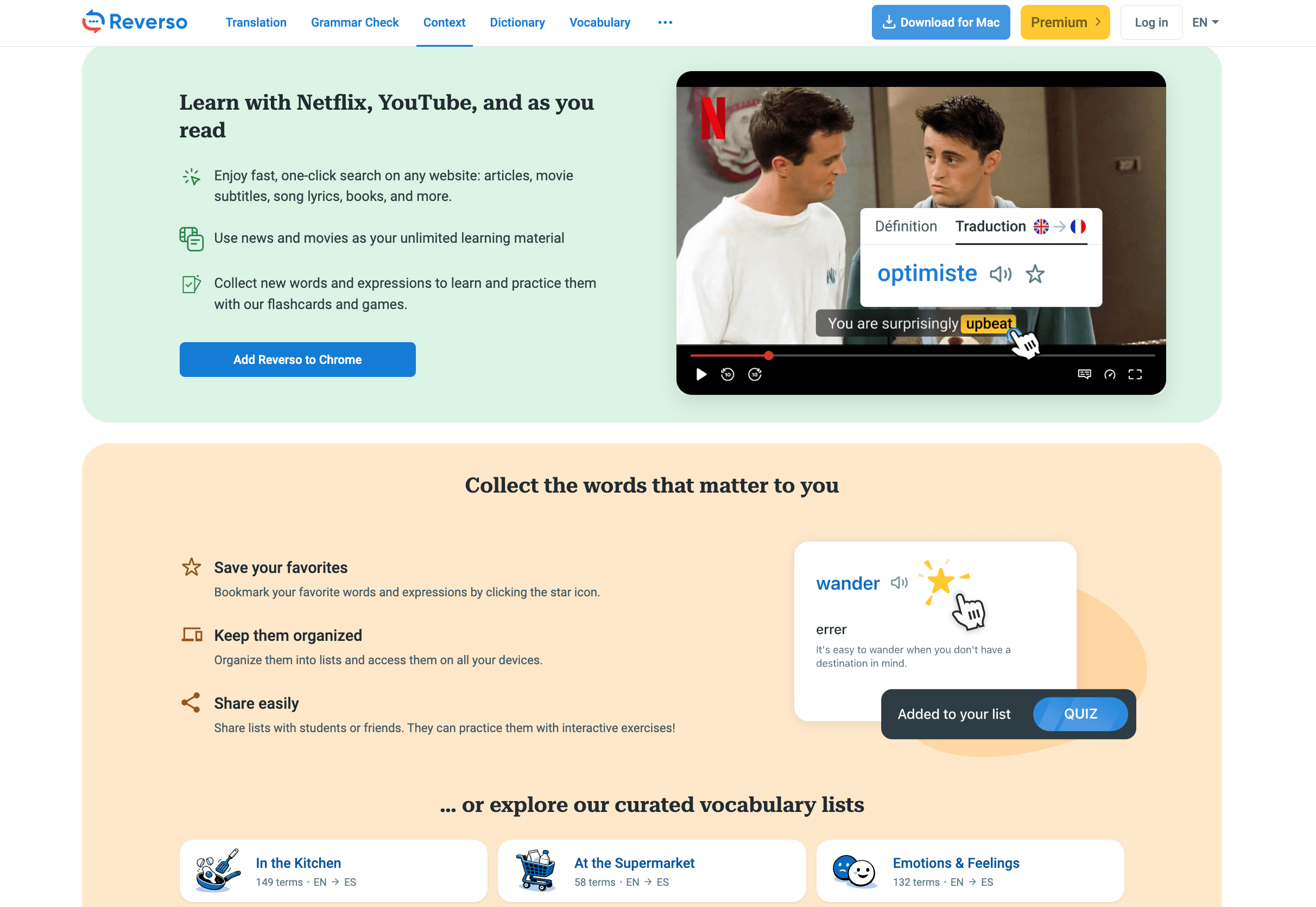
Reverso is useful when a writer wants to inspect how a word or expression appears in different contexts. Its examples reveal that “meeting” can map to reunión, encuentro, sesión, junta, cita, or asamblea. Examples still require judgment because an extracted sentence may not match the intended market, register, or institution.
DeepL is a stronger candidate when the job includes full written materials or documents. Its current language documentation distinguishes European Spanish and Latin American Spanish as target options, while noting that feature availability can vary by language and model. A reviewer should still verify market terminology, names, numbers, layout, and tone.

During the Meeting: Translate Speech Early Enough to Respond
Live translation adds speech recognition, speaker turns, latency, audio routing, captions, and possibly translated voice. A correct sentence that arrives after the topic changes may not support participation.
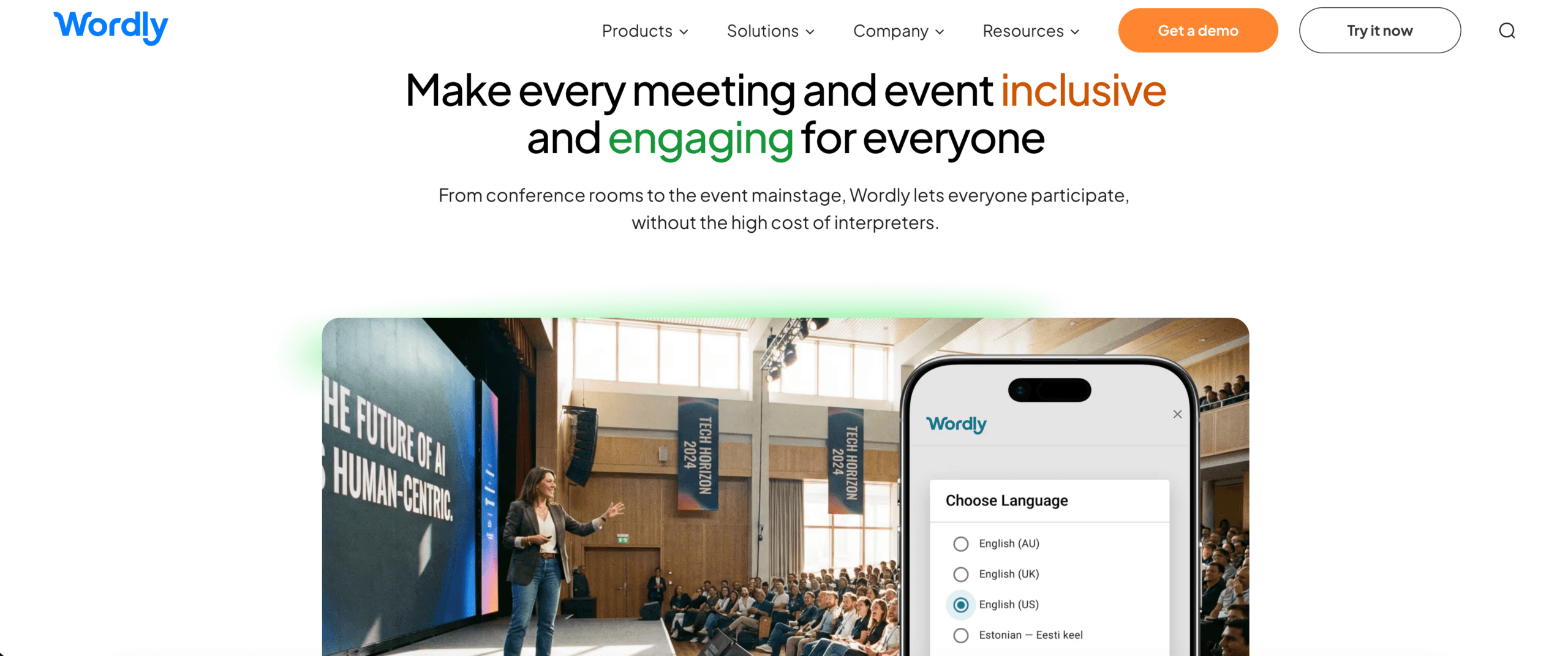
Wordly provides AI translation, captions, and audio for meetings and events. Attendees can use personal devices to read or listen in a selected language. This model is relevant to conferences, councils, training, and other sessions where an audience needs multilingual access without a human interpreter assigned to every language.
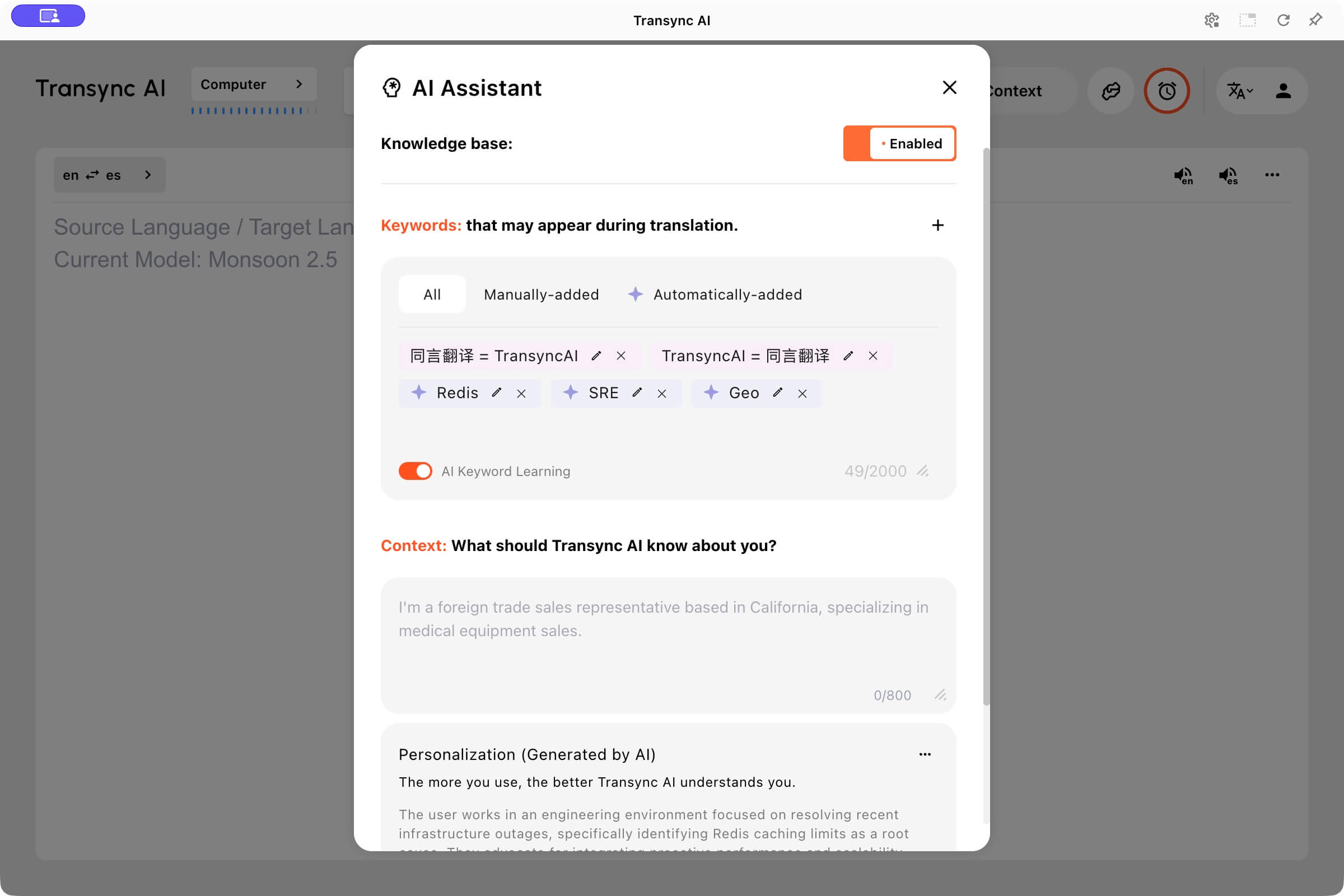
Transync AI is designed for live meeting translation across online calls and in-person conversations. Bilingual captions let users inspect original and translated text, while the AI voice translator can provide Spanish playback where supported. Hosts can prepare names and specialist vocabulary through AI Assistant Keywords Context.
For a webinar, class, town hall, or product briefing, Transync AI Presentation Mode lets audience members join by link, QR code, or Room ID and choose from the languages enabled by the host. They can read translated content on their own devices and use voice playback when it is available.
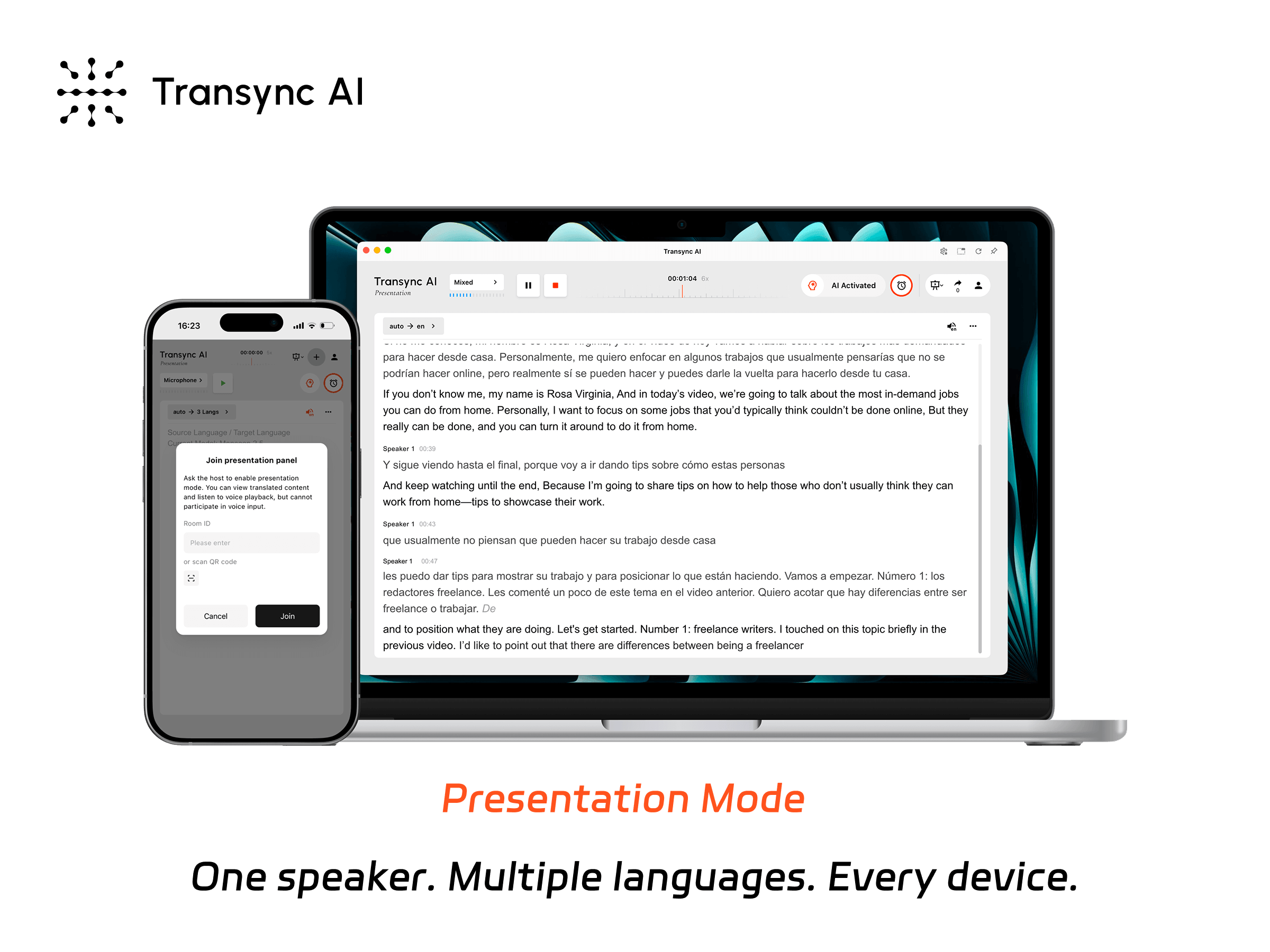
Presentation Mode lets one host share live translation with audience members on their own devices.
After the Meeting: Translate the Record, Not the Memory
Meeting minutes should distinguish decisions, open questions, action owners, dates, and conditions. A summary can be useful, but it should not replace the source transcript when exact wording matters.
Transync AI provides AI meeting notes after a translation session. Review the source and Spanish text before sharing decisions. Correct names, numbers, terminology, and any statement affected by overlapping speech or poor audio.
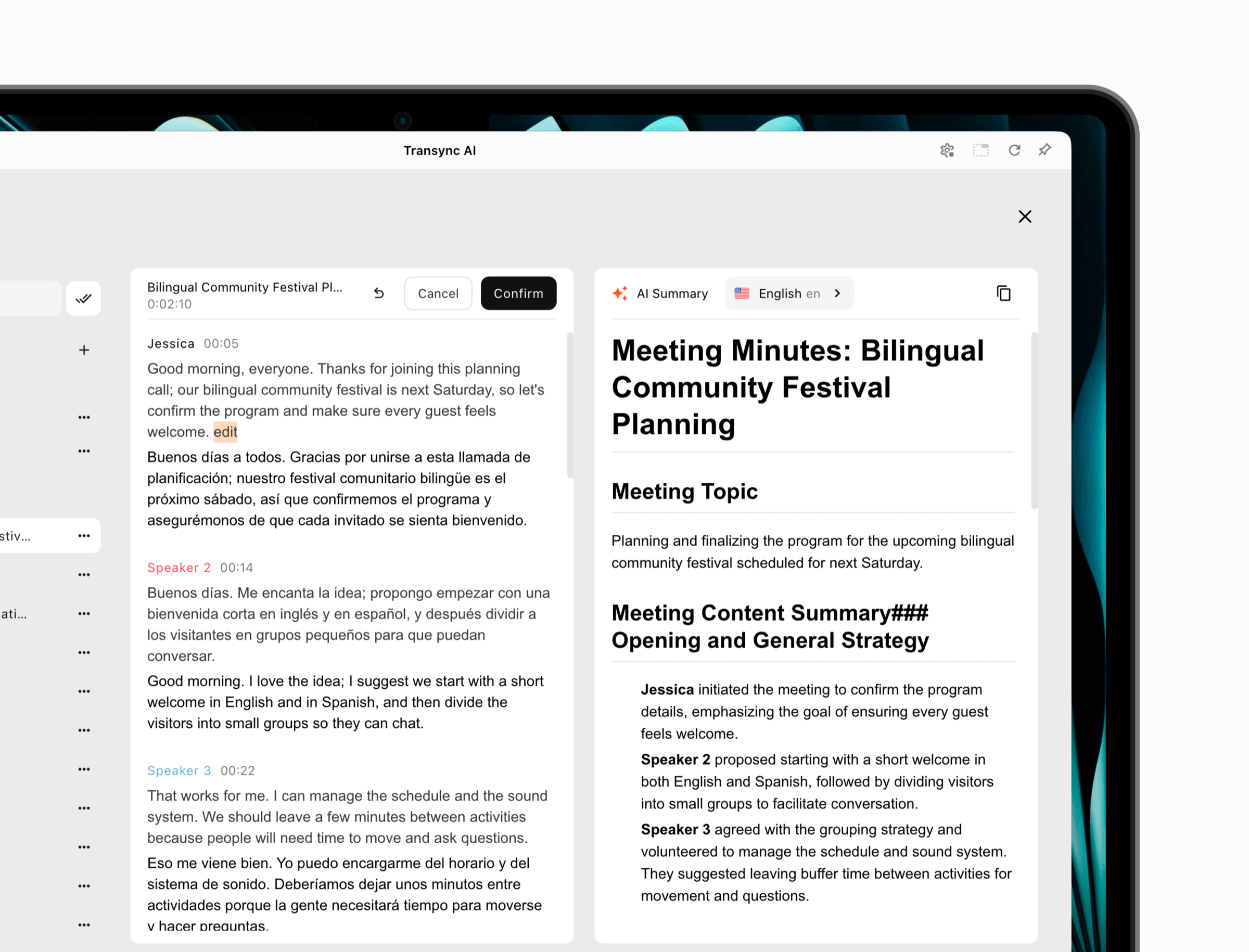 For formal minutes, a bilingual secretary or qualified reviewer should approve the record. If the meeting affects legal rights, public policy, medical care, employment, or major financial commitments, professional interpretation and translation may be required.
Meeting in Spanish Translation Tool Comparison
| Product | Best Moment | Main Input | Useful Spanish Output | Important Boundary |
|---|---|---|---|---|
| Reverso | Choosing a word or expression | Typed phrase or text | Context examples and alternative meanings | Examples are not an approval for formal use |
| DeepL | Preparing agendas and documents | Text and supported files | Written Spanish with variant controls where available | Live meeting participation is a different workflow |
| Wordly | Providing multilingual access at meetings and events | Live speaker or event audio | Captions and translated audio on attendee devices | Confirm event setup, language support, and current plan |
| Transync AI | Running interactive meetings or shared presentations | Microphone and computer audio | Bilingual captions, Spanish voice, context, and notes | Requires a network and is not a document or subtitle editor |
The right meeting in Spanish translation product depends on the moment of use. A contextual dictionary can resolve cita versus reunión. A document tool can prepare an agenda. An event platform can distribute Spanish to a large audience. A meeting-first tool can help participants understand and respond while the discussion continues.
The Three-Chair Rehearsal
Instead of evaluating Spanish output alone, rehearse the meeting from three chairs: speaker, Spanish listener, and record keeper. Rotate people so the workflow is experienced from every side.
Chair 1: The Speaker
The speaker reads a short agenda at natural speed. It should contain a person’s name, a product name, a date, a price, a negative condition, and one correction. The speaker then shares computer audio and briefly interrupts another participant, because real meetings are not studio recordings.
Chair 2: The Spanish Listener
The listener follows only the translated Spanish for part of the rehearsal. This person records when the core meaning becomes available, whether names and numbers remain clear, and whether the chosen regional style feels appropriate. If voice playback is used, the listener wears headphones to avoid echo.
Chair 3: The Record Keeper
The record keeper compares the source, Spanish translation, and resulting notes. This person verifies the decision, owner, due date, price, and condition. A meeting in Spanish translation workflow fails if the live experience feels smooth but the record changes “cannot” into “can.”
The rehearsal passes only if all three chairs succeed. Clear source speech cannot compensate for inaccessible Spanish output. Natural captions cannot compensate for a wrong decision record. A perfect record created hours later cannot restore participation that was impossible during the meeting.
Which Spanish Should the Meeting Use?
There is no single spoken or written Spanish style shared identically across every country. For many international meetings, neutral and widely understood vocabulary is a practical starting point. A specific market may require local terms, forms of address, pronunciation, and institutional language.
Before the event, decide:
- Spain, Latin America generally, or a specific country;
- formal or informal address;
- local job titles and department names;
- decimal, date, currency, and measurement formats;
- whether product names remain in English;
- how acronyms should be expanded and pronounced;
- whether participants will speak more than one language.
Do not assume that changing a document translator’s variant setting automatically changes every live speech feature. Text, speech recognition, voice output, and summaries may have different language coverage. Test the complete route.
A professional reviewer should handle highly visible or consequential meeting in Spanish translation material. Neutral Spanish can broaden comprehension, but it does not replace local legal or cultural expertise.
Frequently Asked Questions
What is the most common meeting in Spanish translation?
The most common general translation is reunión. Use it for a team meeting, business meeting, weekly meeting, or other gathering where people discuss something. Context may instead call for cita, encuentro, junta, sesión, or asamblea.
How do you say “I have a meeting” in Spanish?
Tengo una reunión is the general answer. Tengo una cita fits an appointment, while Tengo una junta may sound natural for a workplace or board-related meeting in some regions.
Is junta or reunión better for a business meeting?
Reunión is the safer neutral choice across markets. Junta may be preferred for a board, governing group, or ordinary workplace meeting in some regions. Confirm the intended country and whether the noun refers to the meeting or the board itself.
What is the difference between Spanish translation and interpretation?
Translation usually refers to written material, while interpretation refers to spoken communication delivered live or consecutively. Technology products sometimes use “translation” as a broad label for both. Formal notices should describe the actual service accurately.
Can AI translate a Spanish meeting in real time?
Yes. Transync AI and Wordly provide live language workflows involving captions and translated audio. Their interaction models differ, so test the actual meeting type, language pair, audio path, participant access, latency, and record requirements.
Can attendees join Spanish translation through a QR code?
Yes. Transync AI Presentation Mode allows a host to share a link, QR code, or Room ID. Attendees choose an enabled language and follow the presentation on their own devices. The audience view is for reading and listening rather than speaking into the host’s translation task.
Can one tool translate the agenda, live meeting, and minutes perfectly?
Do not assume so. Written documents, live speech, and formal records have different requirements. A team may use a document translator before the meeting, a live translation product during it, and a qualified reviewer for final minutes.
When should a human Spanish interpreter lead?
Use a qualified interpreter for legal proceedings, medical consultations, immigration matters, safety-critical discussions, labor negotiations, and other high-stakes meetings. AI captions may provide supplementary access, but accountability should remain with qualified professionals.
Choose the Meaning Before the Tool
Start with the sentence. If “meeting” names an ordinary gathering, choose reunión. If it names an appointment, encounter, board gathering, formal sitting, or member assembly, consider cita, encuentro, junta, sesión, or asamblea. If “meeting” is a verb, rewrite the sentence around reunirse, encontrarse, conocer, or another appropriate verb.
Then decide whether the job ends with the word or continues into a real event. Use Reverso to inspect contextual alternatives, DeepL for written meeting materials, Wordly for multilingual event access, and Transync AI when participants need bilingual captions, translated voice, prepared terminology, and a reviewable record while the conversation is still active.
A strong meeting in Spanish translation workflow preserves more than vocabulary. It carries the right meaning into the invitation, the live exchange, the participant’s device, and the final record.