

Translate Spanish to English without changing the speaker’s meaning. Avoid 3 quote errors and compare tools for text, recorded interviews, and live calls.
To translate Spanish to English, set Spanish as the source language and English as the target, then translate the complete passage. For an interview, keep the original statement beside the English draft and check what a reader would believe the speaker said. Natural English is the goal, but a smoother sentence must not change the speaker’s opinion.
That distinction matters when a short interview becomes a newsletter quotation, a workshop recap, or a customer story. The most appealing sentence is not necessarily the most faithful one.
Consider one participant’s feedback after a workshop. The task is not to make the workshop sound successful. It is to represent the participant fairly.
One Spanish statement and its English translation
Here is a constructed interview example, not a real testimonial or a translation captured from any product:
Español: Al principio me costó seguir la explicación, pero el ejemplo final me ayudó.
Inglés: At first I found the explanation hard to follow, but the final example helped me.
The participant describes a change in their experience: initial difficulty followed by something helpful. Neither half cancels the other.
A possible attributed paraphrase is:
The participant initially struggled to follow the explanation but found the final example helpful.
That is the writer’s summary, not a translated quotation. In a finished article, present it as ordinary reported speech rather than putting the newly composed sentence in quotation marks.
When you translate Spanish to English for publication, decide which form you need before shortening or polishing the result. A translated quotation, a paraphrase, and an excerpt serve different purposes.
Translate Spanish to English by meaning not word shape
The first error is treating a familiar-looking word as a fixed English replacement.
En el ejemplo, me costó seguir la explicación expresses difficulty following the explanation. It does not describe a payment. The Real Academia Española documents both the price-related and difficulty-related meanings of costar. The rest of the sentence determines which meaning is relevant here.
“At first it cost me to follow the explanation” copies Spanish structure without producing natural English. “At first I found the explanation hard to follow” carries the intended experience more clearly.
There is room for another faithful version, such as “I struggled to follow the explanation at first.” Translation does not require every reviewer to choose exactly the same English words.
But the freedom has limits. “The explanation was impossible to understand” intensifies the criticism. “I did not understand anything” adds an absolute claim. Neither is justified by this source.
The same applies to the positive half. “The final example helped me” does not say that the participant mastered the whole subject or that every earlier problem disappeared.
To translate Spanish to English accurately, compare the strength of the statement, not just its topic. Keep difficulty as difficulty and help as help; do not turn either into a dramatic verdict.
Keep the difficulty and the help together
The second error is choosing an excerpt that changes the impression created by the full answer.
Al principio establishes the initial stage. Pero connects it to a contrasting experience. An English version that keeps “at first” and “but” makes that relationship easy to follow.
Suppose a recap uses only:
The final example helped me.
This is not automatically an unfair excerpt. It can work if nearby copy explains that the participant initially had difficulty following the explanation.
The problem appears when the headline says “An easy workshop from start to finish” and the shortened quote is offered as support. The words selected from the answer may be genuine, but the overall presentation now suggests something the participant did not say.
An ellipsis is not a remedy for a misleading impression. Nor does retaining the original Spanish somewhere else guarantee that the English headline is fair.
The editorial guidance from Reuters makes two relevant distinctions: translated quotations should use idiomatic language while preserving tone, and selective quotation must remain representative of the speaker’s remarks.
Apply that principle when you translate Spanish to English for a pull quote or caption. Read the excerpt together with the headline and surrounding paragraph, not as an isolated sentence.
Do not turn a paraphrase into a quotation
The third error is replacing the speaker’s translated words with the editor’s conclusion while leaving quotation marks around it.
“The workshop was a great learning experience” might be a tempting promotional rewrite. It is not a translation of our example. The participant did not give that overall verdict.
A fair paraphrase can be concise: the participant initially struggled with the explanation but found the final example helpful. Attribute it to the participant and keep it outside quotation marks in the article.
A translated quotation can still be natural English. You do not have to preserve Spanish word order, but you do have to preserve the person’s meaning and stance. “Literal” and “faithful” are not interchangeable requirements.
Do not invent identity details either. The Spanish statement uses me, which identifies the person describing their own experience; it does not tell you their gender, job title, or expertise. Verify attribution separately instead of generating it from the sentence.
If a detail would improve the story, ask for it. A useful follow-up is:
Español: ¿Qué parte del ejemplo final te ayudó?
Inglés: Which part of the final example helped you?
This uses informal singular address in Spanish. Adjust the form of address to the interview relationship. Any answer you receive is new source material, not a fact that the translator should have supplied.
When you translate Spanish to English, keep the translated answer, your paraphrase, and your later interpretation distinguishable.
Choose a tool for the interview material you actually have
A written answer, an existing recording, and an interview happening now need different working environments. The comparison below is about those routes, not an accuracy ranking.
Before using any service to translate Spanish to English, check that your organization permits the material to be processed there. Agree on interview and recording arrangements separately from choosing a translator.
| Herramienta o ruta | Best fit for this task | Qué revisar | Límite importante |
|---|---|---|---|
| Lara traduce | Drafting English from a complete Spanish written answer | Source passage, interview context, and English wording | Added context guides a translation; it does not verify a quote or authorize publication |
| Sonix | Working from an existing Spanish interview recording | Corrected Spanish transcript and editable English translation | Translation runs from the transcript, so recognition errors can carry into English |
| Transync AI | Understanding and following up during a live bilingual interview | Live captions and the saved Spanish and English text | It does not retain original audio or serve as a general recording-upload editor |
| Qualified translator and editor | Preparing a quotation for consequential or public-facing use | Meaning, tone, attribution, and surrounding copy | Translation review is separate from publication permissions and editorial decisions |
Lara traduce for a written interview answer
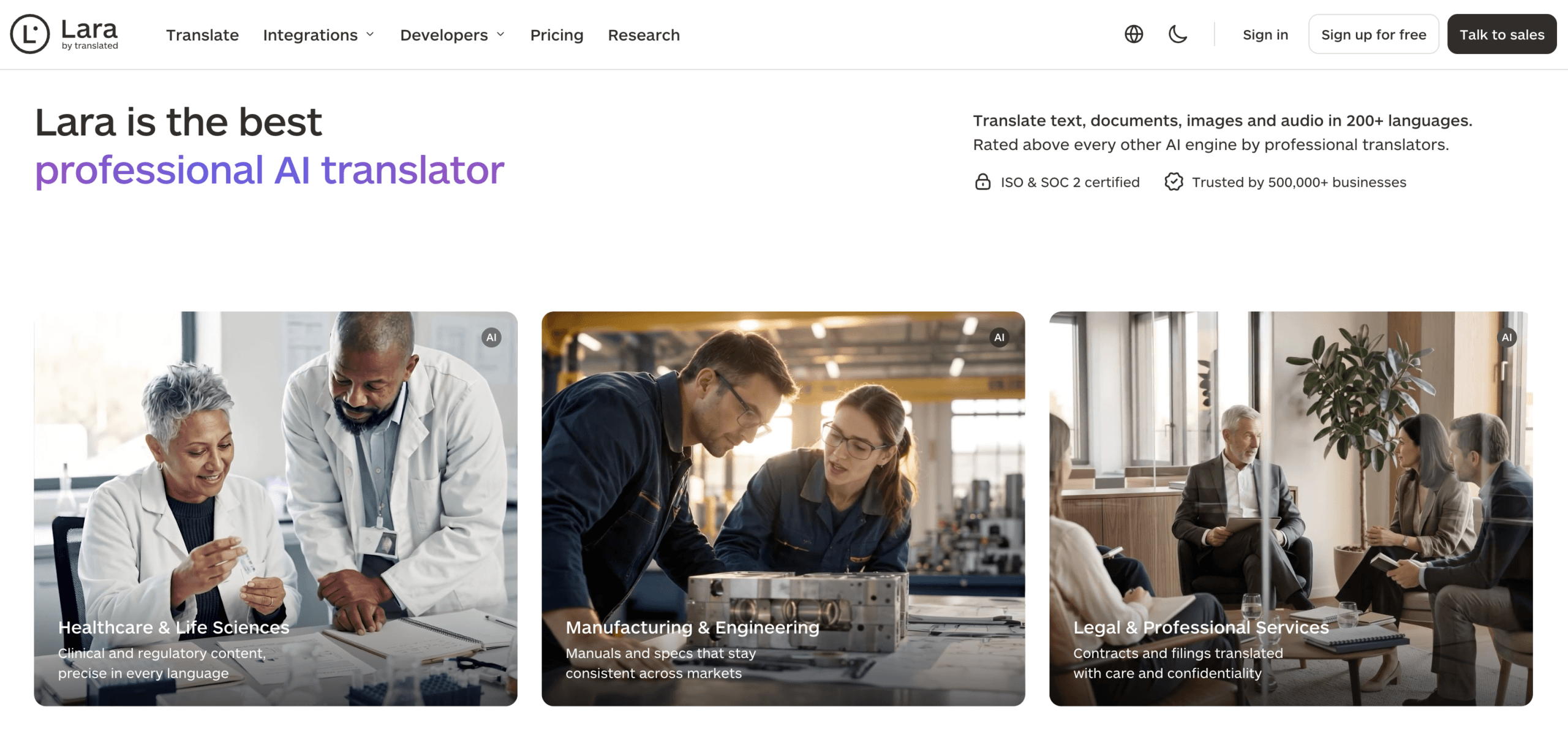
Lara traduce provides a pasted-text workflow with source and target language controls. To translate Spanish to English, paste the full answer, verify the source setting, and choose the English target. Its Instrucciones de traducción de texto describe reviewing and copying the result.
Usar Añadir contexto to explain that this is a workshop participant’s interview answer and that the initial difficulty and later help both matter. This context feature applies to text translation, not document translation. Do not instruct the tool to turn the answer into enthusiastic marketing copy and then present that output as the participant’s quotation.
Sonix for an interview already recorded
Sonix supports Spanish-to-English translation from recorded material. Upload the interview, select Spanish as the spoken language, and transcribe it. Correct the Spanish text before choosing English in the translation menu.
Es official workflow explains that translation uses the transcript rather than the audio, and that the translated text can also be edited. To translate Spanish to English from a recording, check the selected passage against the recording before editing its English version. If the source transcript lost pero, a fluent English result may repeat that loss.

Transync AI for an interview still in progress
Transync AI ofertas traducción de reuniones en vivo with bilingual captions, including the Spanish-to-English direction. Select the language pair and test the actual microphone and remote computer-audio input before the interview.
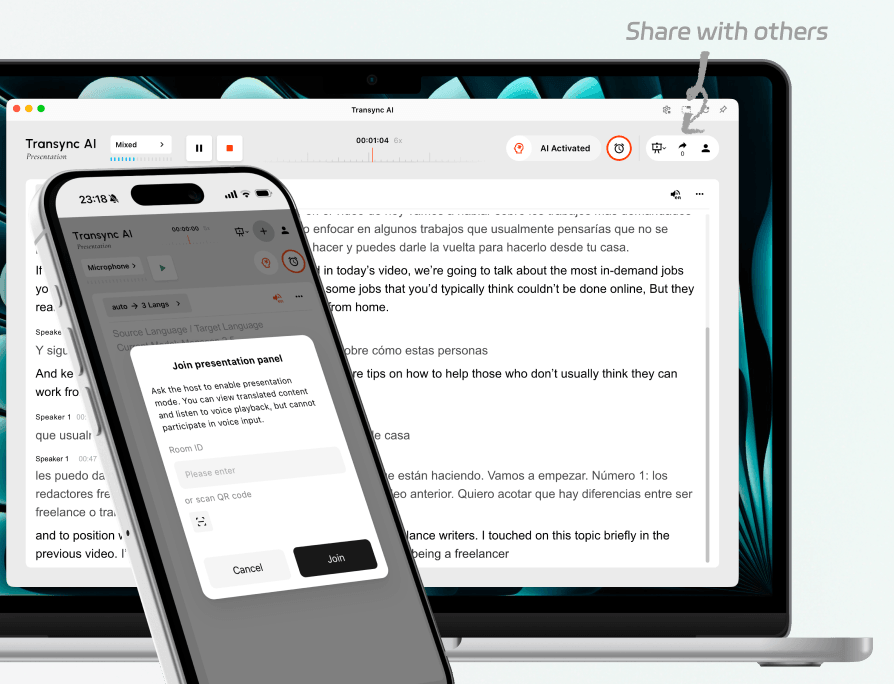
Invite a los asistentes presentes en la sala y a los que se conecten de forma remota a la misma presentación en directo.
The useful moment is the follow-up: you can notice the contrast in the answer and ask which part of the example helped. Use it to translate Spanish to English while the participant can still clarify their meaning.
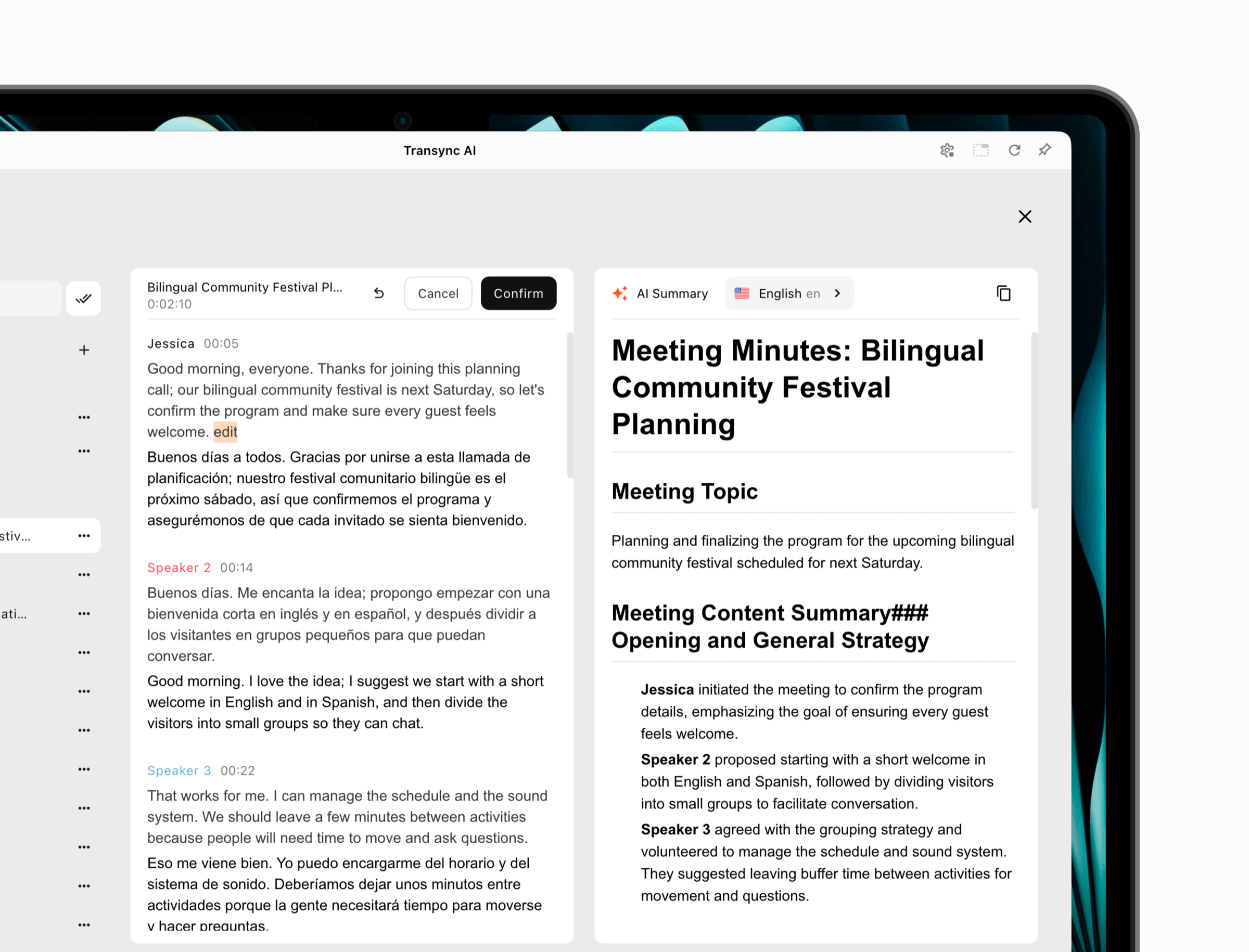
Afterward, review the saved transcript and translation before selecting a quotation. Transync AI does not retain original audio recordings. If your publication workflow needs playback to verify exact wording, arrange a separate recording with the appropriate consent and retain it under your organization’s policy. A saved text record is not a substitute for that recording.
Keep a usable source note with the quote
Before handing the English passage to an editor, keep the complete Spanish statement, the proposed English translation, the verified speaker attribution, and its location in the source. For a recording, note the relevant time; for a written answer, retain the original message or document reference.
Include the planned surrounding copy if the quotation will be shortened. That lets the reviewer judge the impression the published excerpt will create, rather than approving words without their context.
Follow the publication’s house style for indicating a translation, such as a note that the remarks were translated from Spanish. Do not imply that the speaker originally used the English wording.
This source note helps teams translate Spanish to English without confusing a reviewed translation with permission to publish, speaker approval, or verification of every factual claim in the interview.
Questions before publishing
Can I translate Spanish to English directly from audio
Use a product that supports the recording or live-audio workflow you need. In a transcript-based editor, correct the Spanish recognition first. In a live interview, use captions to understand and clarify, then review the source before publishing a quotation.
Must a translated quotation be word for word
No. Natural English can faithfully represent Spanish meaning without copying its structure. Preserve the speaker’s tone and the strength of the statement. If you substantially summarize or interpret, present the result as attributed paraphrase rather than a quotation.
Is a positive excerpt always misleading
No. Judge the excerpt alongside the surrounding copy. A short positive sentence can be fair when the context retains the speaker’s qualification; it becomes misleading when presented as unqualified praise that the full answer does not support.
Let the English reader hear the same opinion
The goal when you translate Spanish to English is not to produce the most flattering sentence. It is to give an English reader a fair understanding of the original speaker. Keep the source, choose quotation or paraphrase deliberately, and review the excerpt in the setting where people will actually read it.