

Translate Chinese into English free while avoiding 7 hidden gaps in scripts, subjects, time, pronouns, names, numbers, and tone. Compare practical tools.
Translate Chinese into English free is possible for quick understanding, vocabulary research, limited document work, and even a short live trial. The difficult part is not finding a free input box. It is recognizing what the Chinese source leaves unstated and what the English target must make explicit.
Chinese can omit a subject that English requires. Time may be carried by context instead of an inflected verb. Spoken tā does not reveal whether the written pronoun is 他, 她, or 它. A name may look like an ordinary word, while 万 and 亿 require numerical conversion rather than character-by-character replacement.
This guide exposes seven hidden gaps before comparing free dictionary lookup, mobile study tools, limited web translation, and a free allowance for live Chinese-English communication. The phrase translate Chinese into English free describes a budget constraint, not a quality guarantee. “Free” is treated as a practical condition with limits, not a promise that every input, feature, or professional use costs nothing.
What Does “Free” Actually Mean?
| Free Route | What You Usually Receive | What May Be Limited | Best Use |
|---|---|---|---|
| Free web dictionary | Character, word, Pinyin, definitions, and examples | Not a polished full-document workflow | Investigating an unfamiliar term |
| Free basic mobile dictionary | Core lookup and selected learning functions | OCR, premium dictionaries, advanced flashcards, or other add-ons may cost extra | Reading and studying Chinese on a phone |
| Free web translator or account | Fast text translation and limited file support | Characters, files, editing, privacy terms, or advanced controls | First-pass understanding of revisable content |
| Free product allowance | A defined amount of live translation after sign-up | Minutes, audience size, languages, or advanced usage | Testing a real conversation or meeting |
| Volunteer or informal help | Feedback from another person | Availability, expertise, confidentiality, and accountability | Low-risk clarification, not automatic professional approval |
A translate Chinese into English free claim should answer six questions: Is an account required? Is there a character, file, image, or minute limit? Which functions are paid? Can the result be edited or exported? How is the data handled? Is the output suitable only for understanding, or for publication and decisions?
Free access is useful. It does not remove the cost of correcting an ambiguous source, checking terminology, restoring layout, reviewing confidential data, or approving a consequential translation.
Hidden Gap 1: “Chinese” Does Not Identify the Source Completely
A request to translate Chinese into English free should first identify the script and region. Simplified Chinese and Traditional Chinese share much of their language, but character forms, vocabulary, punctuation habits, and market conventions can differ.
| Meaning | Mainland-Oriented Simplified Example | Traditional Example | English Direction |
|---|---|---|---|
| software | 软件 | 軟體 / 軟件, depending on market | software |
| video | 视频 | 影片 / 視頻, depending on market | video |
| information | 信息 | 資訊 / 信息, depending on market | information |
| bicycle | 自行车 | 自行車 / 單車, depending on market | bicycle |
The table is not a complete regional map. Taiwan, Hong Kong, Macau, Mainland China, Singapore, and overseas Chinese communities may prefer different terms or registers. Cantonese writing can also contain vocabulary and grammar that should not be treated as standard written Mandarin.
Before translation, record:
- Simplified or Traditional characters;
- likely source market;
- Mandarin, Cantonese, or another spoken variety if audio is involved;
- target English market, such as US or UK English;
- whether names should use an existing official spelling.
A tool may detect “Chinese” without reliably identifying every regional convention. The reviewer must preserve what the source actually says while making the English suitable for its audience.
This first label keeps a translate Chinese into English free workflow from flattening distinct source markets into one generic category.
Hidden Gap 2: Chinese Can Omit the Subject or Object
Consider the short message:
已经发了。
It can mean “I already sent it,” “We already sent it,” “She already sent it,” “It has already been sent,” or another context-dependent version. Chinese conversation often omits information that participants can recover from the situation. English usually requires an explicit subject.
A translate Chinese into English free tool may choose I, we, or a passive construction even though the source does not identify the actor. That choice can turn a helpful draft into a false claim.
Test with questions:
- Who performed the action?
- What was sent?
- Was it sent to a person, a group, or a system?
- Does the English need an active or passive sentence?
If the context is unavailable, a cautious rendering such as “It has already been sent” may avoid inventing a person, but even that sentence assumes an object that English requires. In legal, investigative, or attribution-sensitive work, mark the ambiguity rather than silently resolving it.
The same problem appears in meeting notes. 同意了 may mean “I agreed,” “They agreed,” or “It was approved,” depending on the conversation. Names and speaker labels are essential evidence.
To translate Chinese into English free safely, recover the actor from evidence instead of rewarding the smoothest guess.
Hidden Gap 3: Time Is Not the Same as English Tense
Chinese verbs do not inflect for past, present, and future in the same way English verbs do. Time can be expressed through adverbs, particles, aspect, surrounding sentences, or shared knowledge.
Compare:
- 我昨天去了。 → “I went yesterday.”
- 我去过。 → “I have been there before” or “I have had the experience of going.”
- 我在看。 → “I am watching/reading.”
- 我明天去。 → “I will go tomorrow” or “I am going tomorrow.”
The particles 了, 过, and 着 do not map mechanically to one English tense. A sentence with 了 may signal completion or a change of state; it does not simply mean “past tense.”
When you translate Chinese into English free, check the timeline separately from vocabulary. Highlight dates, sequence words, deadlines, ongoing states, completed actions, and prior experience. Then select the English tense that expresses the relationship.
This matters in business records. 客户确认了 may indicate that the customer has confirmed something, but the object, timing, and current validity may still depend on surrounding turns. A meeting summary should not upgrade an earlier confirmation into an active approval if it was later withdrawn.
Any translate Chinese into English free test should therefore score timeline accuracy as a separate requirement.
Hidden Gap 4: Spoken Tā Does Not Reveal the Written Pronoun
In standard Mandarin pronunciation, 他, 她, and 它 are all pronounced tā. They usually correspond to “he,” “she,” and “it” in writing, but audio alone may not reveal which character or English pronoun is intended.
Other written forms, names, titles, and plural expressions can add further choices. A voice system that outputs he or she may be guessing from context, speaker information, or statistical patterns.
Use test sentences such as:
- Tā said the contract was ready.
- Tā will lead the review.
- I sent it to tā yesterday.
Then supply different contexts: a known female manager, a male engineer, a company, a pet, or a person whose gender should not be inferred. Observe whether the translate Chinese into English free workflow keeps the reference accurate and respectful.
When identity is unknown or irrelevant, English may allow a person’s name, role, singular they, a passive rewrite, or another neutral construction. The correct choice depends on editorial policy and context—not on the sound tā alone.
Live meetings add speaker separation. If the system attributes the sentence to the wrong person, even a grammatically correct pronoun can create a false record.
For audio, translate Chinese into English free means testing identity recovery as well as sentence fluency.
Hidden Gap 5: A Name Can Look Like an Ordinary Word
Chinese text does not place spaces between every word. A system must segment the character sequence and decide whether it contains a person, organization, place, product, or ordinary expression.
Names create additional uncertainty:
- the same character may have more than one pronunciation;
- a surname can also be a common word;
- an organization may have an approved English name that is not a literal translation;
- Pinyin order may differ from an existing international name style;
- capitalization and spacing can carry brand identity.
For example, 行 may be pronounced xíng or háng depending on meaning, while 重 can be zhòng or chóng. A person’s name may use a reading that a general dictionary cannot safely infer from isolated characters.
A translate Chinese into English free tool should not be trusted to invent an official English company name. Search the organization’s official bilingual materials, business records where appropriate, previous approved translations, email signatures, or the person’s own preferred spelling.
Build a small name list before processing documents or audio. Include Chinese characters, Pinyin or approved English form, role, pronunciation, terms that must remain untranslated, and prohibited alternatives. For live speech, add important names to the product’s terminology or context controls when available.
A translate Chinese into English free workflow becomes safer when verified names enter before automatic translation, not after publication.
Hidden Gap 6: 万 and 亿 Require Numerical Conversion
Chinese groups large numbers around 万 (ten thousand) and 亿 (one hundred million), while English normally groups around thousand, million, and billion.
| Chinese | Numerical Value | Natural English |
|---|---|---|
| 1万 | 10,000 | ten thousand |
| 3.5万 | 35,000 | thirty-five thousand |
| 100万 | 1,000,000 | one million |
| 1亿 | 100,000,000 | one hundred million |
| 10亿 | 1,000,000,000 | one billion |
The characters must be converted, not replaced one by one. Financial text also requires currency, tax status, decimal separators, units, and whether a figure is exact or approximate.
When using translate Chinese into English free services, audit every number independently:
- amounts and currency;
- percentages and decimal points;
- dates and time zones;
- measurements and converted units;
- model and version numbers;
- ranges, negatives, and approximations;
- 万, 亿, and colloquial number expressions.
For speech, test 十四/四十 and other acoustically vulnerable pairs under the real accent and room conditions. Ask the listener to repeat the English number before the conversation proceeds. A fluent sentence cannot compensate for a tenfold or hundredfold error.
To translate Chinese into English free responsibly, give every quantity its own source-to-target check.
Hidden Gap 7: Politeness, Modality, and Idioms Carry Intent
Chinese business communication may soften a request through context and conventional phrasing rather than an English-style please. Expressions such as 麻烦你, 方便吗, 辛苦了, and 请考虑一下 require attention to relationship, tone, and purpose.
Literal output can sound too abrupt, too deferential, or simply strange:
- 麻烦你确认一下。 may become “Could you please confirm this?” rather than “Trouble you to confirm.”
- 方便吗? may mean “Would that be convenient?” rather than “Is it convenient?”
- 应该可以。 may express cautious confidence: “It should be possible,” not an unconditional “Yes.”
- 再看看吧。 may postpone a decision rather than promise another detailed review.
Idioms and set expressions add another layer. 马马虎虎 is not about horses and tigers; 画蛇添足 does not normally require a literal story about drawing a snake when the intended English is “add something unnecessary” or “overdo it.”
The best translate Chinese into English free result should preserve the speaker’s action, confidence, politeness, and implied next step. For important messages, ask an English reviewer to describe how direct, certain, and committed the target sounds. Compare that response with the Chinese intent.
This final gap shows why translate Chinese into English free is a communication task, not only a vocabulary task.
Translate Chinese into English Free: Tool Comparison
| Product or Route | Free Access Model | Strongest Use | Useful Evidence | Important Boundary |
|---|---|---|---|---|
| MDBG | Free web dictionary and Chinese study tools | Characters, words, Pinyin, definitions, examples, and text annotation | Alternative senses and word-level structure | Not a publication-ready document or live-meeting workflow |
| Pleco | Free basic mobile app with optional paid add-ons | Mobile Chinese lookup, handwriting, dictionaries, and learning | Character readings, dictionary entries, and pronunciation resources | Advanced dictionaries and features may require purchases |
| DeepL | Free web/account access with plan-dependent limits | Fast Chinese-to-English text and supported-file drafts | Editable source/target review and English variant selection | Limits and document features vary; output still needs contextual review |
| Transync AI | 40 minutes of real-time translation upon sign-up under the current free plan | Live Chinese-English meetings and conversations | Bilingual captions, optional Chinese Pinyin, translated voice, prepared terms, and meeting notes | Requires a network and is not a general document translator |
| Qualified professional | Usually paid | Publication, legal, medical, safety, financial, or other consequential work | Queries, domain judgment, revision, and accountable approval | Requires the correct language direction, specialization, time, and budget |
The right free route depends on the missing evidence. A dictionary can reveal possible readings. A text translator can produce a draft. A meeting tool can preserve the live exchange. None of those automatically supplies the context or professional approval absent from the source.
MDBG for Free Character and Word Research
MDBG is a free online Chinese-English and English-Chinese dictionary with search by Chinese, Pinyin, or English. It also provides tools such as text annotation, Chinese input, examples, and study functions.
Use MDBG when a translate Chinese into English free result contains an unfamiliar character, questionable word boundary, or possible alternative reading. Looking up the components can reveal why a full-sentence system chose one meaning and whether another sense fits better.
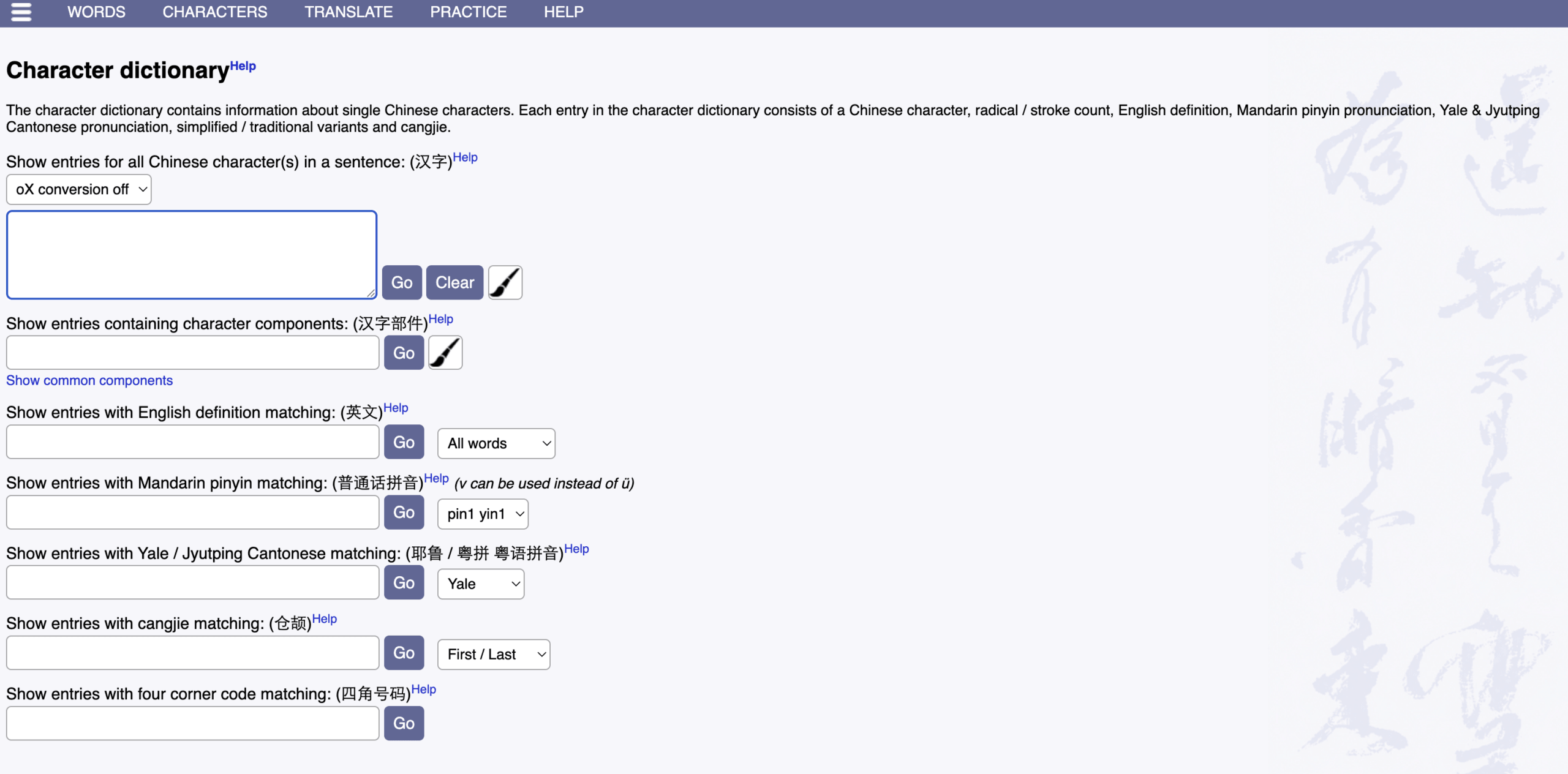
MDBG does not decide the correct sentence from dictionary entries alone. A character can have several readings, and a word can change meaning by field or region. Use the source sentence and real-world context.
Pleco for Mobile Chinese Lookup
Pleco is a Chinese dictionary and learning app for mobile devices. Its official materials describe a free basic version, while advanced dictionaries and features are available as add-ons. The broader product includes tools such as handwriting lookup, audio, document reading, flashcards, and OCR, with availability depending on platform and purchase.
For someone trying to translate Chinese into English free while reading a sign, message, or document on a phone, Pleco can help identify characters, Pinyin, definitions, and example usage. Handwriting input is valuable when the user cannot type or pronounce the character.
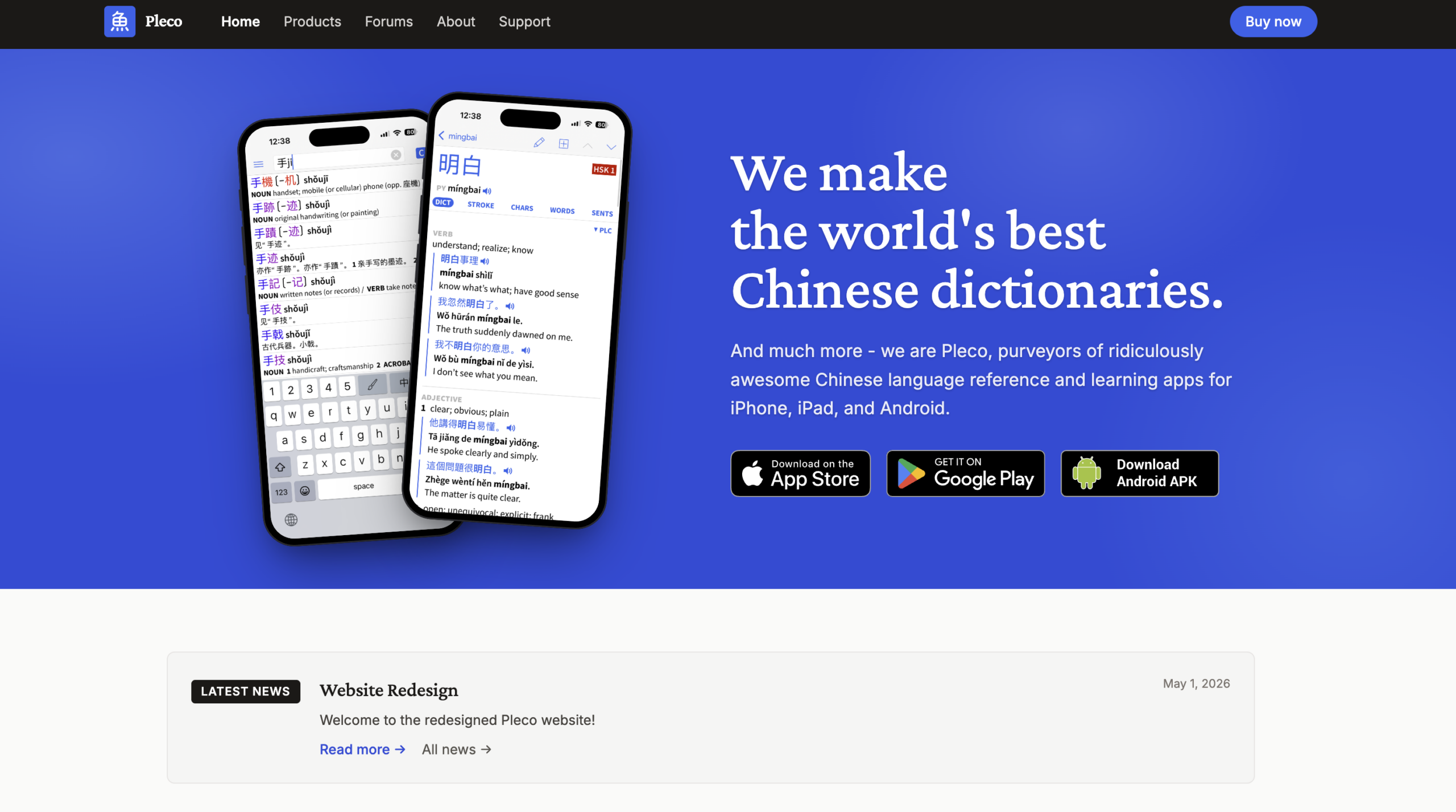
Check which functions are included in the free basic version before assuming OCR, specialist dictionaries, or every learning feature is free. Pleco is strongest as a Chinese reference environment, not as automatic approval for a full professional translation.
DeepL for Revisable Text and Files
DeepL supports Chinese as a source language and offers American and British English as target options for Chinese. Its web and account-based services can translate text and supported files, with limits and editing options that depend on the current product and plan.
This makes DeepL useful when translate Chinese into English free means producing a first draft that a person can compare with the source. Supply complete paragraphs rather than isolated sentences when context resolves omitted subjects, pronouns, or terminology.

The current language documentation notes that Chinese source detection does not distinguish varieties. The team should therefore identify Simplified or Traditional input and market context separately. Free file limits and supported formats can change, so check the live help page before a large project.
DeepL output remains a draft when names, numbers, legal effect, publication quality, or specialist terminology matter. Review the target English for facts as well as fluency.
Transync AI for Free Live Trial Minutes
Transync AI currently provides 40 minutes of real-time translation upon sign-up on its $0 plan. Chinese and English are included among its supported languages. The product is built for live meeting translation with bilingual captions and translated playback through its AI voice translator.
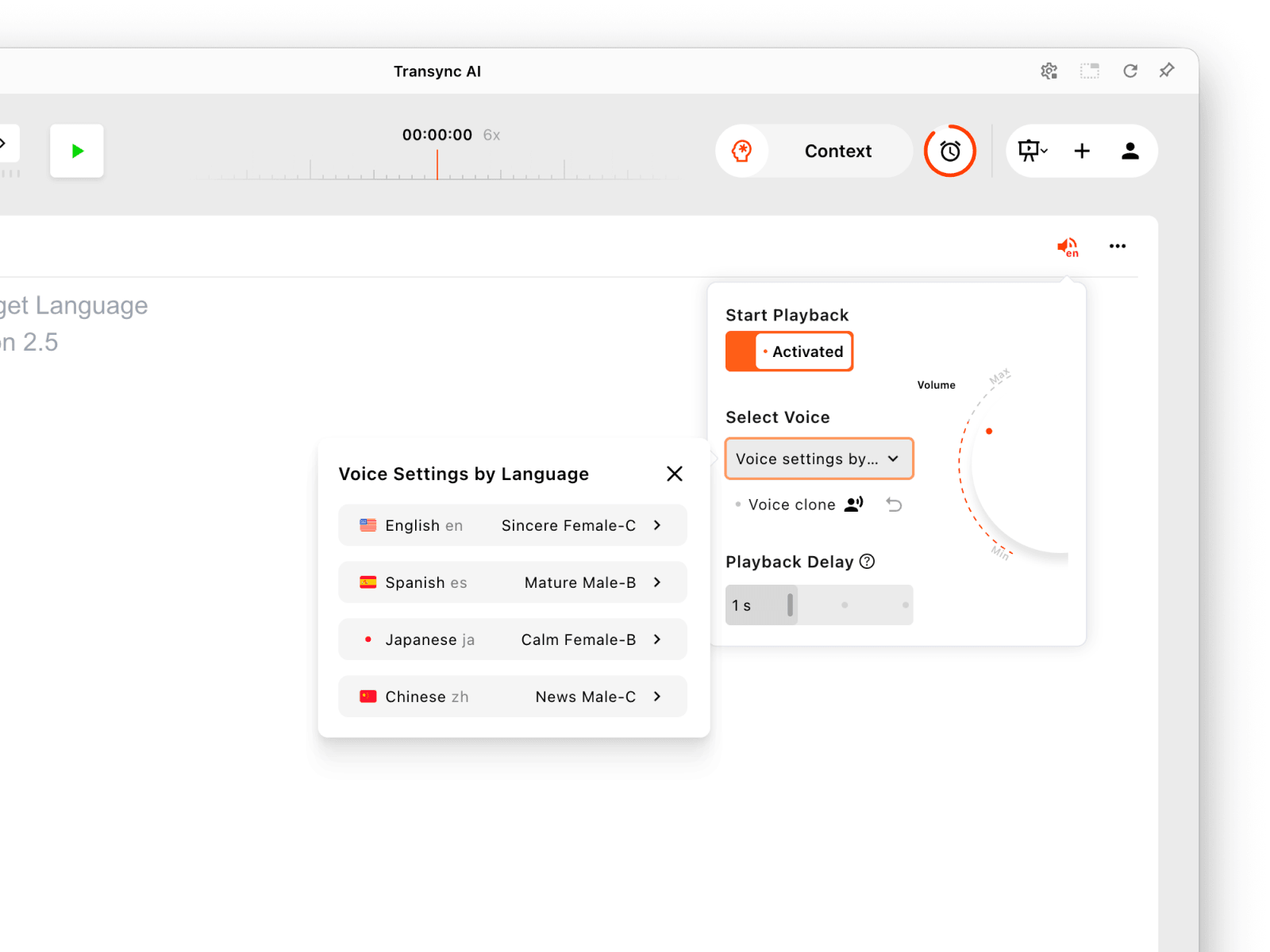
Configure voice playback separately for each presentation language.
When Chinese appears in a live translation, users can turn on Show Chinese Pinyin. The interface then displays Pinyin above the Chinese characters while the translation is running. This extra reading layer helps learners and non-native readers connect the visible characters with their Mandarin pronunciation. It is also useful when a participant recognizes a spoken name or term but cannot yet read the characters confidently. Pinyin supports pronunciation and verification; it does not replace the Chinese source text or resolve the meaning of a polyphonic character without context.
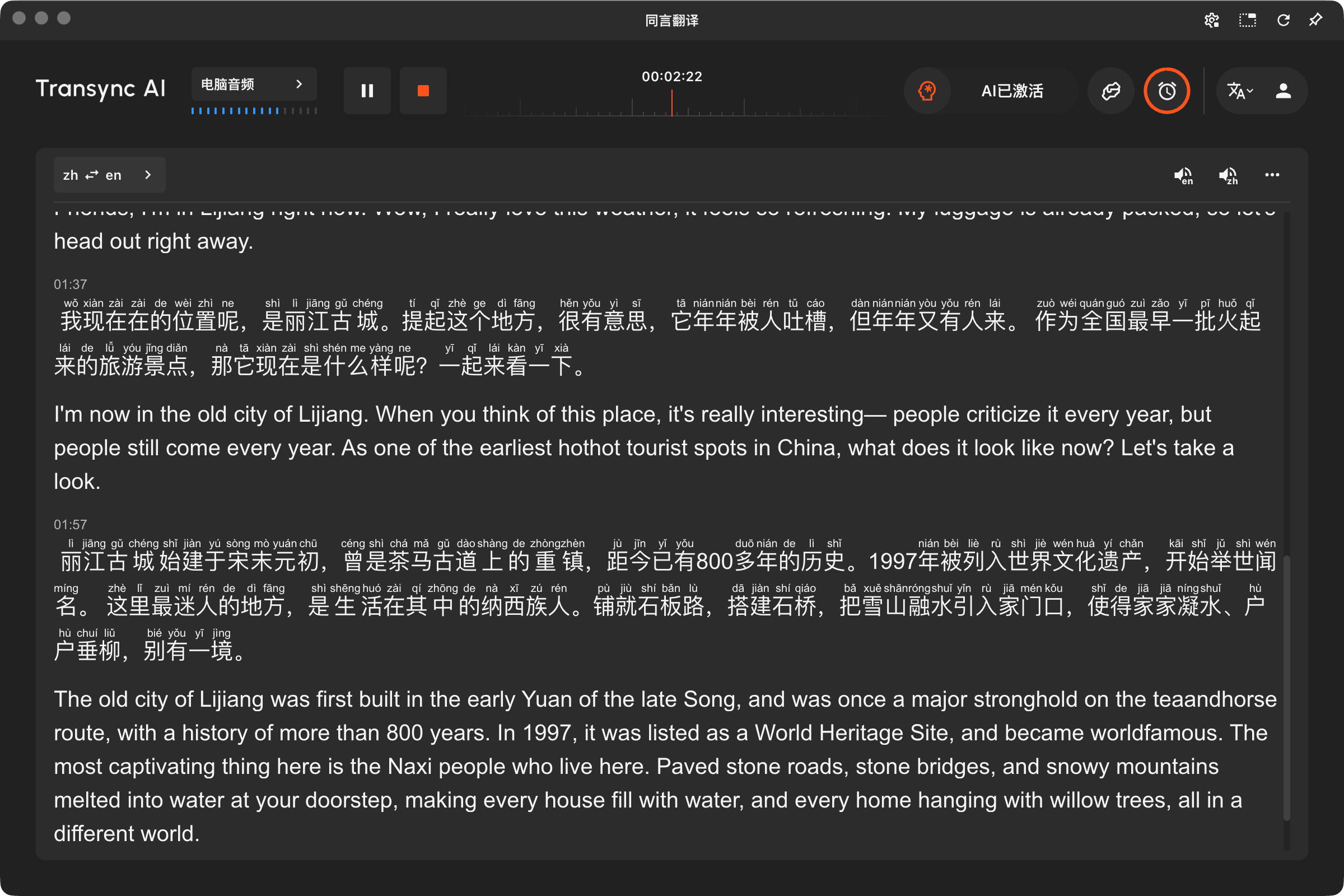 Before a call, hosts can prepare personal names, company names, and domain terms through AI Assistant Keywords and Context. After the conversation, AI meeting notes provide another artifact for checking decisions, names, and quantities.
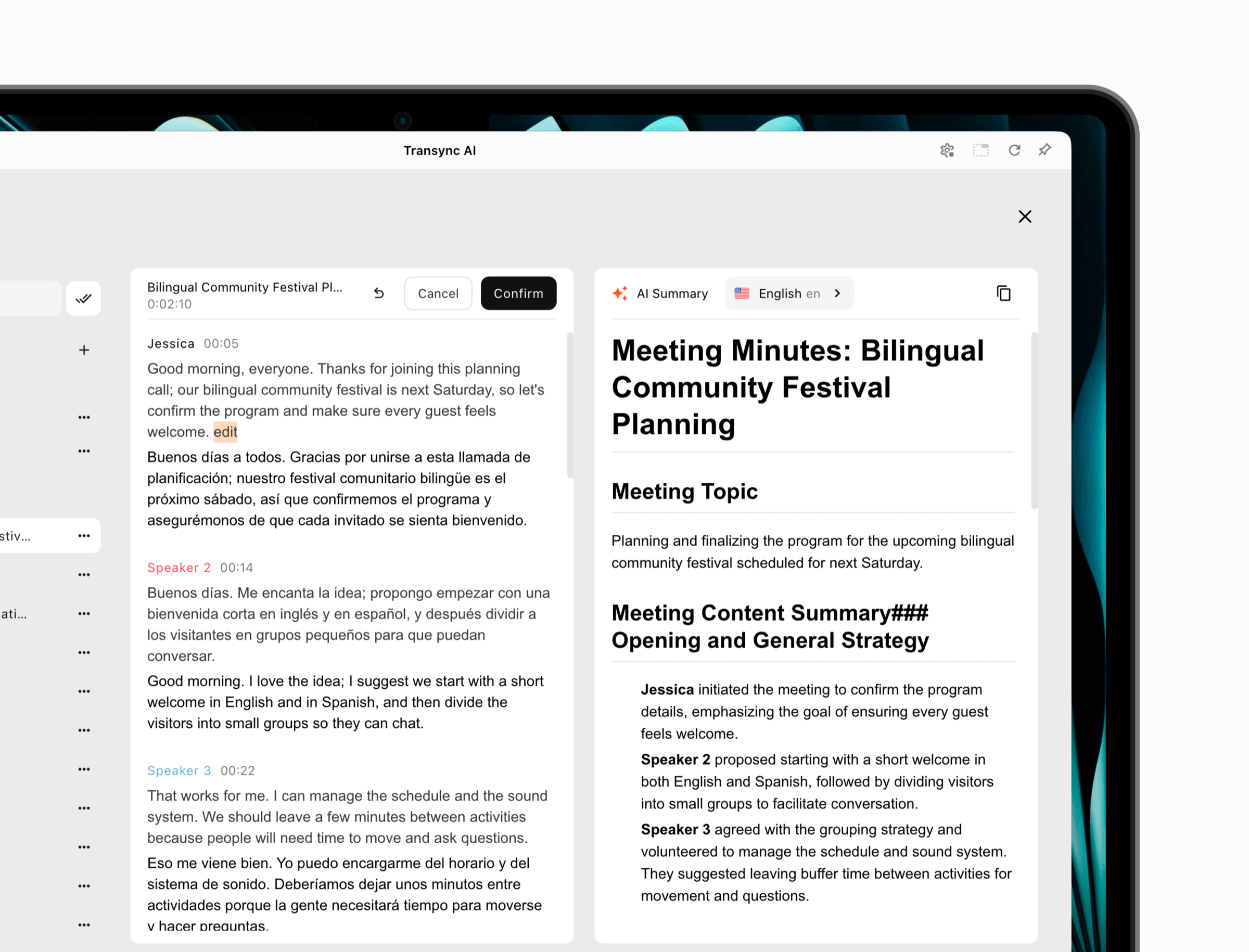
For a class, briefing, webinar, or one-to-many session, Transync AI Presentation Mode lets attendees join by link, QR code, or Room ID and select from languages enabled by the host. They can read or listen on their own devices when voice playback is available.
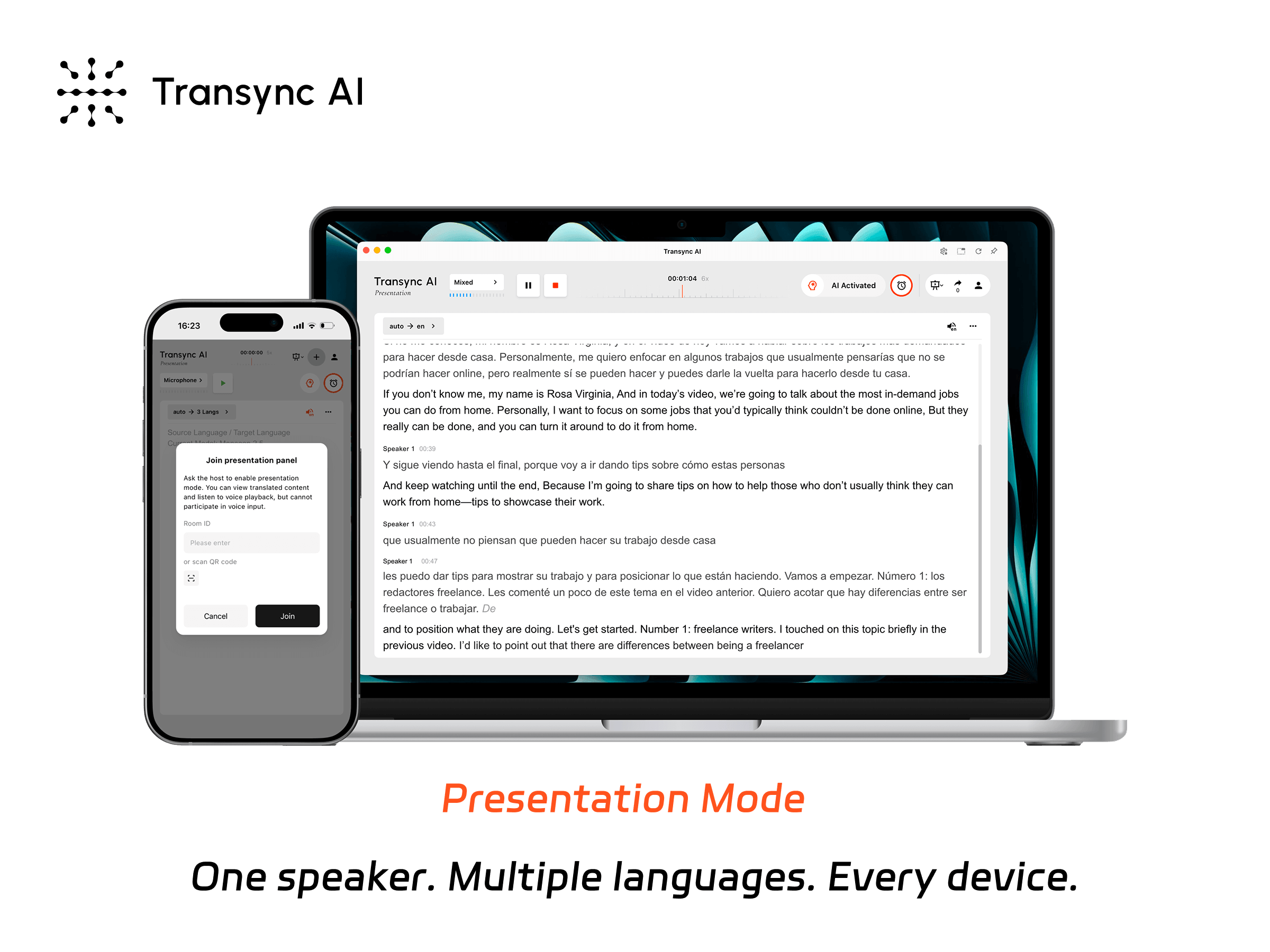
Presentation Mode lets one host share live translation with audience members on their own devices.
Use the free allowance to test the real Chinese-English pair, accent, microphone, room, network, names, numbers, and meeting platform. Transync AI requires a network and is not a pasted-text, arbitrary-file, OCR, or frame-level subtitle editor. Free minutes and plan terms can change, so confirm the current pricing page before relying on an allowance.
The Context Backfill Sheet
Before accepting a translate Chinese into English free result, fill the information that English needs but the Chinese source may not state directly.
| Label | Question | Example Evidence |
|---|---|---|
| Script and region | Which Chinese variety and market produced the source? | Traditional Chinese from a Taiwan customer |
| Actor and object | Who did what to whom? | The supplier sent the revised drawing |
| Time and status | Is the action planned, ongoing, completed, or withdrawn? | Completed yesterday; still valid |
| Pronoun or identity | Who or what does tā refer to? | Manager Li; use their approved English name |
| Names and segmentation | Which strings are names, brands, or protected terms? | Company glossary and email signature |
| Quantity | What is the exact number, unit, currency, and scale? | 3.5万 CNY = CNY 35,000 |
| Tone and intent | Is the sentence a request, suggestion, condition, or commitment? | Polite request, not a command |
Do not invent missing labels simply to make the English smooth. If the information cannot be recovered, flag the ambiguity or ask the source author.
Test the Backfill, Not Only the Sentence
Give a target-English reviewer the translated output and ask seven questions: Which Chinese market? Who acted? When? Who does the pronoun identify? Which terms are names? What exact quantity is involved? How strong is the request or commitment?
If the reviewer’s answers conflict with the source context, record the error by label. This makes correction more useful than a vague accuracy score.
Recheck the Final Destination
For a document, inspect tables, headings, names, and layout. For software, inspect strings inside the interface. For audio, compare the source transcript before judging translation. For a live meeting, confirm that participants understood early enough to respond and that the notes preserve later corrections.
Privacy, Security, and High-Stakes Content
“Free” does not mean anonymous, offline, confidential, or unrestricted. Before entering production content, review the service’s current terms, privacy materials, retention and deletion controls, training policy, processing locations, subprocessors, access controls, and account settings.
Remove unnecessary personal data from test samples. Decide who may upload, edit, export, share, and delete documents, audio, transcripts, translations, and notes. Free consumer access and contracted business services can have different controls.
Use a qualified Chinese-to-English translator or interpreter when errors could materially affect legal rights, healthcare, safety, immigration, employment, finance, compliance, or public reputation. Confirm whether the professional works from Simplified or Traditional Chinese, understands the subject, writes for the intended English market, and can meet any certification requirements.
Frequently Asked Questions
Can I translate Chinese into English free online?
Yes. Free dictionaries and web translators can support word lookup and first-pass understanding, while some products offer limited document functions or live trial minutes. Check account requirements, current limits, data handling, and whether the output needs human review.
What is the best way to translate Chinese into English free?
Use a dictionary such as MDBG or Pleco for characters and readings, DeepL for revisable text or supported-file drafts, and Transync AI when the source is a live meeting. The safest workflow combines the appropriate tool with context and target-language review.
Can I translate Traditional and Simplified Chinese the same way?
They share much of the language, but character forms, vocabulary, market conventions, and regional usage can differ. Identify the source market and script. Do not assume that automatic Chinese detection captures every regional distinction.
Why does Chinese-to-English translation add pronouns?
Chinese can omit a subject or object when context makes it understood, while English usually requires one. The system may therefore add I, we, he, she, they, it, or a passive subject. Check that choice against the source context.
Can free translation handle Chinese names correctly?
It can provide a useful draft, but names may have multiple readings or approved English spellings that are not predictable from characters alone. Verify the person’s preference or the organization’s official bilingual materials.
Can I translate Chinese into English free during a meeting?
Transync AI currently offers 40 real-time translation minutes upon sign-up under its free plan. Test Chinese-English speech, captions, voice playback, terminology, audio routing, and the network before an important meeting. Confirm current pricing and allowance terms when you sign up.
Can I display Pinyin while translating Chinese speech?
Yes. In Transync AI, enable Show Chinese Pinyin and Pinyin will appear above the Chinese characters during translation. This can make a translate Chinese into English free live trial more useful for pronunciation support, character recognition, and checking unfamiliar names. Keep the original Chinese visible because Pinyin alone does not identify every character, tone-dependent meaning, or context-specific reading.
Is free Chinese-to-English translation safe for confidential files?
Do not assume so. Inspect the exact service, plan, privacy terms, retention, deletion, training policy, processing locations, and access controls. Remove unnecessary sensitive data and use an organization-approved route.
When should a human translator review the English?
Use professional review for content that will be published, reused widely, certified, or relied upon for legal, medical, safety, financial, employment, immigration, or regulatory decisions. The reviewer should have the appropriate language direction and subject expertise.
Free Access Works Best With Visible Context
Translate Chinese into English free tools can save time when the task is matched to the product and the reader keeps the missing context visible. A dictionary can explain a character. A web translator can create a draft. A limited live allowance can test a real conversation.
The seven gaps remain: script and market, omitted actors, time and aspect, spoken pronouns, names and segmentation, number systems, and implied tone. None is solved by the price label alone.
Use the Context Backfill Sheet, verify fragile facts in the final destination, and involve a qualified professional when consequences rise. That is how a translate Chinese into English free workflow becomes useful without pretending that correction, privacy, and approval are costless.