

Tradutor English to Spanish mixes Portuguese and English. Learn 7 dangerous false friends, choose the right Spanish variety, and compare useful tools.
Tradutor English to Spanish is a mixed-language search phrase. Tradutor is Portuguese, while standard Spanish uses traductor and English uses translator. The likely intention is simple: translate English into Spanish, possibly from the perspective of someone who already speaks Portuguese.
That Portuguese background can be helpful because Portuguese and Spanish share many roots. It can also create unusually convincing mistakes. A word may look familiar in all three languages while carrying a different meaning in English or Spanish.
This guide treats the query as a three-language border crossing. It first corrects the search phrase, then inspects seven dangerous false friends, regional Spanish choices, voice translation, and the tools that fit dictionary research or live conversation.
The Fast Answer: Which Phrase Should You Use?
| Langue | Natural Phrase | Signification |
|---|---|---|
| Anglais | English to Spanish translator | A person or tool that translates from English into Spanish |
| Espagnol | traductor de inglés a español | A translator from English into Spanish |
| portugais | tradutor de inglês para espanhol | A translator from English into Spanish |
| Mixed search query | tradutor english to spanish | Understandable as a search, but not a complete phrase in one language |
Typing tradutor English to Spanish into a search engine can still produce useful results. In polished writing, however, choose one language and follow its grammar. The Portuguese spelling does not become Spanish merely because the target language is Spanish.
The distinction also changes with service type. A translator normally works with written content. An interpreter handles spoken or signed communication. Consumer products often use “translator” for both, but a formal brief should specify text, documents, recorded audio, or live speech.
Why Portuguese Speakers Face a Special Spanish Trap
Portuguese and Spanish are closely related, so readers can often recognize vocabulary before studying the other language formally. This creates speed, but recognition is not the same as precision.
The most dangerous words are not the obviously different ones. They are familiar-looking words that invite the wrong meaning. Linguists often call them false friends ou false cognates.
For a tradutor English to Spanish workflow, there can be two interference paths:
- the English source resembles a Spanish word but means something else;
- the Portuguese speaker recognizes a Spanish form through Portuguese and assumes the languages use it identically.
The seven checks below expose both paths. The examples use broadly understandable Spanish, but regional and situational differences still matter.
False Friend 1: Actual Is Not Usually Actual
Anglais actual means real, genuine, or existing in fact. Spanish actual normally means current or present-day. Portuguese atual also means current.
| Intended English | Risky Spanish | Better Spanish | Pourquoi |
|---|---|---|---|
| the actual price | el precio actual | el precio real | “Precio actual” normally means the current price |
| the actual reason | la razón actual | la verdadera razón | The intended meaning is the real reason |
| actual results | resultados actuales | resultados reales | “Actuales” points toward current results |
A Portuguese speaker may feel unusually confident about Spanish actual because Portuguese atual is familiar. That confidence reinforces the wrong English-to-Spanish choice.
When using a tradutor English to Spanish tool, test the word inside a complete sentence. “What is the actual price?” and “What is the current price?” should not automatically produce the same target sentence.
The correct alternative depends on context. Real, verdadero, efectivo, exacto, or a rewritten sentence may be better than one fixed replacement.
False Friend 2: Assist Is Not Automatically Asistir
Anglais assist usually means help. Spanish asistir commonly means attend, although asistir a alguien can mean assist or provide care in certain contexts. Portuguese assistir often means watch or attend, with usage varying by construction and region.
Comparer:
- Can you assist the customer? → ¿Puede ayudar al cliente?
- I will attend the meeting. → Asistiré a la reunión.
- She watched the presentation. → Spanish normally needs vio la presentación, not a direct copy of Portuguese assistiu à apresentação.
A weak tradutor English to Spanish result may choose asistir whenever it sees assist. The sentence can remain grammatical while shifting the action from helping someone to attending an event.
Check the participants around the verb. Who is helping whom? Who is attending what? Who is watching what? The answer determines the Spanish verb.
This distinction becomes important in meetings. “Ana assisted the presenter” means Ana helped the presenter; “Ana attended the presentation” means she was present. A meeting summary that confuses those roles creates a false record.
False Friend 3: Embarrassed Is Not Embarazada
Anglais embarrassed usually becomes avergonzado ou avergonzada in Spanish. Spanish enceinte means pregnant. Portuguese embaraçado ou embaraçada can mean embarrassed, awkward, or confused depending on context.
This is a classic three-language trap because the Portuguese form appears to confirm the incorrect Spanish choice.
- I was embarrassed by the mistake. → Me avergoncé por el error.
- She felt embarrassed. → Se sintió avergonzada.
- She is pregnant. → Está embarazada.
Gender and sentence structure can also change the best rendering. Spanish may prefer me dio vergüenza, sentí vergüenza, fue incómodo, or another construction rather than a direct adjective.
The tradutor English to Spanish review should flag emotionally sensitive words even when the first output looks fluent. A mistake here may be funny in a classroom but damaging in healthcare, human resources, or customer support.
False Friend 4: A Library Is Not a Librería
Anglais library means biblioteca in Spanish. Spanish librería means a bookstore or bookshop. Portuguese follows a similar distinction: biblioteca is a library and livraria is a bookstore.
| English Place | Espagnol | portugais |
|---|---|---|
| library | biblioteca | biblioteca |
| bookstore | librería | livraria |
| bookcase or shelving | estantería / librero, depending on region | estante / estante de livros |
The English form creates the trap; Portuguese can actually help resolve it if the speaker remembers the biblioteca / livraria distinction.
A tradutor English to Spanish tool should be tested with more than the isolated word:
- Return the book to the library.
- Buy the book at the bookstore.
- The software library needs an update.
The third sentence is technical. Spanish may use biblioteca de software or another established term for the audience. It does not refer to a physical building. Domain context matters as much as dictionary meaning.
False Friend 5: Pretend Is Not Usually Pretender
Anglais pretend means act as if something is true when it is not. Spanish normally uses fingir or a related expression. Spanish pretender often means intend, seek, aspire to, or claim, depending on context. Portuguese pretender commonly means intend.
Comparer:
- Do not pretend you approved it. → No finjas que lo aprobaste.
- We intend to launch in June. → Pretendemos lanzar en junio. ou Tenemos previsto lanzar en junio.
- The company seeks to expand. → La empresa pretende expandirse.
For Portuguese speakers, pretender already feels like “intend.” The danger appears when the English source uses pretend and visual similarity pulls the Spanish output toward pretender.
In a tradutor English to Spanish test, include both meanings in the same sample. A capable workflow should distinguish “pretend to agree” from “intend to agree.” The first describes an insincere performance; the second describes a plan.
Tone matters too. Pretender can sound formal or carry different shades across regions. A natural business translation may use tener previsto, querer, buscar, ou aspirar a plutôt.
False Friend 6: Exit Is Not Éxito
Anglais exit means sortie in Spanish. Spanish succès means success. Portuguese êxito also means success, although everyday Brazilian Portuguese may prefer sucesso in many contexts.
- Emergency exit → salida de emergencia
- Exit the application → salir de la aplicación or a product-specific command
- The campaign was a success → La campaña fue un éxito
- Exit code → código de salida in computing
Accent marks make Spanish succès visually distinct, but users often omit accents when typing. A search, interface string, or informal message may therefore look even closer to English exit.
The best tradutor English to Spanish workflow does not translate interface labels without knowing the action. Sortie, close, sign out, leave, et cancel may require different Spanish commands. A literal choice can send users to the wrong place or make a safety sign unclear.
Review signage and interface commands in their final environment. A one-word label needs more context, not less.
False Friend 7: Sensible Is Not Usually Sensible
Anglais sensible means reasonable, practical, or showing good judgment. Spanish sensible usually means sensitive or capable of feeling. Portuguese sensível also means sensitive.
Comparer:
- a sensible decision → una decisión sensata
- a sensible person → una persona sensata / prudente
- sensitive information → información sensible
- sensitive skin → piel sensible
The Portuguese association with sensível can again strengthen the wrong English-to-Spanish mapping. The target may be grammatical but describe emotional or physical sensitivity instead of sound judgment.
When evaluating tradutor English to Spanish output, ask the reviewer to paraphrase the adjective. Does the target describe good judgment, emotional responsiveness, physical sensitivity, or confidential classification? Each meaning leads to different Spanish.
This word is especially important in security and privacy content. Sensitive data can be datos sensibles, while a sensible data policy would need language such as una política de datos sensata or a more natural rewrite.
Tradutor English to Spanish False-Friend Summary
| English Source | Tempting but Wrong Spanish | Likely Spanish Direction | Portuguese Clue |
|---|---|---|---|
| actual | actual | real / verdadero | atual means current |
| assist | asistir | ayudar | assistir often means watch or attend |
| embarrassed | enceinte | avergonzado/a | embaraçado/a can mean embarrassed |
| library | librería | biblioteca | livraria means bookstore |
| pretend | pretender | fingir | pretender means intend |
| exit | succès | salida / salir | êxito means success |
| sensible | sensible | sensato/a | sensível means sensitive |
Use this table as an alert list, not as a complete dictionary. Context can activate less common meanings, technical senses, or regional preferences. The safe habit is to inspect the full sentence and its purpose.
Choose the Spanish Audience Before Translating
Spanish is not one uniform target. A tradutor English to Spanish request should identify the country, region, organization, and relationship whenever the content will be published or used professionally.
Spain and Latin America
Common differences include ordenador / computadora, móvil / celular, zumo / jugo, and preferred forms of address. Not every Latin American country uses the same vocabulary, and “neutral Latin American Spanish” is an editorial compromise rather than a language with one official rulebook.
Formality and Pronouns
Decide whether the audience expects tu, usted, vous, vousotros, or regional vos. This choice affects pronouns, verb forms, possessives, and tone throughout the text.
A support message to one customer in Mexico may use usted. A youth campaign in Spain may use tu ou vousotros. An Argentine product may use vos if the brand voice supports it.
Numbers, Dates, and Units
Check decimal separators, thousands separators, day-month order, currency, time format, and measurement units. Do not assume that preserving the digits preserves the meaning.
For a tradutor English to Spanish project, the target locale should be part of the brief rather than a setting chosen at the final export.
Which Tool Fits the Job?
| Produit ou itinéraire | Utilisation optimale | Useful Evidence | Principale limitation |
|---|---|---|---|
| WordReference | Investigating a word, phrase, or specialized term | Multiple dictionary entries and context-rich forum discussions | Not an end-to-end document or live-meeting workflow |
| SpanishDictionary.com | Learning meanings, examples, conjugation, and pronunciation | Definitions, example sentences, conjugations, and audio/pronunciation guidance | Educational lookup does not approve professional deliverables |
| Transync AI | Live English-Spanish meetings, conversations, and presentations | Bilingual captions, translated voice, prepared terminology, and meeting notes | Nécessite une connexion réseau et n'est pas un éditeur de documents ou de sous-titres. |
| Qualified language professional | Publication, legal, medical, safety, or other consequential work | Specialist judgment, queries, revision, and accountable approval | Requires the right language direction, expertise, time, and budget |
The best choice depends on whether the reader needs to investigate one false friend, learn Spanish, participate in a conversation, or publish an approved translation.
WordReference for Contextual Word Research
WordReference provides Spanish-English dictionaries and extensive language forums. Dictionary entries can reveal several meanings, while existing forum discussions often show why a phrase changes with sentence context, dialect, or subject area.
Cela fait WordReference useful when a tradutor English to Spanish result looks suspicious. Search the core form, inspect several senses, and read only discussions that match the intended context. A forum answer about legal Spanish should not automatically govern a casual marketing sentence.
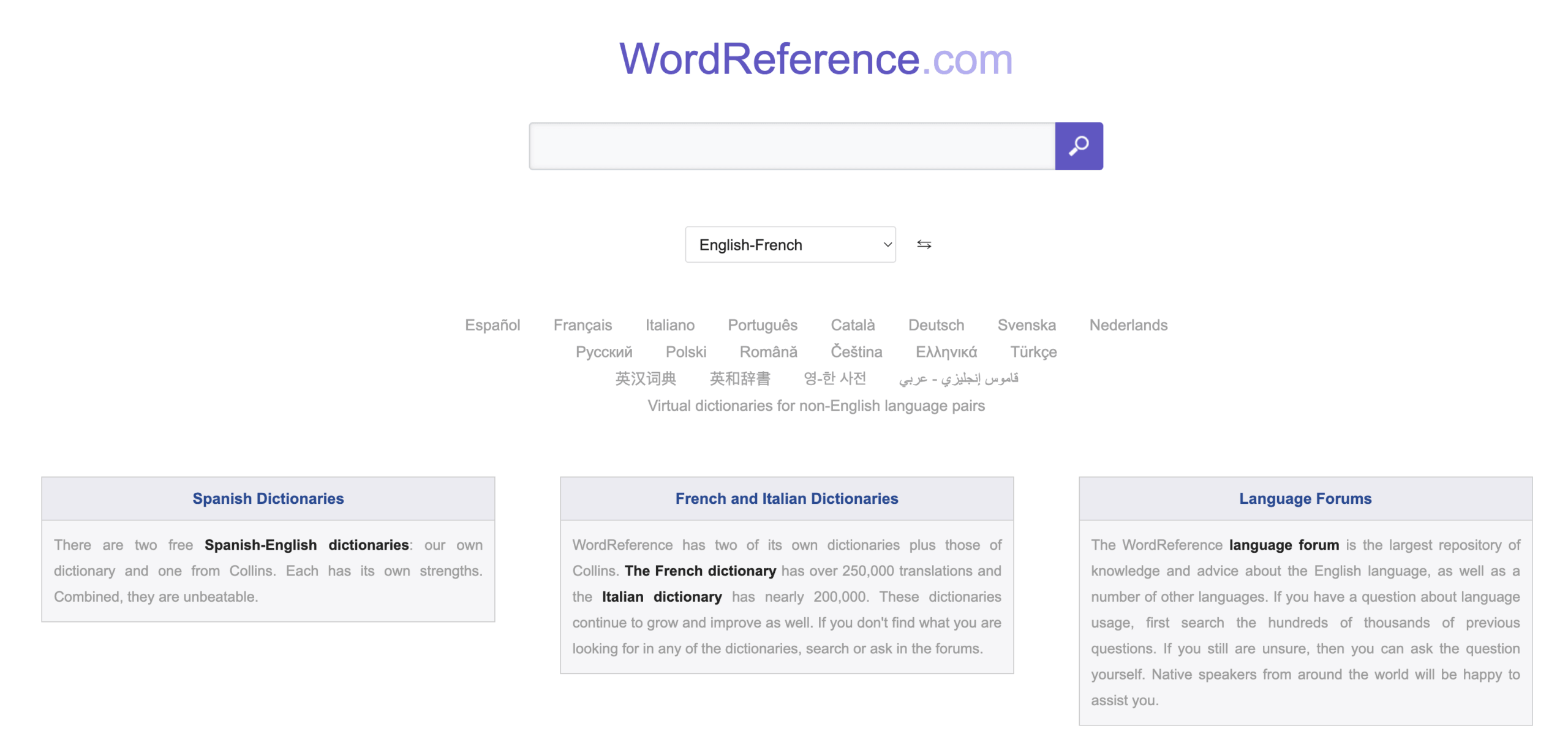
WordReference is a research aid, not an automatic approval system. Forum contributions vary, older discussions may not reflect current usage, and the final choice still belongs to a competent writer or reviewer.
SpanishDictionary.com for Learning and Pronunciation
SpanishDictionary.com combines English-Spanish dictionary entries with examples, conjugations, pronunciation information, and learning resources. It is helpful when the user needs to understand why asistir, fingir, ou sensato behaves differently in a complete sentence.
For a tradutor English to Spanish learner, the ability to inspect verb forms and hear pronunciation is valuable. A dictionary answer can become a short lesson instead of a word substitution.

SpanishDictionary.com does not remove the need to choose a target region, check specialist terminology, or obtain professional review for consequential content. Example sentences explain usage; they do not certify that an entire document is ready to publish.
Transync AI for Live English-Spanish Communication
Transync AI est conçu pour traduction de réunion en direct Lors d'appels en ligne et de conversations en face à face, il propose des sous-titres bilingues. Traducteur vocal IA can play translated speech. Hosts can prepare names, brand terms, and difficult vocabulary through Mots-clés et contexte de l'assistant IA et avis Notes de réunion sur l'IA après la séance.
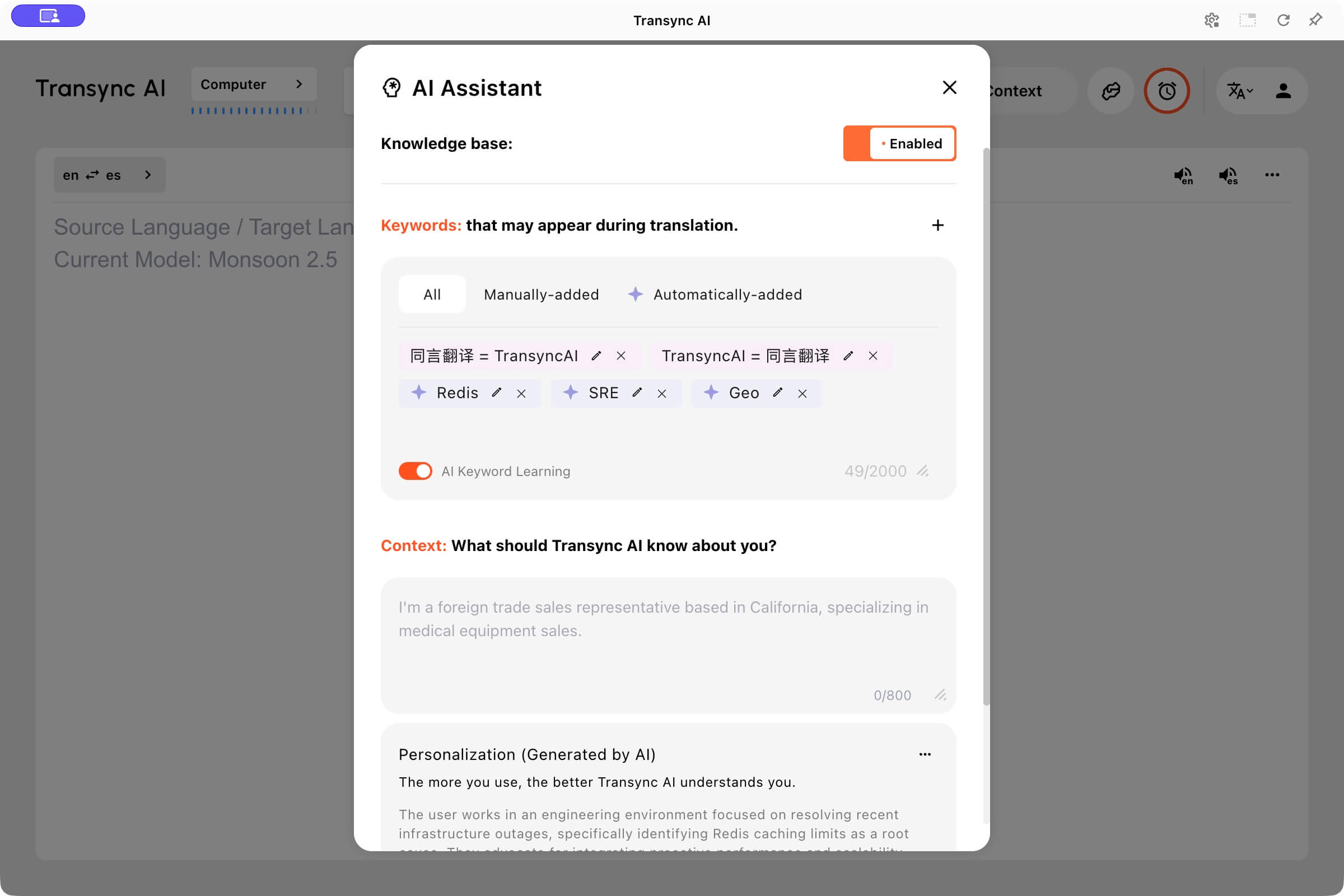 This route fits a tradutor English to Spanish need when people must listen and respond during a meeting rather than translate one isolated word. Bilingual captions help participants compare the source with the Spanish output, and the speaker can clarify a false friend before the conversation moves on.
Essayez Transync AI gratuitement
For a class, webinar, training session, or company presentation, Transync AI Mode de présentation lets audience members join by link, QR code, or Room ID. Each person can choose from the languages enabled by the host and read or listen on a personal device when voice playback is available.
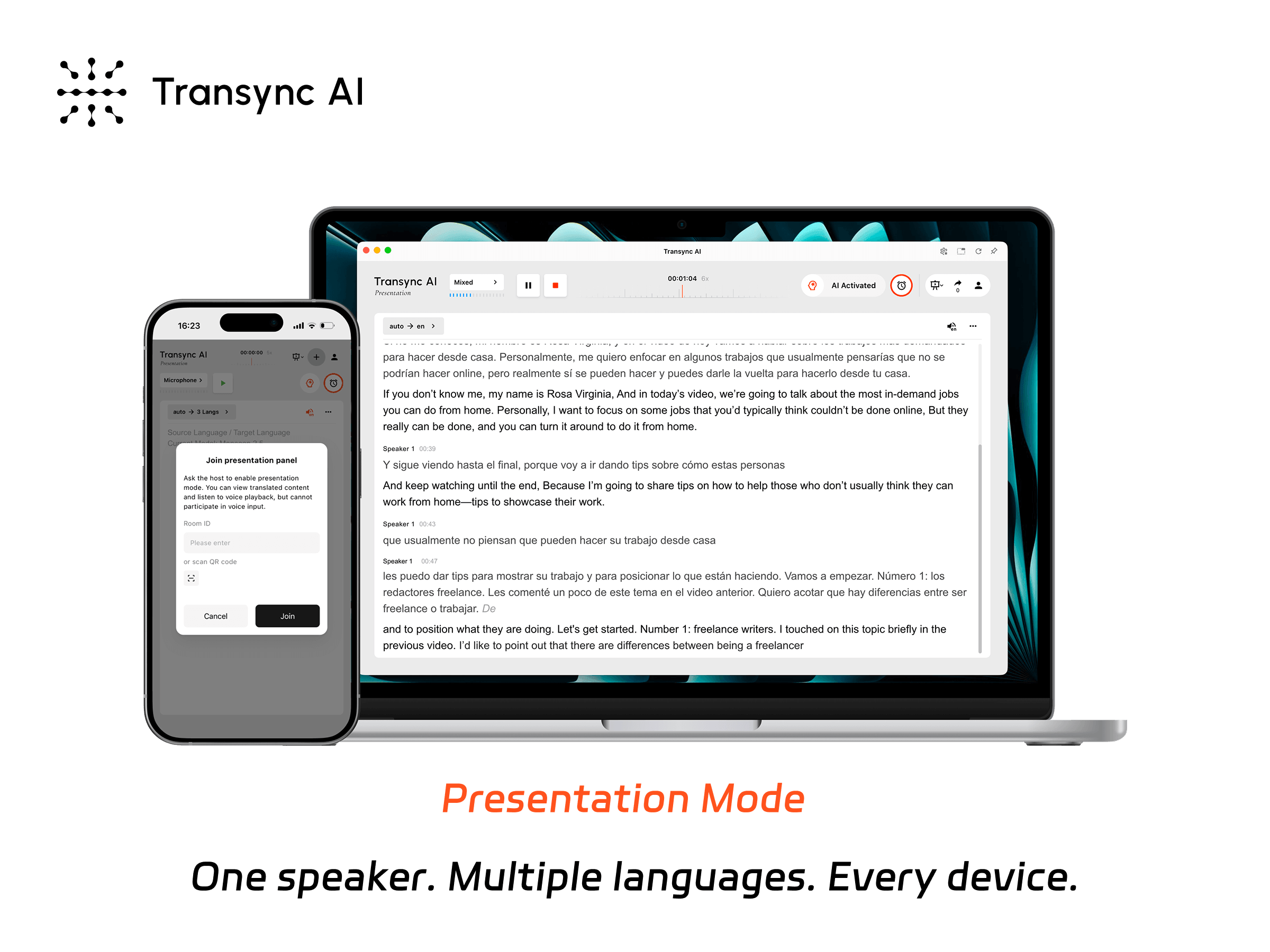
Le mode Présentation permet à un animateur de partager une traduction en direct avec les membres du public sur leurs propres appareils.
Transync AI requires a network and is not designed for arbitrary document translation, offline use, or frame-level subtitle post-production. Test the real English-Spanish pair, microphone, accent, terminology, room, and network before an important event.
The Three-Stamp Review
Before accepting a tradutor English to Spanish output, give every important term one of three stamps.
Green: Meaning Is Stable
The target meaning is clear from context, terminology is approved, and a competent reviewer sees no material regional or grammatical problem. Green does not mean “looks similar”; it means the intended action or fact survived.
Amber: Familiar Form, Unproven Meaning
The source and Spanish look similar, or Portuguese familiarity makes the choice feel obvious, but the sentence has not been checked in context. The seven false friends in this article begin as amber.
Resolve amber terms through dictionaries, parallel examples, a glossary, subject references, or a language professional. Record the approved choice so the same question does not recur.
Red: Meaning or Consequence Changed
The target changes a person’s role, physical condition, location, intention, instruction, deadline, amount, or level of certainty. Red items must be corrected before use. If the content is live, the speaker should clarify the point immediately and the record should reflect the correction.
The stamp system separates stylistic preference from meaning risk. A slightly awkward but accurate sentence may be amber for editing; enceinte for “embarrassed” is red.
A Practical Three-Language Test Card
Create a small card for each risky expression:
| Champ | Exemple |
|---|---|
| Source anglaise | We need the actual price before we assist the client. |
| Intended meaning | We need the real price before we help the client. |
| Portuguese association to resist | preço atual; assistir |
| Approved Spanish | Necesitamos el precio real antes de ayudar al cliente. |
| Target region and tone | Mexico; formal customer support |
| Risk if wrong | Current price replaces real price; attendance replaces help |
| Critique | Named Spanish-language reviewer |
Run the same card through the real medium. For writing, inspect the complete paragraph. For speech, read it naturally and listen for recognition errors. For a meeting, let a Spanish-speaking participant respond only from the translated output. If the response assumes the wrong action, the workflow failed even if the sentence sounded polished.
A collection of approved cards can become a glossary for future tradutor English to Spanish work. Include false friends, product names, titles, abbreviations, and regional preferences.
Privacy and Human Review
Before pasting documents or sending meeting audio to any online service, review its current terms, privacy materials, retention controls, model-training policy, processing locations, subprocessors, access controls, and deletion process. Free public tools and contracted business plans may handle data differently.
Remove unnecessary personal or confidential information from test samples. Decide who may upload, review, share, export, and delete the source and target. For voice workflows, account for recordings, transcripts, generated audio, meeting notes, and any cloned-voice data separately.
Use a qualified English-to-Spanish translator or interpreter when errors could materially affect healthcare, legal rights, safety, immigration, employment, finance, compliance, or public reputation. A bilingual colleague can provide useful feedback, but bilingual ability alone does not establish professional translation competence in a specialized field.
Foire aux questions
Is “tradutor” Spanish or Portuguese?
Tradutor is Portuguese. The standard Spanish noun is traductor, while English uses translator. Tradutor English to Spanish is understandable as a mixed search query, but polished Spanish would use traductor de inglés a español.
What does tradutor English to Spanish mean?
It normally means an English-to-Spanish translator or a request to translate English into Spanish. The Portuguese spelling suggests that the searcher may speak Portuguese, which makes Spanish-Portuguese similarities and false friends especially relevant.
What is the best tradutor English to Spanish for individual words?
WordReference is useful for comparing dictionary senses and context discussions. SpanishDictionary.com adds examples, conjugation, and pronunciation support. Always place the word in a complete sentence before choosing a translation.
Can Portuguese speakers understand Spanish automatically?
Portuguese knowledge can accelerate reading, but similarity does not guarantee the same meaning, pronunciation, grammar, or social usage. False friends such as actual, asistir, enceinte, et sensible can create confident mistakes.
Which Spanish variety should a translator use?
Use the variety expected by the intended audience. Specify the country or market, formality level, pronouns, vocabulary, number and date conventions, and brand voice. “Neutral Spanish” may be useful for broad communication, but it does not eliminate regional preferences.
Can a tradutor English to Spanish handle live meetings?
Transync AI is designed for live meetings and conversations with bilingual captions and translated voice. Test the actual audio route, accent, room, network, and terminology. High-stakes meetings may still require a qualified human interpreter.
Can one translator handle text, documents, voice, and video equally well?
Not necessarily. Dictionary research, document translation, live interpretation, and video dubbing require different evidence and editing controls. Choose the workflow based on the source, recipient, timing, and consequence of error.
When should a human Spanish translator review the result?
Use human review when content will be published, distributed widely, used repeatedly, or relied upon for legal, medical, safety, financial, employment, immigration, or compliance decisions. The reviewer should have the appropriate language direction and subject expertise.
Cross the Language Border With Context
Tradutor English to Spanish begins as a mixed Portuguese-English query, but it points to a genuine translation need. The safest response is not to mock the wording or replace words mechanically. It is to identify the source, Spanish audience, medium, and consequence of error.
Portuguese can provide a valuable bridge to Spanish. It can also make false friends look trustworthy. Check actual, assist, embarrassed, library, pretend, exit, and sensible in complete sentences; then verify the result in the final document, interface, conversation, or presentation.
With context, regional choices, and a three-stamp review, a tradutor English to Spanish workflow becomes more than a search box. It becomes a reliable path from intended English meaning to usable Spanish.