

A foreign language converter can handle text, speech, files, or meetings—but 7 dangerous assumptions can ruin accuracy, privacy, and delivery.
A foreign language converter does not convert language as neatly as software converts a PNG into a JPG. It tries to preserve meaning while words, grammar, tone, sound, timing, and cultural expectations change around it. The result may be useful, but it is never proof that every important detail survived.
That distinction matters because people use the same search phrase for very different jobs. One person wants to understand a Korean menu. Another needs an English version of a PDF. A media team wants translated subtitles from an interview. A project manager needs colleagues to respond during a multilingual call. Those tasks do not belong to one universal Convert button.
The fastest way to choose a foreign language converter is therefore to challenge seven assumptions before choosing a product. The right answer depends on what enters the system, what must come out, when the result becomes useful, and who can correct it.
A useful foreign language converter should make that complete path easier to understand rather than disguise it behind a single button.
The Seven Dangerous Assumptions at a Glance
| Assumption | What Actually Happens | Evidence to Demand |
|---|---|---|
| 1. One click performs one simple conversion | Images need OCR; speech needs transcription; files need layout handling | Show every intermediate layer that can be reviewed |
| 2. Fluent output is faithful output | Polished language can hide a changed number, name, or negative | Test fragile facts separately from style |
| 3. A language label defines the audience | Dialect, script, register, and regional terms still vary | Confirm the exact language pair and target market |
| 4. Text, recordings, and live speech are interchangeable | Each input creates a different workflow and correction window | Match the product to the real source |
| 5. A Listen button creates reusable translated audio | Playback rights and export options vary by service | Check permitted use and deliverable format |
| 6. Online means private—or offline means effortless | Data paths, retention, downloads, and local models differ | Review the exact product, plan, and deployment |
| 7. The longest language list wins | Coverage does not guarantee equal quality or feature support | Test the required pair with real content |
These assumptions are more useful than a generic accuracy claim. A foreign language converter should be evaluated as a chain of transformations, not as a magic box with two language menus.
Assumption 1: “Convert” Is One Simple Action
Typed text can travel directly into machine translation. A photograph must first be examined by optical character recognition. Speech must be recognized as source-language text. A recording may need speakers and timestamps. A document may contain tables, headers, images, footnotes, and reading order. A live meeting adds microphones, computer audio, network delay, and participant access.
The word “convert” hides those intermediate stages. Consider four examples:
- Photo: image → detected characters → source text → translated text → reconstructed image or copied result.
- Enregistrement: audio → source transcript → translated transcript → subtitle file or synthesized voice.
- Document: file structure → extracted content → translation → reconstructed layout → human review.
- Meeting: live audio → speech recognition → translation → captions or voice → participant response → saved record.
Every arrow can introduce an error. If the OCR reads “5 mg” as “50 mg,” a perfect translation engine will preserve the wrong number. If speech recognition hears “can” instead of “can’t,” natural target-language audio can make the mistake sound more convincing.
Before using a foreign language converter, identify the first machine-readable layer. Ask whether you can inspect and correct it before the result moves downstream. Visibility is especially valuable for recordings, documents, and content that will be published more than once.
In other words, the foreign language converter must be tested from the raw source to the final recipient, not only at the translation box in the middle.
Assumption 2: Fluent Output Must Be Accurate
Readers often trust a sentence because it sounds confident. Yet fluency and fidelity are different qualities. A translation can be elegant while changing who performed an action, removing a condition, softening a refusal, or turning an estimate into a promise.
Create a short “fragile facts” packet before judging any product:
On 14 November, Dr. Mina Park said we cannot ship 15 units to Porto before PO-8472 is approved. The estimate is €5,050, excluding tax.
This sentence includes a date, a name, a negative, a quantity, a place, an identifier, a dependency, a currency amount, and a tax condition. Translate it into the target language and ask a bilingual reviewer to mark each fact separately. Only after those facts pass should the reviewer judge tone and naturalness.
A responsible foreign language converter trial should also include an ambiguous pronoun, an idiom, a product term, and a sentence whose formal or informal register matters. A polished demonstration with generic travel phrases tells you almost nothing about these failure points.
For legal, medical, immigration, safety, or high-value contractual language, use a qualified human professional. Automated output can support preparation or a first draft, but it should not quietly become the controlling version.
Assumption 3: “Spanish,” “Chinese,” or “Portuguese” Defines the Job
A language name is only the beginning of a specification. Portuguese used in Brazil may differ from Portuguese used in Portugal. Chinese may require a particular spoken variety and either simplified or traditional writing. Spanish terminology and preferred formality vary across regions and industries.
Even when a foreign language converter supports the label shown in the menu, verify:
- the source and target variants;
- the intended country or community;
- formal, neutral, or informal address;
- script and writing conventions;
- names and transliteration rules;
- measurement, date, and number formats;
- approved company or industry terminology.
Do not choose Automatic language detection when the source is short, mixed-language, or easily confused. A product name, airport code, or two-word message may not provide enough evidence. Select the source language manually when the conversation or document stays in one language.
For recurring business use, prepare ten to twenty approved terms. A glossary or context feature can improve consistency, but it still needs testing with grammatical changes and full sentences. Replacing isolated words mechanically can create awkward or incorrect language.
Assumption 4: Text, Files, Recordings, and Meetings Are the Same Job
The difference is not cosmetic. Each input has its own clock and deliverable.
| Source | When the Result Is Needed | Useful Output | Candidat solide |
|---|---|---|---|
| Typed text, signs, or images | Immediately, usually for personal understanding | Translated text and optional playback | Papago |
| Sensitive text, voice, or files on a computer | During individual work, sometimes without internet | Local translation and editable files | Lingvanex |
| Recorded interview, podcast, or video | Before editing or publication | Reviewable transcript, translation, and timed subtitles | Sonix |
| Live meeting or presentation | While people are speaking | Bilingual captions, translated voice, participant access, and notes | Transync AI |
This is the article’s central answer: a foreign language converter should be selected by source and deadline before language count or visual design. The product that handles a screenshot well may not accept an uploaded interview. The product that translates a recording after ten minutes may still be unsuitable for a negotiation in progress.
Route 1 : Papago for Quick Multimodal Understanding
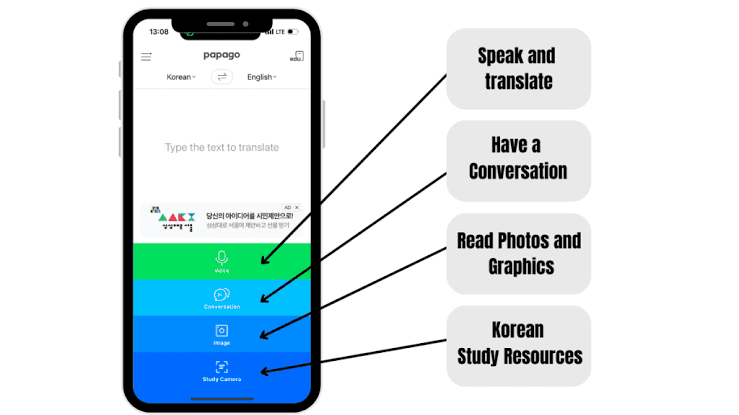
Papago offers text, image, document, voice, and website modes in its current web experience, with availability varying by feature and language pair. Its language menu gives particular visibility to Korean, English, Japanese, and Chinese alongside several other languages. That makes it a practical candidate for travel, study, short messages, and everyday work involving prominent Asian language pairs.
Utiliser Papago when the goal is immediate comprehension rather than a managed publishing process. Test text and image modes separately: an accurate text translation does not prove that a photograph with glare, vertical writing, or decorative fonts will be recognized correctly.
Read the current terms before reusing generated audio or entering sensitive material. The web interface currently provides specific notices about translation data and restrictions around text-to-speech output. A Listen control is not automatically a license to publish the voice in a course, advertisement, broadcast, or commercial video.
Meilleure adéquation : quick text, signs, images, study, and everyday comprehension.
Boundary: feature and language availability vary, and consumer output still requires review before consequential reuse.
Route 2 : Lingvanex for Desktop and Offline-Controlled Work
Lingvanex positions its desktop software around offline translation of text, voice, and files. Its official product page currently describes downloadable language packs, support for common document formats, image translation, and operation without an internet connection.
Cela rend Lingvanex relevant when a user needs more control over the data path or expects to work with limited connectivity. “Offline,” however, does not mean zero setup. The correct application and language resources must be installed before the network disappears. Device storage, operating-system support, model availability, updates, and file limits should be checked in advance.
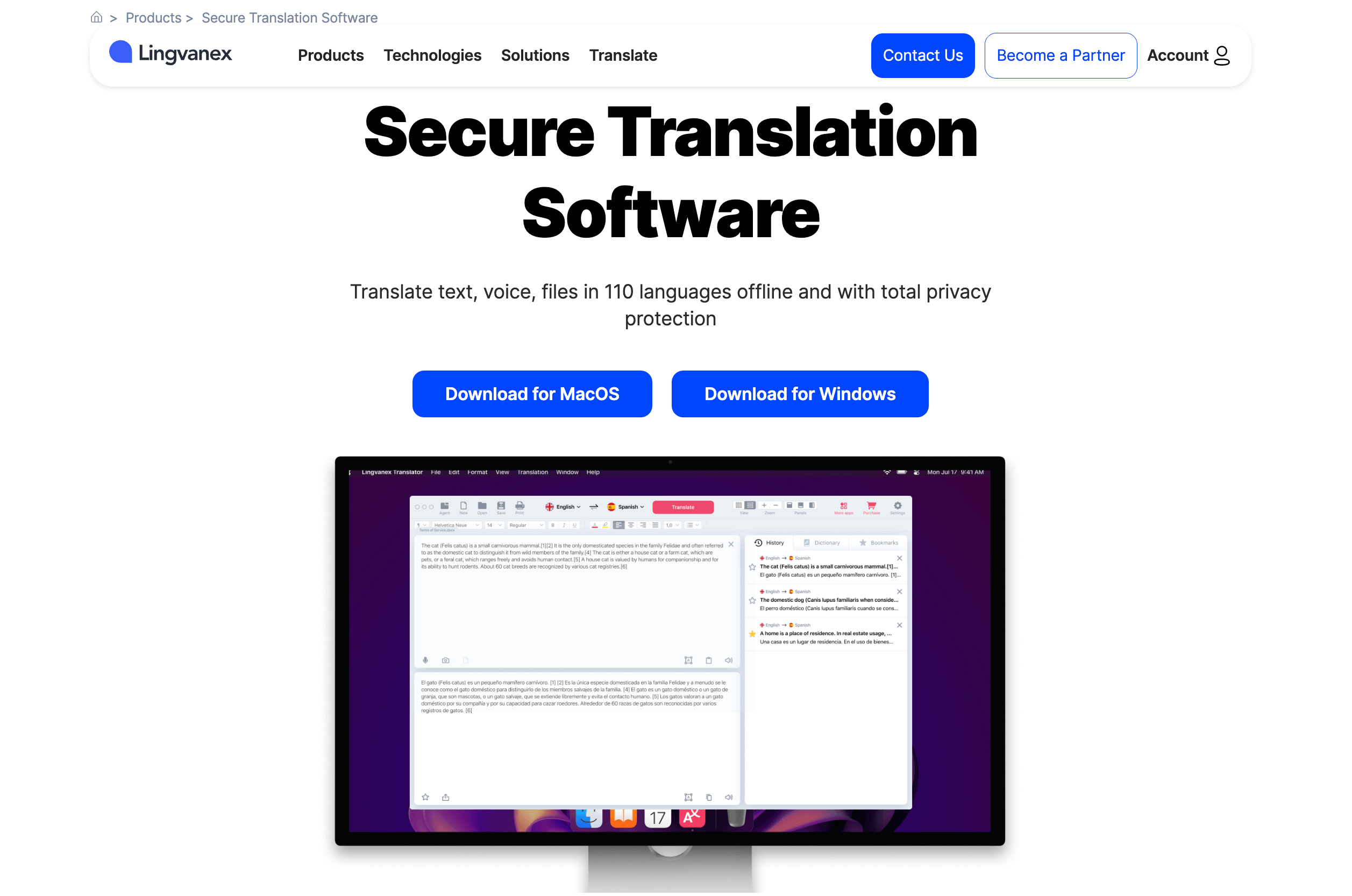
Run a real document through Lingvanex, not only pasted text. Inspect tables, headings, links, image text, page flow, and terminology. Local processing may address one privacy requirement, but the organization must still manage access to the device, backups, exported files, and reviewer copies.
Meilleure adéquation : desktop translation, selected offline scenarios, and files that need local handling.
Boundary: confirm the exact operating system, language packs, formats, and offline behavior before travel or deployment.
Route 3 : Sonix for Recorded Audio and Video
Sonix treats audio translation as a visible two-stage process: it transcribes a recording in the source language and then translates that transcript. The source and translated versions can be reviewed side by side, while timestamps support subtitle exports such as SRT and VTT.
That intermediate transcript is the important feature. Before translating an interview into several languages, a reviewer can correct a name, acronym, quantity, or misheard negative once in the source. The corrected transcript then becomes a stronger base for downstream translation.
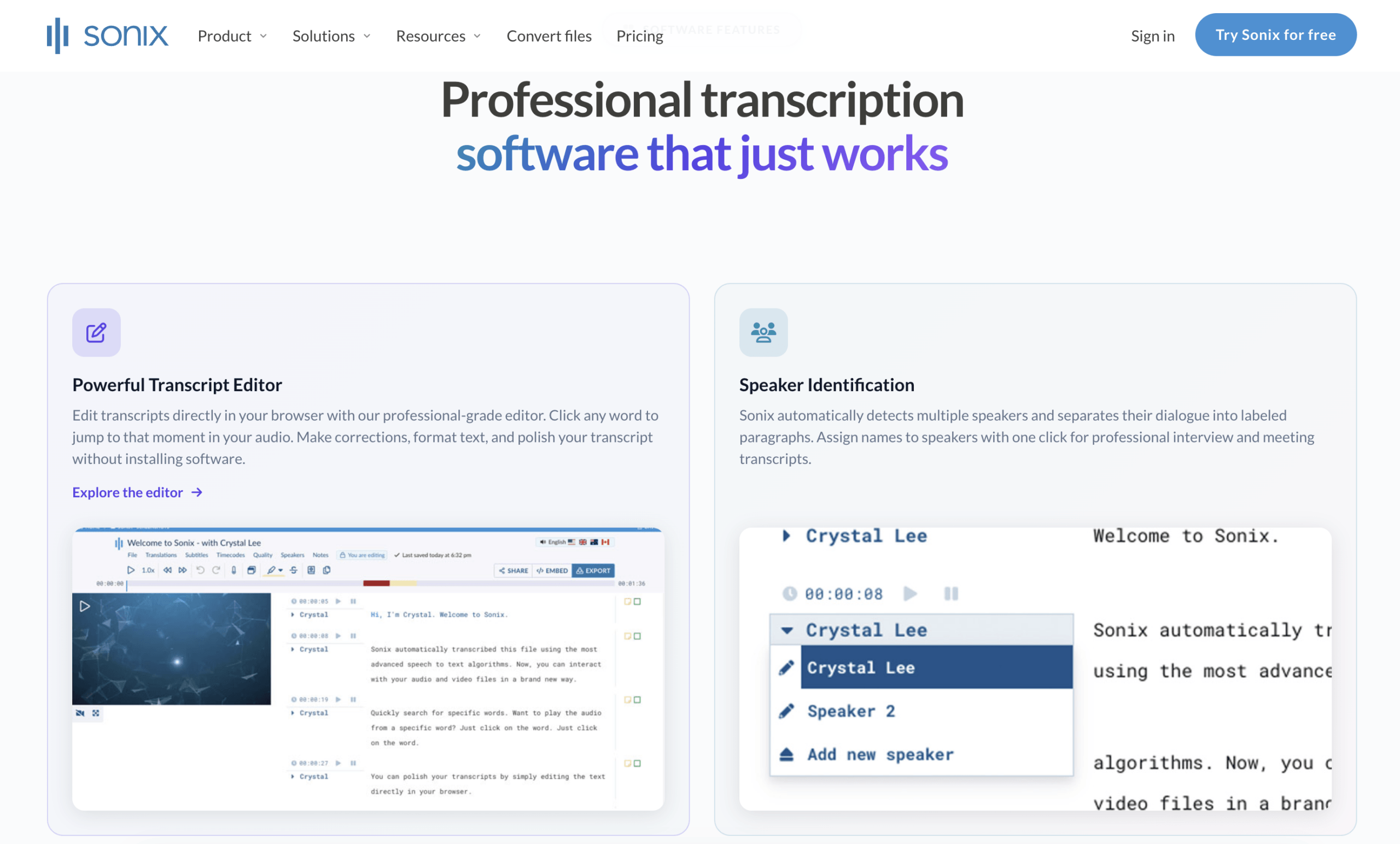
Test Sonix with the hardest representative minute: overlapping speech, background music, a proper name, a technical term, a number, and a sentence crossing a scene change. Review the transcript before the translation. If the source text is wrong, the target text may reproduce the mistake perfectly.
Meilleure adéquation : interviews, podcasts, training recordings, video transcripts, and translated subtitles.
Boundary: this is a file-first review workflow, not a substitute for low-delay, two-way meeting translation.
Route 4 : Transync AI for Speech That Is Happening Now
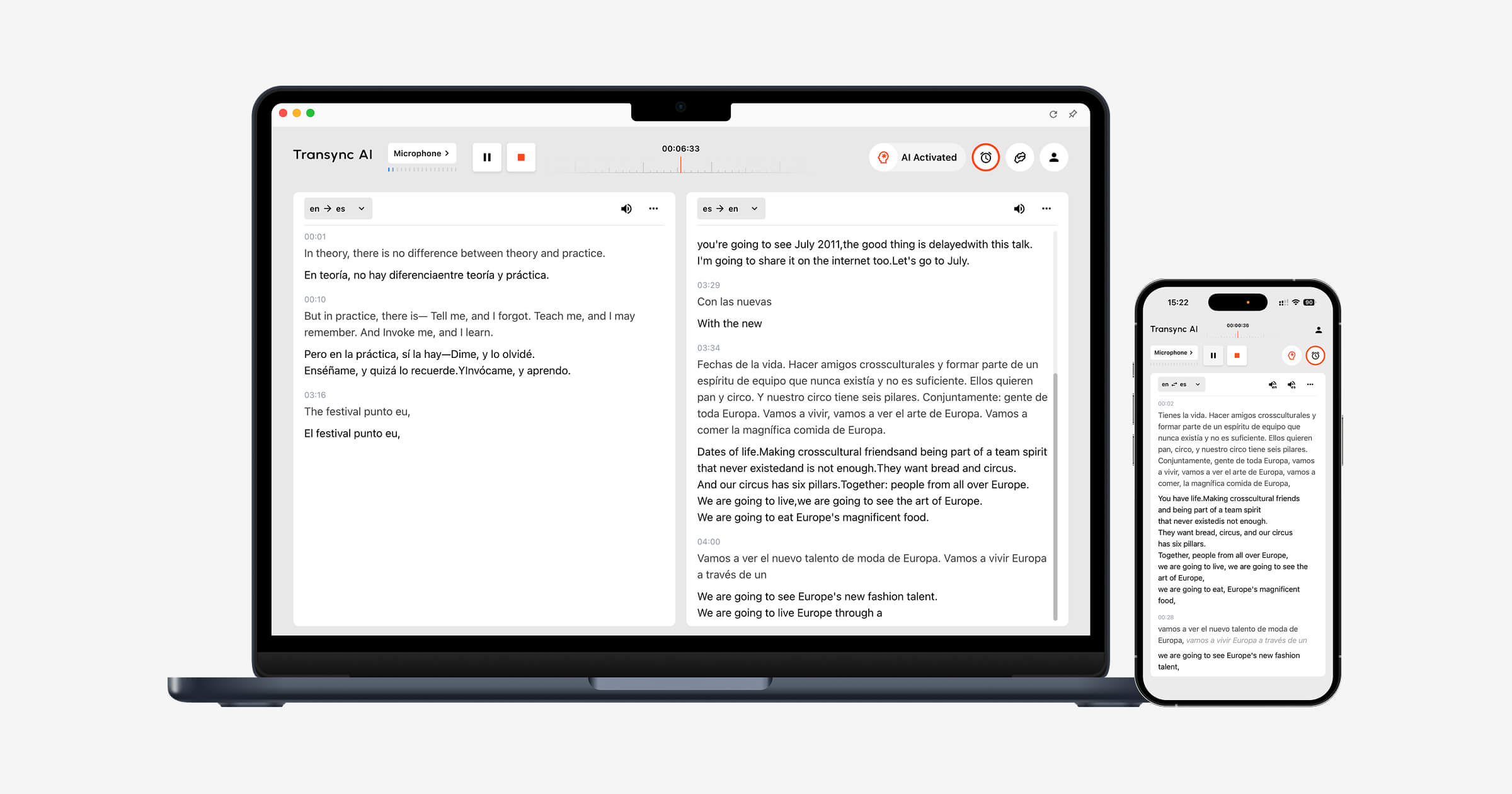
Transync AI is built around traduction en temps réel for meetings, calls, and in-person conversations. Users can follow bilingual captions and, where supported, hear output through the Traducteur vocal IA. Teams can provide names and specialized terms through Contexte des mots-clés de l'assistant IA and review Notes de réunion sur l'IA après la conversation.
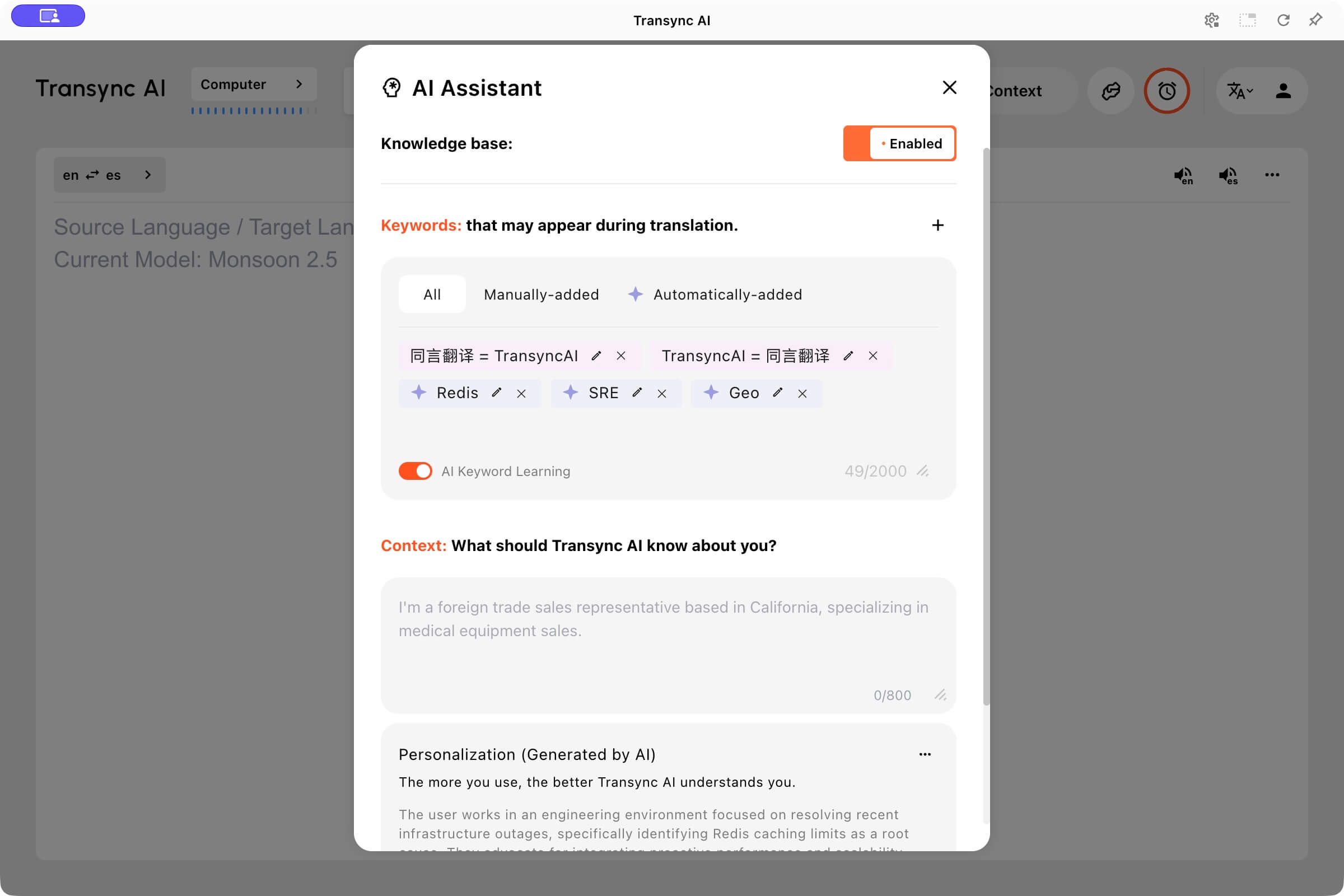 This route is useful when the translation must arrive early enough for someone to respond. The success measure is not only the final sentence. It includes audio capture, delay, speaker changes, visible correction, participant comprehension, and the record available afterward.
Essayez Transync AI gratuitement
For a lecture, webinar, town hall, or product demonstration, Transync AI Mode de présentation lets a host share an active link, QR code, or Room ID. Audience members can choose from languages enabled by the host and follow translated text, with voice playback when available, on their own devices.
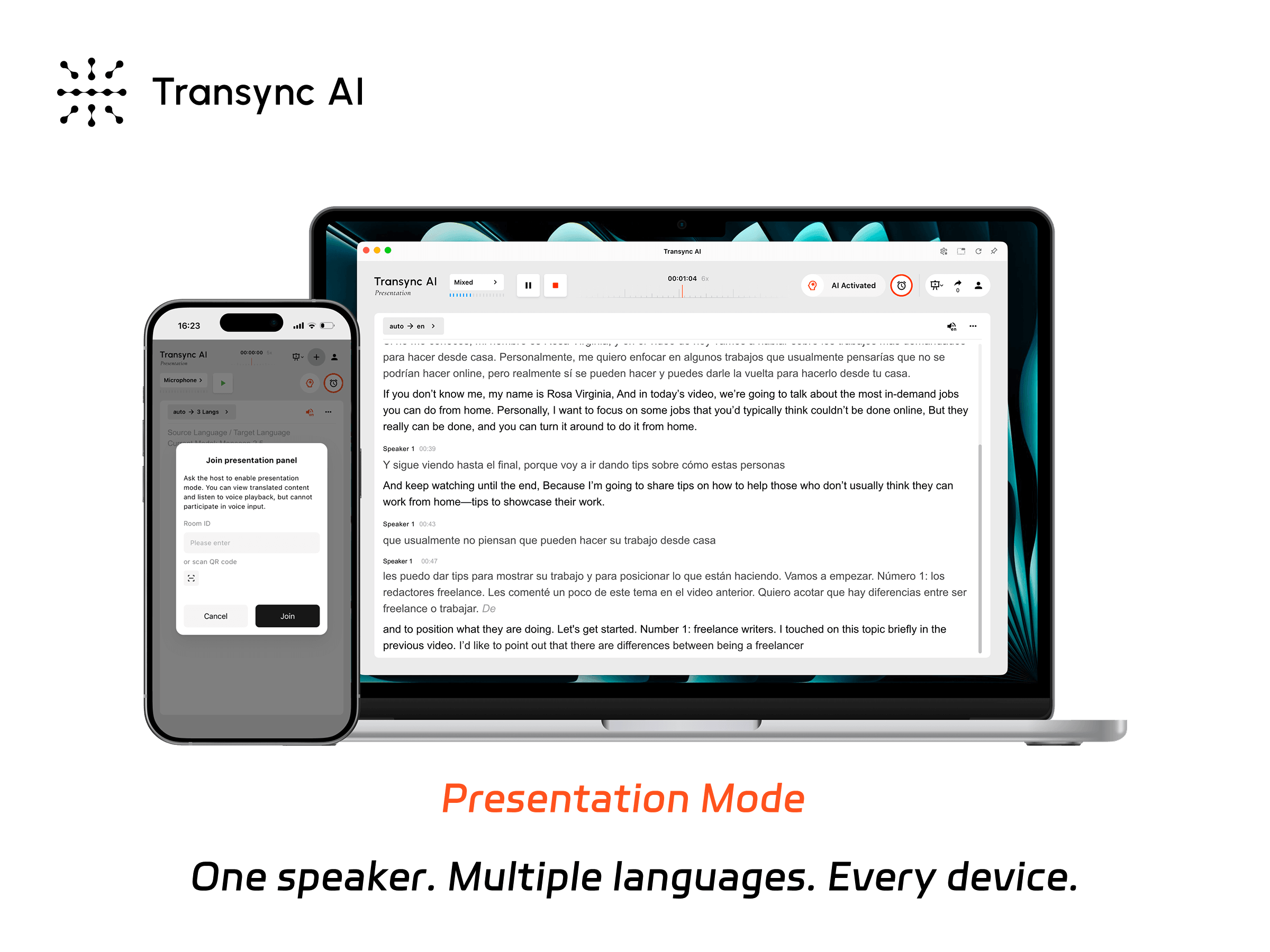
Le mode Présentation permet à un animateur de partager une traduction en direct avec les membres du public sur leurs propres appareils.
Meilleure adéquation : recurring multilingual meetings, remote calls, live classes, webinars, and one-to-many presentations.
Boundary: Transync AI requires a network connection and is not a general tool for uploading finished audio, translating arbitrary documents, or editing frame-accurate subtitles.
Assumption 5: A Listen Button Creates a Reusable Voice Asset
Text-to-speech can help a traveler pronounce a phrase or help a meeting participant listen without reading constantly. It does not follow that the resulting audio can be downloaded, edited, redistributed, sold, placed in a video, or used to imitate another person.
When a foreign language converter speaks, check four separate questions:
- Is playback available for the exact target language?
- Can the audio be exported, or only heard inside the product?
- What uses are permitted by the current terms and plan?
- If voice cloning is involved, did the speaker authorize it?
Do not use natural-sounding voice as an accuracy check. A synthesized speaker will confidently read a wrong translation. Verify the target text first, then judge pronunciation, pacing, emotional fit, and listening comfort.
For public dubbing, use a media workflow with explicit export and usage terms. For a live meeting, prioritize understandable playback, headphones, echo prevention, and the participant’s ability to read the corresponding caption.
The safest foreign language converter voice workflow keeps the translated text visible and verifies permission before the audio is reused.
Assumption 6: Online Means Private—or Offline Means Effortless
A browser padlock protects data in transit; it does not by itself explain retention, model training, subprocessors, administrator access, account controls, regional processing, or deletion. Likewise, an offline application may avoid cloud transfer while still leaving sensitive exports, caches, backups, and screen captures on a device.
Before entering confidential content into a foreign language converter, document:
- what data is collected;
- whether content is retained or used to improve services;
- which account or plan terms apply;
- where processing and storage occur;
- who can access saved history or shared records;
- how data and exports can be deleted;
- whether the organization has approved the tool for that data class.
Consumer and enterprise versions under the same brand may have different controls. Verify current documentation for the exact product and plan instead of extending one privacy statement to an entire company.
Never casually enter medical records, identity documents, privileged legal material, credentials, unreleased financial information, confidential source code, or customer data. Remove unnecessary identifiers or use an approved environment.
Assumption 7: The Longest Language List Wins
Language totals are difficult to compare. One vendor may count source languages, another target languages, and another language pairs. Text translation may support a language that voice output, offline mode, OCR, glossaries, or subtitles do not. A regional variant may appear only in one feature.
The best test is a small acceptance set for the exact route:
- one clear sentence;
- one sentence with a negative;
- two names and an acronym;
- a date, price, and measurement;
- a local idiom;
- an approved technical term;
- one noisy or poorly formatted sample matching real use.
Ask a target-language reviewer to mark semantic errors, terminology errors, and style preferences separately. This makes the foreign language converter evaluation more useful than a single score such as “accurate” or “natural.” A style preference may be easy to edit; a reversed obligation is not.
A foreign language converter passes only when the required language pair and feature work together on the content the buyer actually expects to process.
A Seven-Minute “Convert” Button Challenge
This short test exposes whether the interface matches the actual job.
Minute 1: Name the Source
Write down whether the source is typed text, an image, a document, a recording, a live microphone, computer audio, or a combination. Do not accept “language” as the input description.
Minute 2: Name the Recipient
Identify who needs the result and on which device. A presenter reading a monitor, a traveler holding a phone, an editor exporting subtitles, and ten meeting participants have different delivery requirements.
Minute 3: Set the Deadline
Decide whether the translation must work during speech, after a recording finishes, before publication, or only as a private draft. This single answer removes many unsuitable products.
Minute 4: Insert Fragile Facts
Use the test sentence from this article or build one with a name, number, negative, date, unit, and specialized term. If voice is involved, speak at normal speed rather than dictating unnaturally.
Minute 5: Correct One Error
Observe whether you can repair OCR, transcription, terminology, translation, subtitle timing, or the meeting record. A foreign language converter that cannot expose the relevant layer may be difficult to trust at scale.
Minute 6: Check the Data Path
Confirm the current policy for the exact interface and account. If the content is not permitted, stop the test and use sanitized material.
Minute 7: Inspect the Deliverable
Copy the text, open the document, play the subtitle file, join from a participant device, or review the saved record. The output is successful only when the intended person can actually use it.
Foire aux questions
What is a foreign language converter?
A foreign language converter is an informal name for software that translates meaning from one language into another. Depending on the product, it may accept text, images, documents, recorded audio, video, or live speech and return translated text, captions, files, subtitles, or synthesized voice.
Is a foreign language converter the same as a translator?
In ordinary searches, the terms often refer to the same general category. “Converter” can be misleading because translation is not a fixed format change. The software must interpret meaning, context, grammar, and sometimes speech or layout before producing the target language.
Which foreign language converter is best for Asian languages?
Papago is worth testing for everyday work involving Korean, Japanese, Chinese, English, and its other listed languages. The right choice still depends on the precise language pair, input mode, region, terminology, and intended use. Test it with representative content and a qualified reviewer.
Which foreign language converter works offline?
Lingvanex currently markets desktop translation with downloadable language packs and offline handling for text, voice, and files. Install and test everything before losing connectivity, and confirm support for the required language, operating system, and document format.
Can a foreign language converter translate a recording?
Yes, if it accepts audio or video files. Sonix transcribes the source recording first, lets users review the transcript, and then creates a translated transcript that can retain timing for subtitle export. A live meeting product and a recording-upload product should not be treated as interchangeable.
Which foreign language converter is best for meetings?
Transync AI is designed for conversations while they are happening. It combines bilingual captions, optional translated voice, terminology context, and post-meeting records. Rehearse the real microphones, computer audio, network, language pair, and participant devices before an important meeting.
Can a foreign language converter replace a human professional?
It can accelerate comprehension and create useful drafts, but it should not replace accountable expertise in legal, medical, immigration, safety, or other high-stakes work. Human review also remains important for public campaigns, cultural nuance, and material business commitments.
Convert the Workflow Before You Convert the Language
The safest buying decision begins before the translation box opens. Define the source, recipient, deadline, deliverable, correction path, and data policy. Then choose the product whose workflow already matches those conditions.
Utiliser Papago for quick multimodal understanding, Lingvanex when desktop or offline-controlled work is central, Sonix for reviewable recorded media, and Transync AI when people need to understand and respond in real time. None is universally best because none receives the same job.
A trustworthy foreign language converter does more than produce a fluent target sentence. It makes the fragile stages visible, gives a responsible person a way to correct them, and delivers the result in time for the intended recipient to act.
If live multilingual meetings or presentations are your hardest conversion problem, test Transync AI using the real language pair, audio route, terminology, and audience devices. You can also review the comparaison de produits ou le guide des alternatives before building a shortlist.