

Translate English to Spanish speech without losing 6 hidden signals: formality, politeness, certainty, turn-taking, humor, and commitment.
To translate english to spanish speech well, a system must carry more than words across the language boundary. It must also preserve who is speaking to whom, how politely a request is framed, how certain a claim sounds, when a person has finished, whether a joke is serious, and what someone has actually promised to do.
That is why a fluent Spanish voice can still produce a bad conversation. “Could you send that today?” is not a question about physical ability. “That might work” is not approval. “We will look into it” is not the same as “We will fix it.” If the Spanish output changes those social signals, the listener may take the wrong action even when every noun is correct.
This guide treats spoken translation as a transfer of intent. It explains six hidden signals, shows how English and Spanish express them differently, and compares live tools for one-to-one calls, meetings, and presentations. The goal is not one universal Spanish sentence. It is a reliable way to choose the right Spanish for the relationship and situation.
What Must Survive When You Translate English to Spanish Speech?
Every spoken message has at least two layers. The proposition is the literal information: send the file, move the date, approve the budget. The social function tells the listener how to interpret that information: request, suggestion, hesitation, refusal, joke, or commitment.
| Spoken English | Literal Proposition | Hidden Social Signal | Possible Spanish Direction | Hlavní riziko |
|---|---|---|---|---|
| “Could you send it today?” | Send it today | Polite request | “¿Podría enviarlo hoy?” | Translating it as an ability question |
| “I think we are close.” | The work is near completion | Cautious assessment | “Creo que estamos cerca.” | Removing the uncertainty |
| “That might work.” | The idea is possible | Weak acceptance, not approval | “Eso podría funcionar.” | Upgrading it to “That works” |
| “Go ahead.” | Continue or take the turn | Permission or turn handoff | “Adelante” / “Continúe” | Choosing the wrong register |
| “We will look into it.” | The issue will be examined | Investigation, not guaranteed resolution | “Lo revisaremos.” | Turning review into a promise to fix |
The Spanish column contains possible directions, not universal answers. Region, relationship, subject matter, and surrounding turns can change the best wording. A serious attempt to translate english to spanish speech therefore begins by identifying the social function before selecting the final sentence.
Signal 1: Relationship and Formality
English often uses Vy across relationships that Spanish marks more explicitly. Depending on the market and situation, a speaker may need tú, používané, ustedes, vosotros, nebo vos. Verb forms, pronouns, greetings, and commands then change with that choice.
Imagine an English manager saying, “Can you review this by Friday?” The message could be rendered informally to a close colleague, formally to a new client, or collectively to a team. A system that produces grammatically correct Spanish but changes the relationship can sound cold, overly familiar, or inconsistent.
To translate english to spanish speech for a recurring meeting, decide these points before the call:
- Which Spanish market is the primary audience?
- Do participants normally use first names and informal address?
- Is one person being addressed, or the whole group?
- Should customer-facing language remain formal even when internal language is informal?
- Are there approved greetings, titles, and closing phrases?
Consistency matters more than choosing the supposedly “most neutral” form. Switching between tú a používané during the same customer conversation can feel like an unexplained change in distance. In Spain, vosotros may be natural for an informal plural audience; across much of Latin America, ustedes is the usual plural form. In parts of Latin America, vos is common in everyday speech. A regional label alone still does not determine the right register, so verify it with the actual audience.
In other words, a plan to translate english to spanish speech should name the intended relationship as clearly as it names the language pair.
Signal 2: Politeness Lives Inside the Request
English softens requests with modal verbs, past forms, questions, and indirect phrasing:
- “Could you open the document?”
- “Would you mind checking the total?”
- “I was hoping we could move the meeting.”
- “When you have a moment, could you reply?”
A literal word sequence may preserve the vocabulary while missing the request. “Would you mind…?” is especially vulnerable because a mechanical answer to the surface question can reverse the intended response. Natural Spanish may use a conditional verb, a polite question, por favor, a time-softening phrase, or a more direct sentence appropriate to the relationship.
When you translate english to spanish speech, listen for what the speaker wants the other person to do. Then preserve the level of pressure. A polite English request should not become a blunt command, but an urgent instruction should not become so soft that the listener misses the deadline.
The safest check is behavioral: after hearing the translation, what action does the Spanish listener believe is expected, and by when? That answer reveals more than a back-translation of individual words.
Use that listener response whenever you translate english to spanish speech with requests that affect service, schedules, or responsibilities.
Signal 3: Certainty Must Not Become a Promise
Business English is full of small words that control risk: květen, might, probably, pravděpodobně, should, could, I thinka as far as I know. They indicate evidence, uncertainty, expectation, or personal judgment.
| English Statement | Commitment Level | Safer Spanish Direction | Dangerous Upgrade |
|---|---|---|---|
| “It should arrive tomorrow.” | Expected, not guaranteed | “Debería llegar mañana.” | “Llegará mañana.” |
| “We may be able to reduce the price.” | Possibility | “Quizá podamos reducir el precio.” | “Podemos reducir el precio.” |
| “I think legal approved it.” | Speaker belief | “Creo que el equipo legal lo aprobó.” | “El equipo legal lo aprobó.” |
| “That might work.” | Tentative acceptance | “Eso podría funcionar.” | “Eso funciona.” |
| “We can commit to Friday.” | Explicitní závazek | “Podemos comprometernos para el viernes.” | A vague statement without ownership |
If a system removes a hedge, it can create a promise that the English speaker never made. If it adds uncertainty, it can weaken a firm decision. This is one of the highest-value checks when teams translate english to spanish speech for sales, procurement, legal review, project delivery, or support escalations.
Do not judge this signal by elegance alone. Ask a Spanish reviewer to rank each translated sentence as uncertain, probable, expected, or committed. Compare that ranking with the source speaker’s intent.
This certainty check should be mandatory when you translate english to spanish speech containing forecasts, approvals, prices, or delivery dates.
Signal 4: Turn-Taking Is Part of Meaning
Conversation includes small expressions that manage the floor: “right,” “okay,” “uh-huh,” “go ahead,” “sorry,” “one second,” and “you first.” Some confirm understanding; some merely show that the listener is still present; others yield or reclaim the speaking turn.
An English speaker who says “right” while another person is talking may be encouraging them to continue, not declaring that their statement is correct. If translated voice plays every backchannel as a full sentence, it can interrupt the main speaker. If the system suppresses “go ahead,” the other person may not know the floor is theirs.
Overlapping speech makes this harder. Two accurate translations played at the same time are still unusable. A practical translate english to spanish speech workflow needs readable speaker separation, controllable playback behavior, and a meeting habit that leaves short spaces between turns.
For live use, agree on three simple conventions:
- Say names before directing a question to a specific person.
- Pause briefly after a complete thought when translated voice is enabled.
- Repeat a decision in one clean sentence after an interruption.
These conventions do not make the conversation artificial. They make the hidden turn structure visible to both people and to the translation system.
Teams that regularly translate english to spanish speech can add those conventions to the meeting invitation so no participant has to discover them mid-call.
Signal 5: Humor, Idioms, and Emotional Stance
“Let’s not boil the ocean” should not send a Spanish listener searching for a pot. “That went well” can be sincere or sarcastic. “Interesting” can express curiosity, doubt, or polite disagreement depending on voice and context.
To translate english to spanish speech in these moments, preserving the reaction is usually more important than preserving the image. A familiar idiom may have a natural Spanish counterpart. A workplace joke may need a short paraphrase. Sarcasm may require context that audio recognition alone cannot recover reliably.
Use a three-way decision:
- Translate directly when the phrase is ordinary and carries the same effect.
- Adapt the expression when Spanish has a natural equivalent with the same function.
- Explain briefly when the reference is culture-specific or central to the discussion.
Do not force humor into a supposedly equivalent joke during a safety briefing, disciplinary conversation, contract negotiation, or medical discussion. In those settings, clarity should win. For a prepared keynote or webinar, review jokes, slogans, and wordplay before the event so the speaker knows what can survive live delivery.
Prepared language is especially valuable when presenters translate english to spanish speech for an audience that cannot interrupt to ask what a joke meant.
Signal 6: Closure and Commitment
The end of a discussion often contains the most consequential language: who owns the task, what will be delivered, when it is due, and what remains undecided. Unfortunately, conversational closure is also full of vague phrases.
Consider these English statements:
- “We will look into it.”
- “Let’s circle back next week.”
- “I can take the first draft.”
- “We are good to go, pending legal approval.”
- “I do not see a blocker.”
They do not carry the same level of commitment. “Pending legal approval” is a condition, not decorative context. “I do not see a blocker” is an observation, not necessarily authorization. A translate english to spanish speech system should preserve those boundaries, and the meeting record should make them auditable.
At the end of a multilingual meeting, state each action in a controlled form:
Owner + action + object + deadline + condition.
For example: “María will send the revised pricing sheet by 3 p.m. Madrid time on Thursday, if finance approves the discount.” Ask the Spanish listener to repeat or confirm the same five elements. This is not redundant; it is a compact safeguard against polished ambiguity.
If you translate english to spanish speech for project decisions, this closing formula creates a cleaner source for both live listeners and later notes.
Translate English to Spanish Speech: Workflow Comparison
No product owns every spoken-translation scenario. The useful question is how the translation reaches the listener and what evidence remains after the conversation.
| Produkt nebo trasa | Model doručení | Best-Fit Scenario | Useful Controls or Evidence | Boundary to Check |
|---|---|---|---|---|
| Transync AI | Standalone real-time translation for meetings and conversations; audience delivery through Presentation Mode | Two-way calls, in-person conversation, recurring meetings, and one-to-many presentations | Bilingual captions, translated voice, terminology/context, notes, link/QR/Room ID audience access | Network and audio setup matter; Presentation Mode audience members listen/read but do not speak into the host task |
| JotMe | Desktop live translation alongside meetings plus browser, link, QR, code, or subtitle-camera sharing | Meetings or events where participants need captions or optional translated voice on their own devices | Live text, shared translation, custom vocabulary, notes/transcripts depending on plan and settings | Quality modes, minutes, voice usage, and sharing rules vary |
| Talo | An AI bot joins supported video calls from a pasted meeting link | Voice-first Zoom, Google Meet, or Microsoft Teams calls | Two-way translated voice, 60-language positioning, centralized call workflow | The bot-based workflow is tied to supported meeting environments |
| Lidský tlumočník | A qualified person interprets consecutive or simultaneously | High-stakes, nuanced, regulated, or relationship-sensitive discussions | Clarification, cultural judgment, accountability, and pre-session briefing | Scheduling, cost, specialization, and interpreter working conditions |
Run the same representative conversation through each shortlisted route. Include polite requests, uncertain estimates, two people speaking close together, one regional phrase, and a final conditional commitment. The winner is the workflow that preserves listener understanding—not simply the one with the smoothest demo voice.
Transync AI for Meetings and Presentations
Transync AI is designed for real-time multilingual conversations. Its překlad živého setkání workflow can run alongside common meeting platforms without requiring a meeting-specific plugin, while bilingual text helps both sides inspect what was heard and translated.
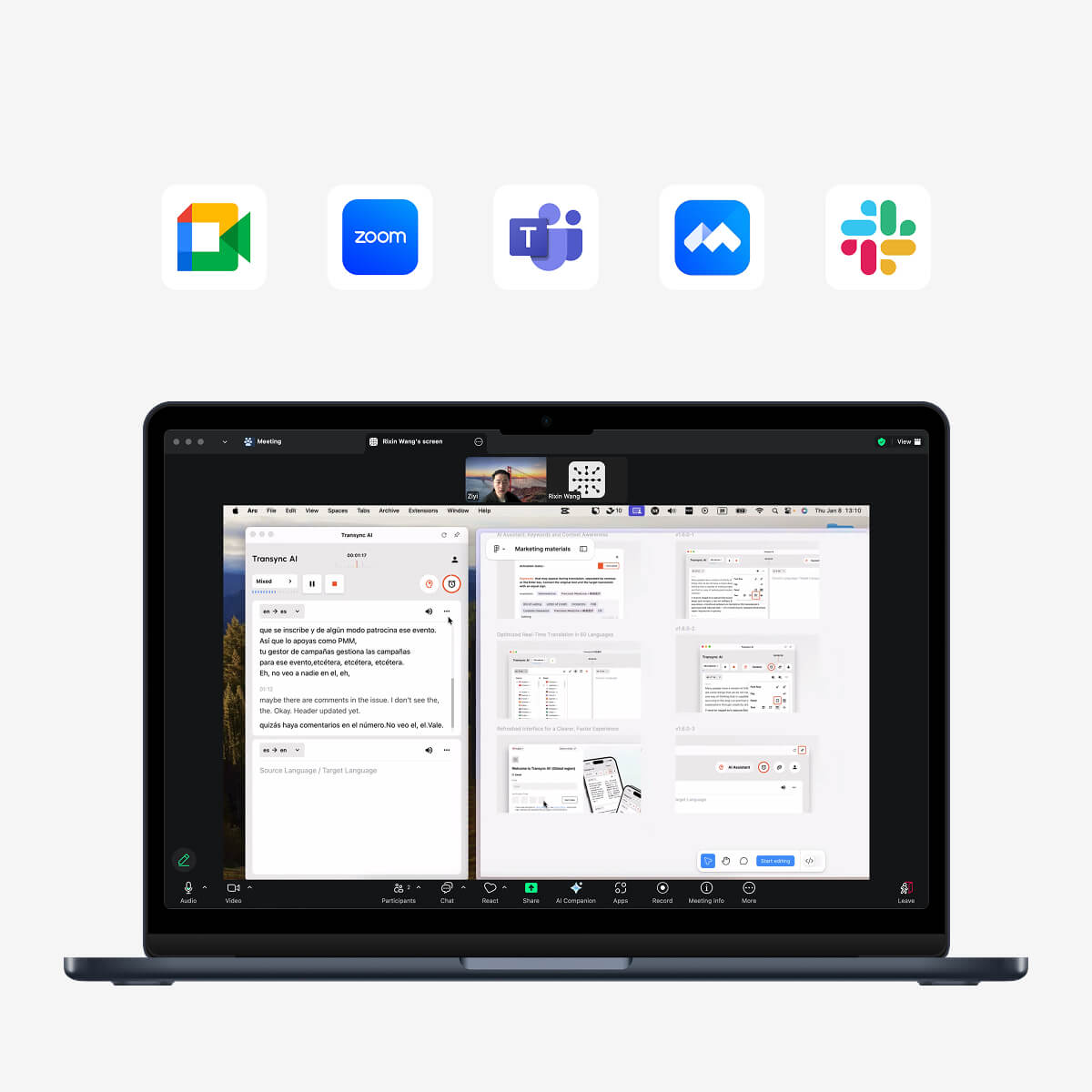
Kompatibilní s hlavními platformami pro online schůzky pro bezproblémový překlad v reálném čase
For people who need to translate english to spanish speech in both directions, Transync AI combines live subtitles with Hlasový překlad s umělou inteligencí. Playback delay can be adjusted so speech begins quickly or waits for a more complete phrase. That control matters when an English speaker pauses in the middle of a thought and the Spanish voice should not cut in too early.
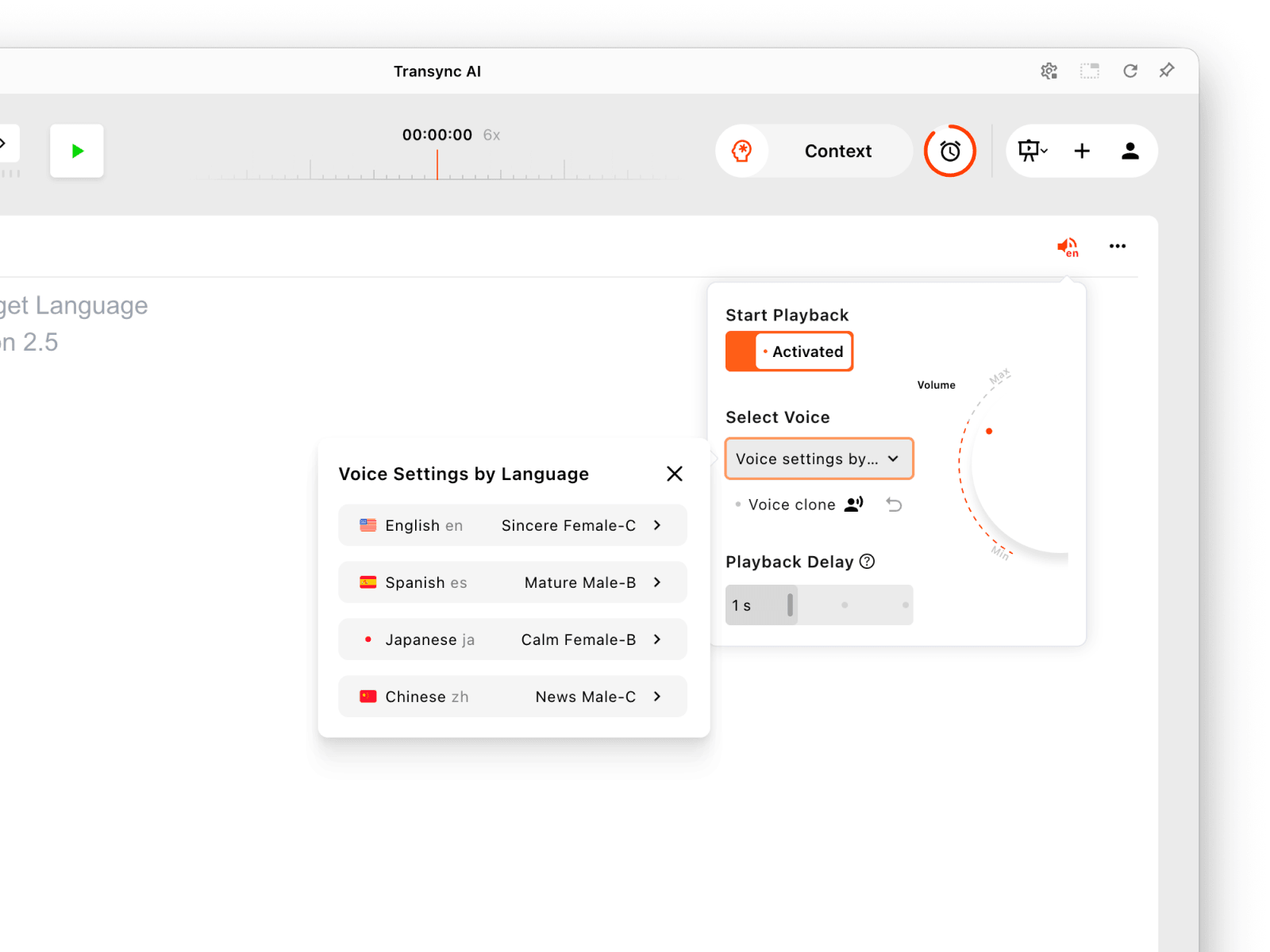
Nakonfigurujte přehrávání hlasu samostatně pro každý jazyk prezentace.
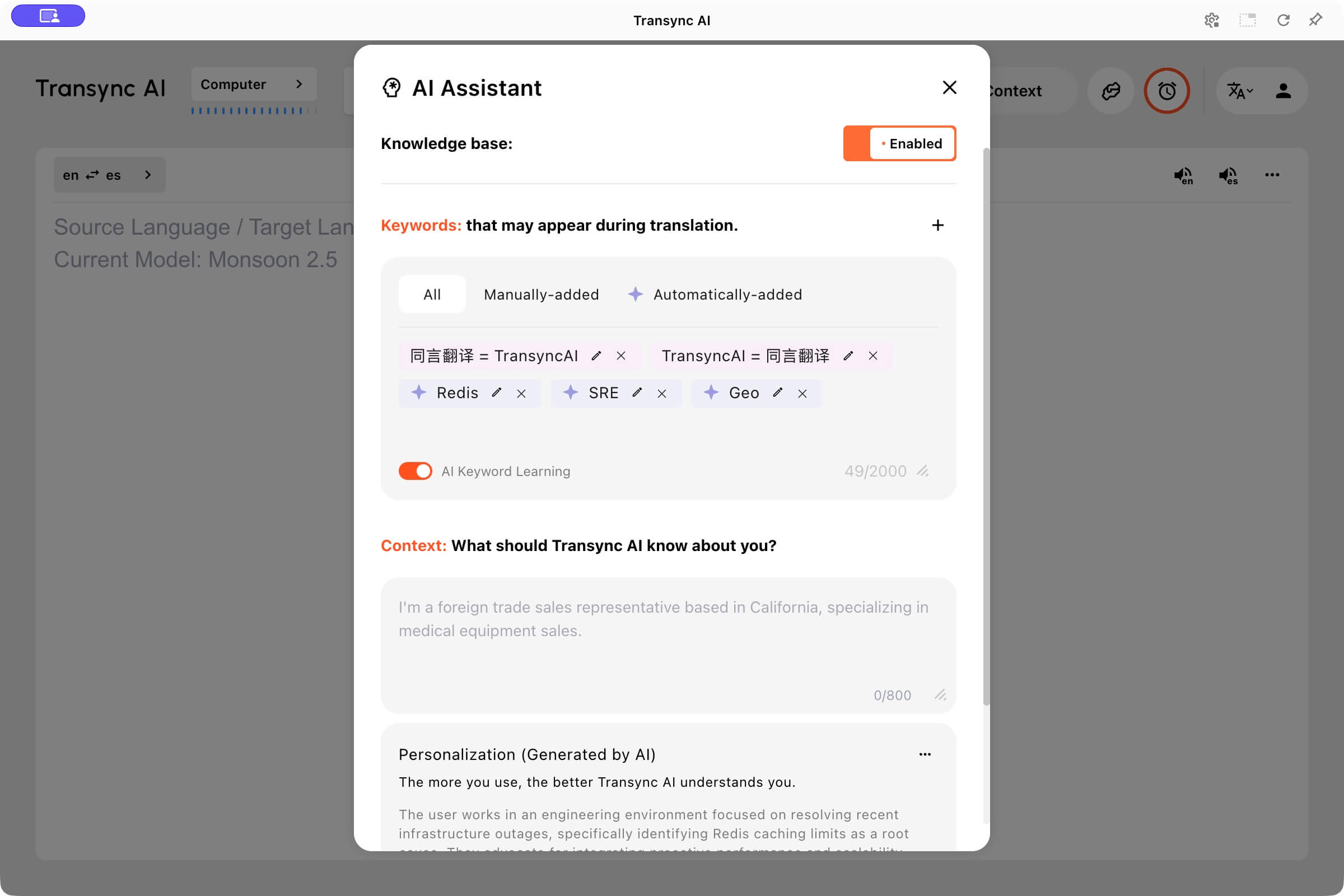
Before a specialist conversation, teams can add names, product terms, and subject background through Klíčová slova a kontext. After the call, Poznámky ze schůzky s umělou inteligencí can provide a record for checking decisions and actions. These aids do not replace review, but they make uncertainty easier to find.
 For a keynote, training session, webinar, or town hall, Prezentační režim lets the host share live translated text and optional voice playback. Audience members join on their own devices through a link, QR code, or Room ID and choose from the languages enabled by the host. The audience panel is for reading and listening; participants do not send voice into the host’s translation task.
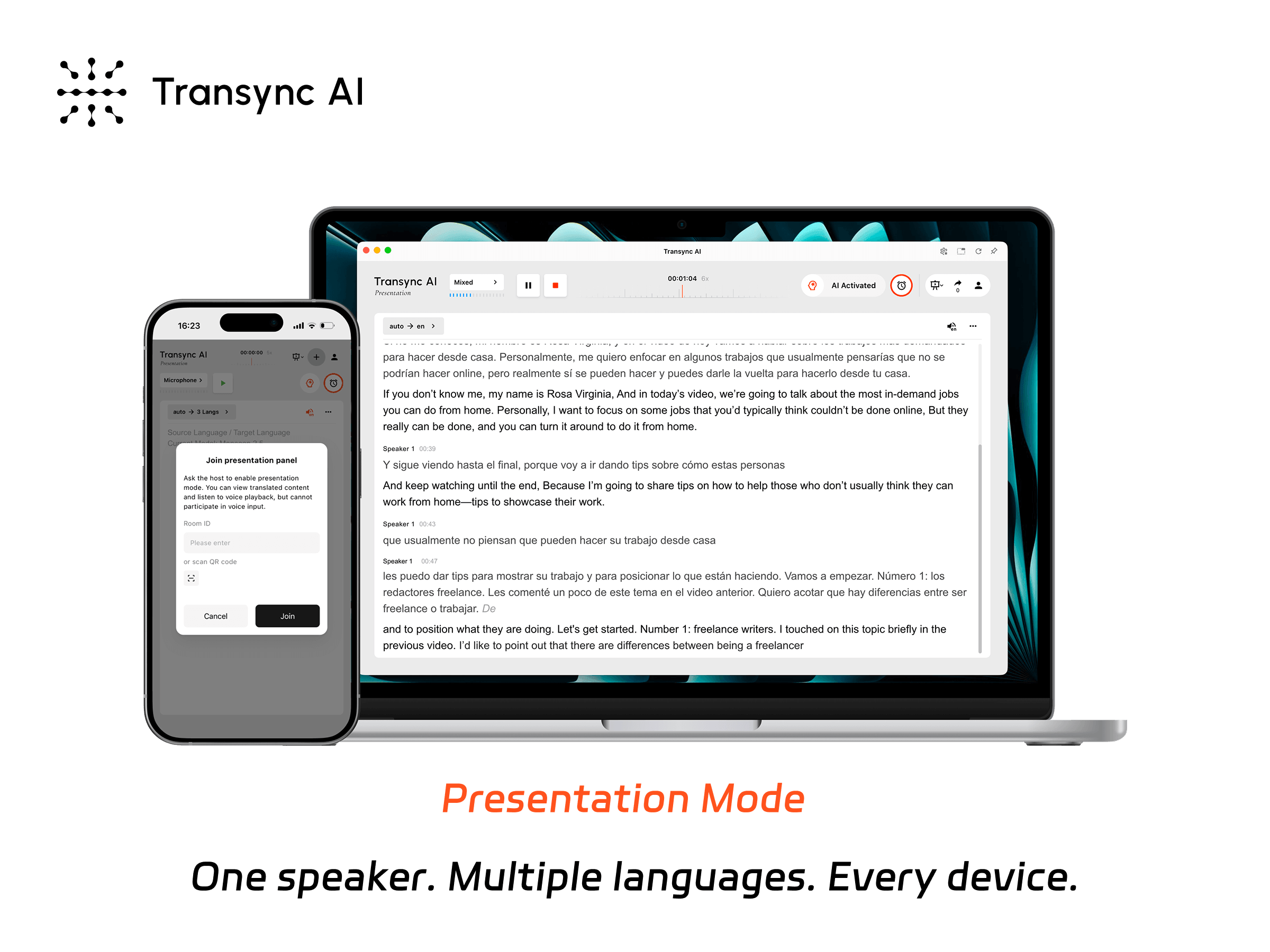
Prezentační režim umožňuje jednomu moderátorovi sdílet živý překlad s diváky na jejich vlastních zařízeních.
Vyzkoušejte Transync AI zdarma
Vybrat Transync AI when the same team needs a practical path from live English-Spanish conversation to bilingual captions and a reviewable record. Test the real microphones, platform audio, accents, terminology, and playback route before a consequential meeting.
JotMe for Shared Live Translation
JotMe provides live translation for meetings and events. Its desktop product can run alongside video-meeting software without joining as a bot, and a host can share translation to participants through a browser link, QR code, or code. Official documentation also describes optional voice translation for guests and post-session sharing controlled by the host.
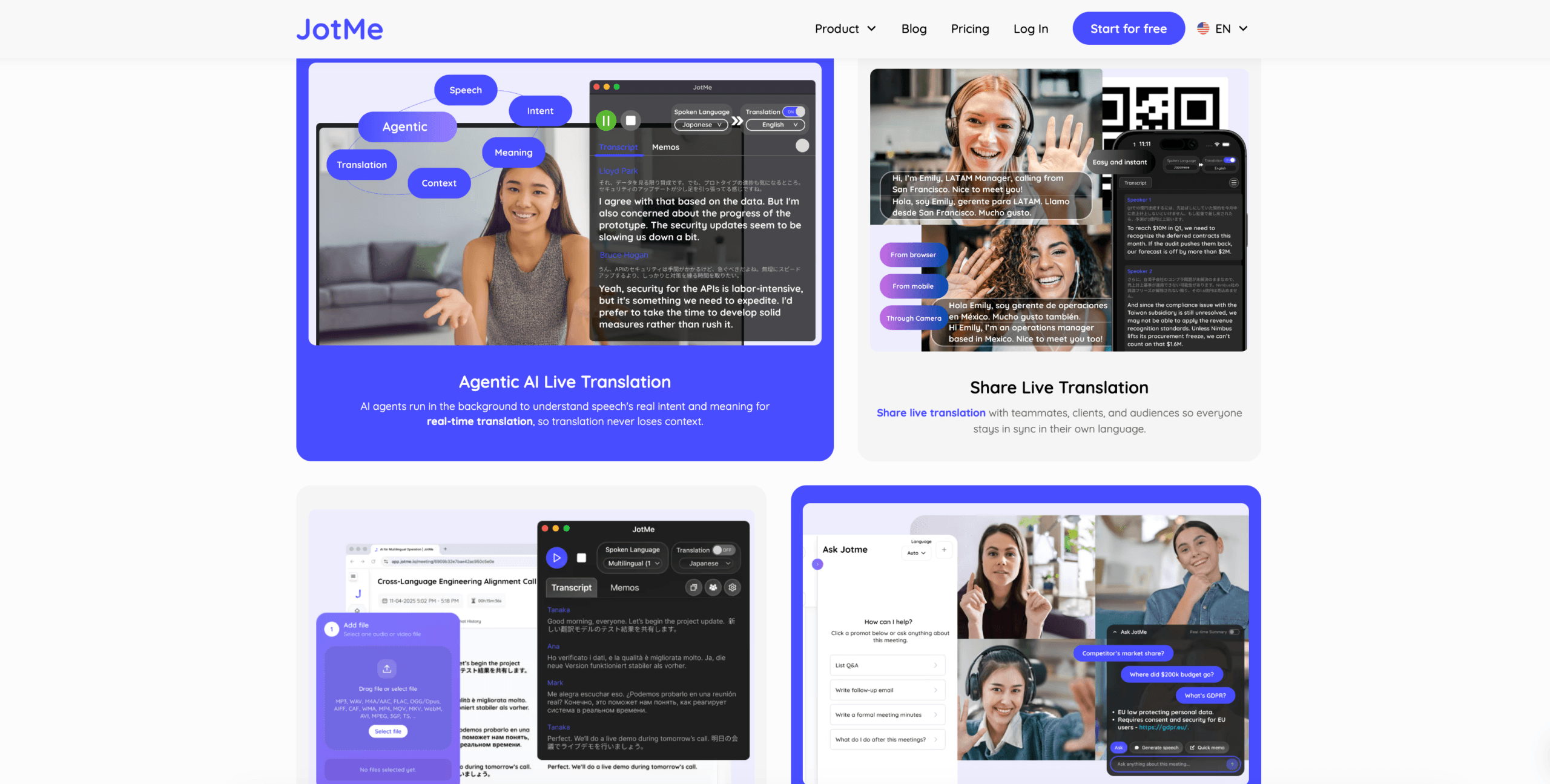
Zvážit JotMe when participant-side access is central and the team wants several sharing routes. Before using it to translate english to spanish speech, compare its current quality modes, language coverage, minute accounting, voice multiplier, vocabulary allowance, and record-sharing settings against the event design.
Talo for a Bot-Based Voice Workflow
Talo focuses on live voice interpretation for video calls. The organizer pastes a meeting link into its portal, and an AI bot joins supported Zoom, Google Meet, nebo Microsoft Teams calls. Its official site currently positions the service around 60 languages and two-way voice communication.
Vybrat Talo when a bot in the call is an acceptable and convenient delivery model. Confirm participant consent, the supported platform, bot admission rules, language pair, current plan limits, and what happens to transcripts or meeting data under the applicable settings and policy.
A Human Interpreter for Consequential Nuance
A qualified human interpreter remains the strongest option when the conversation involves legal rights, informed medical consent, safety instructions, disciplinary action, confidential negotiations, or another decision where a subtle shift can cause material harm.
Human interpretation is not automatically perfect. The interpreter needs the correct specialization, language variety, briefing materials, terminology, audio conditions, breaks, and an agreed mode of interpretation. For major events, simultaneous interpreters may work in teams. For a smaller meeting, consecutive interpretation may allow careful clarification.
Automation can still support preparation and records, but it should not be presented as accountable professional approval. If the purpose is merely to understand a low-risk conversation, software may be sufficient. If the purpose is to establish consent, liability, or an official position, use the level of human review that the consequence requires.
Build a Social Signal Map Before You Choose a Tool
Instead of reading a generic script, collect eight to twelve sentences that your team actually says. For each one, write the proposition and the social function separately.
| Source Line | Proposition | Intended Social Function | What the Spanish Listener Should Infer |
|---|---|---|---|
| “Would you mind sending a revised version?” | Send a revision | Polite request | A revision is requested, not merely discussed |
| “We should be able to deliver next week.” | Delivery next week | Strong expectation with residual uncertainty | Likely, but not an unconditional guarantee |
| “That is one way to look at it.” | Another view exists | Possible polite disagreement | The speaker may not accept the argument |
| “Go ahead, Ana.” | Ana may speak | Turn handoff | Ana has the floor |
| “We are approved, subject to security review.” | Conditional approval | Approval is incomplete | Security review remains a gate |
Then run the lines in the real environment. Do not tell the Spanish reviewer what each line is supposed to mean. Ask them to record:
- perceived formality;
- whether the sentence is a request, option, or instruction;
- confidence level;
- who should act;
- deadline and conditions;
- whether the tone feels sincere, humorous, frustrated, or neutral.
Compare their answers with the source-intent column. This evaluates whether the workflow can translate english to spanish speech as communication rather than as isolated text.
How Should You Handle Regional Spanish?
There is no context-free “Latin American Spanish” that perfectly fits every country, industry, and relationship. Regional choice can affect address forms, common verbs, technical vocabulary, pronunciation, and the naturalness of a recorded voice.
Start with the audience, not the dropdown label. If a call includes Mexico, Argentina, Colombia, and Spain, agree on a broadly understood professional register and avoid highly local idioms. Keep official product names, legal terms, and department names in an approved glossary. Allow participants to ask for clarification without treating it as a failure.
The regional target should therefore be written into the brief whenever you translate english to spanish speech for customers or the public.
For a public presentation, show Spanish subtitles even when translated audio is available. Text gives listeners another path when a word sounds unfamiliar. For a recurring team, save audience preferences and build a shared terminology list from corrections. To translate english to spanish speech naturally, consistency across sessions is often more valuable than chasing an abstract universal accent.
Privacy, Consent, and Human Review
Spoken translation may process voices, names, meeting content, captions, and transcripts. Before using any product, identify who controls the account, where records appear, how long they remain available, who can receive them, and which retention or deletion controls apply. Product marketing is not a substitute for reviewing the current policy and contract.
Tell participants when audio is being processed or recorded and obtain the consent required by the relevant organization and jurisdiction. In audience-sharing modes, decide before the session whether attendees should retain a transcript. Do not expose a confidential record simply because sharing is technically convenient.
Also define the review boundary. Casual travel conversation may need no formal review. A sales recap may need the account owner to confirm price, scope, and next steps. A contract, diagnosis, safety order, or public statement may require a qualified translator, interpreter, lawyer, clinician, or subject expert.
The most responsible way to translate english to spanish speech is to match review effort to consequence.
That principle remains true whether you translate english to spanish speech for one listener, a recurring team, or a large audience.
Často kladené otázky
What is the best way to translate english to spanish speech live?
Choose the delivery model first. A standalone meeting translator suits recurring calls and in-person conversation; a shared audience mode suits presentations; a bot-based interpreter may suit supported video calls; a qualified human interpreter is preferable for high-stakes nuance. Test your real accents, terminology, audio route, and conversational signals before deciding.
Can an app translate english to spanish speech in both directions?
Yes, some real-time products support two-way English-Spanish conversation. Confirm whether both people can speak naturally, how translated voice reaches the remote participant, whether bilingual captions remain visible, and whether speaker changes or overlapping speech are handled clearly.
Why does a correct translation still sound rude?
The system may have preserved the proposition but changed the social function. A modal request may become a command, tú may replace expected používané, or an indirect disagreement may become blunt. Review register and intended action, not only dictionary equivalence.
Should I use Spain Spanish or Latin American Spanish?
Use the variety expected by the actual audience. For a mixed international group, choose a clear professional register, avoid highly regional idioms, and verify important terms. Spain and Latin America are not internally uniform, so a broad label is only a starting point.
Can translated speech be used for legal or medical decisions?
Do not assume consumer or meeting software is sufficient for consequential legal, medical, safety, immigration, or consent decisions. Use a qualified interpreter and the review process required by the institution and jurisdiction.
Are subtitles useful if translated voice is already playing?
Yes. Bilingual or translated subtitles let participants inspect names, numbers, conditions, and unfamiliar terms. They also provide a fallback when room noise, accent, or playback makes a phrase hard to hear.
Final Answer: Preserve the Relationship, Not Just the Sentence
To translate english to spanish speech reliably, first ask what the listener must understand beyond the words. Preserve the relationship through the right register, the request through the right degree of politeness, the claim through the same certainty, the conversation through clear turn-taking, the emotion through appropriate adaptation, and the outcome through explicit ownership and conditions.
A natural voice is useful, but it is not the final test. The real test is whether the Spanish listener makes the same interpretation and takes the same action the English speaker intended. Build a social signal map, compare delivery models in the real environment, keep text available for verification, and add human expertise when the consequence is high.
That is how translate english to spanish speech becomes dependable communication rather than fluent guesswork.