

Choose language translator software by assigning 6 critical owners for source quality, terminology, review, delivery, security, and records.
Language translator software rarely fails alone. A launch page may contain unclear source copy. Nobody may own the approved terminology. A fluent draft may bypass a native reviewer. The translation may arrive in the wrong format, or a meeting record may be shared with people who should not retain it. The software completed its step, but the organization never designed the handoffs around it.
That is why a feature checklist is not enough. Before buying language translator software, assign six owners: the business owner, source owner, terminology owner, language owner, delivery owner, and governance owner. One person may hold several roles in a small team, but no role should disappear.
This ownership model also explains why there is no universal winner. A professional translator needs a different environment from a software localization team. A video editor needs timed subtitles. A meeting participant needs translated captions while a colleague is still speaking. Good software makes the relevant owner’s work visible, correctable, and repeatable.
The Short Answer: Who Must Own the Result?
| Owner | Decision They Make | Failure When Nobody Owns It | Software Evidence to Request |
|---|---|---|---|
| Business owner | Why translation is needed and what “done” means | Teams optimize the wrong output | Brief, target audience, acceptance criteria |
| Source owner | Whether the source is complete and understandable | Ambiguity multiplies across every language | Approved source version and change control |
| Terminology owner | Which names and specialist terms are mandatory | The same concept receives several translations | Glossary or term base with named approver |
| Language owner | Whether target meaning, tone, and locale are acceptable | Fluent mistakes reach users | Review status, comments, and approval record |
| Delivery owner | How the recipient reads, hears, installs, or joins | Correct translation reaches the wrong channel | Export, integration, captions, voice, or access test |
| Governance owner | Where content travels, remains, and can be deleted | Sensitive material exceeds policy | Permissions, retention, audit, and deletion controls |
The best language translator software for a team is the product that supports its most important ownership chain. Language count matters, but it cannot replace source control, review responsibility, usable delivery, or approved data handling.
A Translation Incident With No Obvious Culprit
Imagine a product team preparing a Japanese launch. Marketing sends a final English page to a localization coordinator. Two hours later, product management changes the subscription wording but does not update the translation request. The translator follows an old glossary. A reviewer corrects the tone in a spreadsheet, yet the web team publishes the earlier file. During the launch call, the presenter uses a different product name, and the meeting notes preserve that third version.
Every contributor can truthfully say, “I completed my task.” The release is still inconsistent.
The lesson is not that automation is dangerous. The lesson is that language translator software sits inside a chain of human decisions. A product should be assessed by how clearly it carries source version, terminology, review state, recipient format, and data policy across those decisions.
Owner 1: The Business Owner Defines “Done”
The first owner is not necessarily a translator. It is the person accountable for the business outcome. This person decides whether the job is private comprehension, a legally reviewed contract, localized software, translated subtitles, or a conversation that must remain understandable in real time.
Before anyone opens language translator software, the business owner should complete a short brief:
- Audience: Who will use the target language?
- Tujuan: Understand, decide, publish, comply, learn, or respond?
- Source: Text, files, software strings, recorded media, microphone audio, or computer audio?
- Deadline: During the event, before publication, or with every product release?
- Deliverable: Editable file, localized interface, subtitle file, captions, translated voice, or meeting record?
- Mempertaruhkan: What is the consequence of a wrong name, number, condition, or tone?
- Approver: Who has authority to release the result?
Without this brief, teams compare products that do different jobs. A CAT tool can be excellent for a translator working segment by segment yet irrelevant to an attendee who needs live speech. A meeting translator can make a call understandable without becoming a full localization platform for software releases.
The business owner should also decide where human expertise is mandatory. Legal, medical, immigration, safety-critical, and controlling contractual language requires appropriately qualified professionals. AI output may support preparation, but responsibility must remain explicit.
For this owner, language translator software is successful only when its output matches a defined business decision—not merely when it produces target-language text.
Owner 2: The Source Owner Stops Ambiguity Upstream
Translation cannot reliably clarify a source that its own author does not understand. The source owner confirms that the original content is complete, current, and written for translation.
Perhatikan kalimat ini:
After the review, it can be replaced unless they reject it.
What does “it” refer to? Who are “they”? Does “unless” apply to the review, replacement, or rejection? A fluent target sentence may choose one interpretation and conceal the ambiguity.
The source owner should repair unclear pronouns, unexplained abbreviations, broken sentences, inconsistent product names, hidden text, and obsolete screenshots before translation begins. For speech, the equivalent work includes selecting the correct microphone, reducing echo, preparing speaker names, and avoiding people talking over one another when possible.
Effective language translator software should help identify the exact source version. For files and localization projects, inspect version history, comments, status, and change detection. For meetings, verify which audio source is entering the system and whether the original transcript remains available beside the translation.
One approved source can feed several target languages. One unapproved source can distribute the same mistake across all of them.
Language translator software cannot compensate for an unidentified source version, so source approval should be recorded before translation or live delivery begins.
Owner 3: The Terminology Owner Protects Meaning at Scale
A glossary is not simply a bilingual word list. It records decisions about product names, technical terms, phrases that should remain untranslated, prohibited wording, abbreviations, definitions, and regional preferences.
The terminology owner may be a subject-matter expert, product marketer, legal specialist, linguist, or localization manager. The title matters less than the authority to answer questions such as:
- Is “workspace” translated or kept in English?
- Does “member” mean a paid subscriber or any registered user?
- Which Japanese product spelling is approved?
- Is a model name pronounced as initials or as a word?
- Which Portuguese variant does the company publish?
- When should an English acronym appear beside its translated expansion?
When evaluating language translator software, ask whether terminology is merely suggested or actively checked. Determine who can add terms, who approves them, how changes are versioned, and whether the resource can be shared across projects. A powerful glossary with no owner quickly becomes a collection of conflicting preferences.
For live speech, terminology preparation is shorter but still valuable. Speaker names, company names, product codes, and specialist vocabulary should be entered before an important meeting. Context cannot guarantee perfection, but it gives the system stronger evidence than raw audio alone.
The terminology owner turns language translator software from a collection of isolated outputs into a more consistent organizational resource.
Owner 4: The Language Owner Approves Meaning, Not Just Fluency
The language owner is qualified to judge the target language for the intended audience. This person may be a professional translator, in-market reviewer, bilingual subject expert, interpreter, or editorial lead. “Someone in the office who speaks a little French” is not automatically the right reviewer for a French contract or public campaign.
Review should separate three categories:
- Semantic errors: changed meaning, omitted condition, incorrect number, reversed negative, or wrong actor.
- Terminology errors: approved term ignored, brand name altered, or technical concept used inconsistently.
- Style preferences: a grammatical result could sound more natural, concise, formal, or market-appropriate.
This separation prevents teams from treating every edit as equally serious. A different adjective is not the same as changing “must not” to “may.”
The language owner needs a review surface suited to the material. Text and software strings benefit from source-target comparison, comments, context, translation memory, term bases, and status. Media requires access to audio, speakers, timing, and subtitle constraints. Live meetings require a way to notice and repair misunderstandings during the conversation, followed by a reviewable record.
Language translator software should show who approved the output and which version was approved. If a correction remains in email or a separate spreadsheet, the publishing team may never see it.
For the language owner, good language translator software makes approval visible and keeps the source close enough to verify every important change in meaning.
Owner 5: The Delivery Owner Tests the Recipient’s Experience
A translation is not delivered merely because it exists. The recipient must be able to read, hear, open, install, or join it in the intended environment.
For a document, the delivery owner checks fonts, tables, page breaks, links, reading order, and exported format. For software, this owner checks truncated buttons, plural rules, placeholders, right-to-left layout, screenshots, and build integration. For video, the owner checks subtitle timing, line length, speaker changes, text over graphics, and player compatibility.
For a meeting, the delivery owner checks a different set of questions:
- Can participants join without confusing setup?
- Can they choose the language they need?
- Do translated captions arrive early enough to support a response?
- Can listeners use voice playback without causing echo?
- Can a late attendee recover the context?
- Does the saved record help confirm decisions afterward?
The delivery owner should test the real output, not a screenshot of the editor. Import the localized build, open the exported subtitle, join from a second device, or download the final document. Language translator software succeeds only when the recipient’s last mile works.
That makes recipient testing part of the language translator software evaluation, not an optional task after procurement is complete.
Owner 6: The Governance Owner Controls Data and Memory
Translation systems can process confidential documents, customer data, employee speech, unreleased product information, and meeting decisions. The governance owner—often working across security, privacy, legal, and IT—decides what content may enter the product and how long it may remain.
The review should cover the exact product, plan, deployment, and feature. Ask about:
- data collection and model-training terms;
- processing and storage locations;
- retention and deletion;
- account roles and sharing permissions;
- audit information and export controls;
- subprocessors and integrations;
- local, cloud, or hybrid deployment;
- treatment of recordings, transcripts, and generated voice;
- contract and compliance requirements.
Do not assume every service under one brand uses identical controls. A free consumer interface, enterprise workspace, desktop application, and API may operate under different terms.
The governance owner also decides what becomes organizational memory. Translation memories, term bases, approved subtitles, meeting notes, and corrected transcripts can improve future work. They can also preserve sensitive content longer than intended. Good language translator software makes retention deliberate rather than accidental.
Four Software Environments, Four Ownership Patterns
The following comparison does not rank products from best to worst. It shows which ownership chain each environment is designed to support.
| Produk | Primary Environment | Owner Most Directly Served | Reviewable Evidence | Batas Penting |
|---|---|---|---|---|
| memoQ | Professional document translation and CAT work | Language and terminology owners | Segments, translation memory, term bases, QA, reference material | Not a live meeting interpreter |
| Lokalise | Product and software localization | Business, source, terminology, and language owners | Keys, context, glossary, translation memory, review workflow | Not designed to translate a spontaneous meeting |
| HappyScribe | Recorded audio, video, transcripts, and subtitles | Source, language, and delivery owners | Source transcript, target text, timing, editor, exports | File/media workflow differs from live two-way translation |
| Transink AI | Live meetings, conversations, and presentations | Delivery owner and live participants | Bilingual captions, terminology context, translated voice, notes | Not a CAT tool or general recorded-file subtitle editor |
memoQ: When a Professional Translator Owns the Work
memoQ translator pro is a Windows-based computer-assisted translation environment designed for translators, editors, and reviewers. It supports translation memories, term bases, reference material, quality checks, and many document formats.
Itu membuat memoQ appropriate when a language professional must work segment by segment, reuse approved translations, follow terminology, and deliver a controlled file. It treats the translator as an expert operating a workbench, not as a user requesting an invisible one-click result.
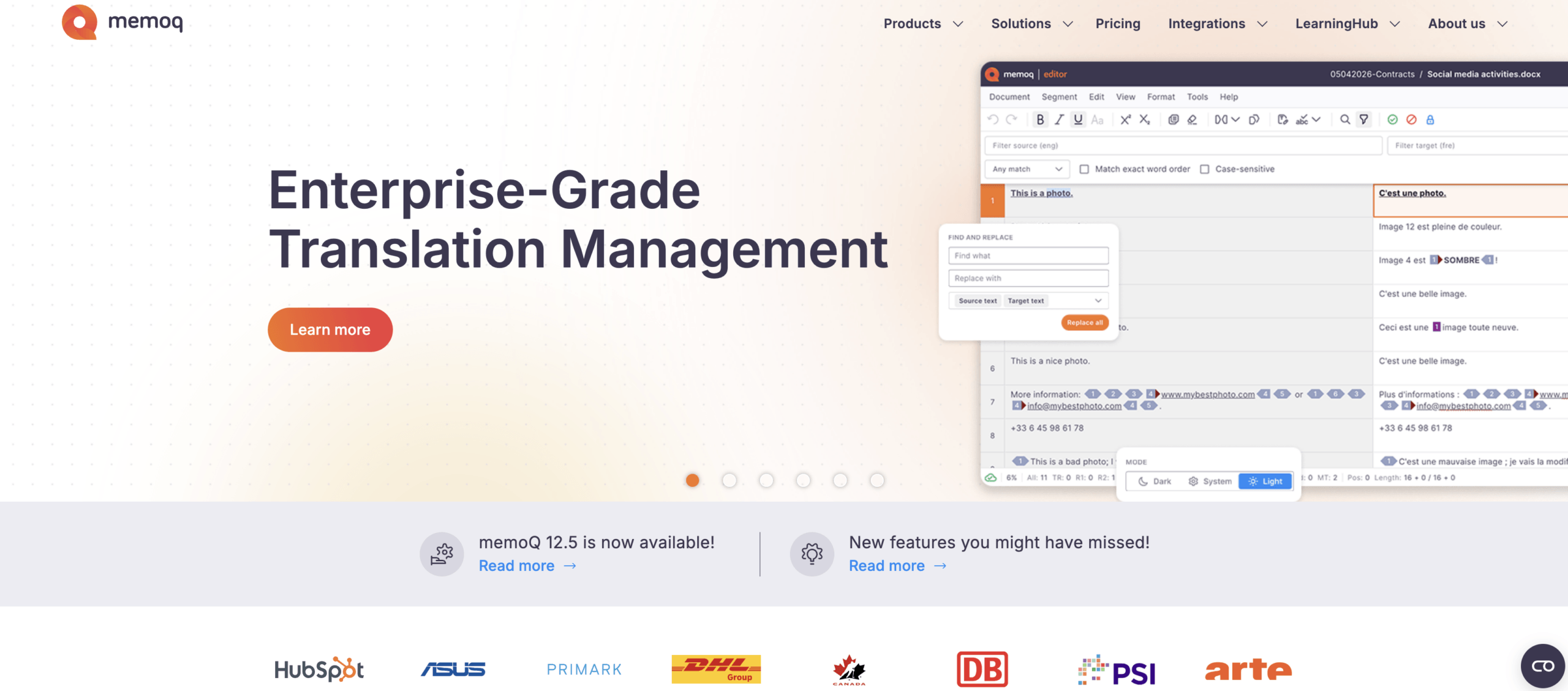
Memilih memoQ when the language owner needs deep editorial control and compatibility with professional translation resources. Confirm operating-system, licensing, collaboration, server, and file-format requirements for the intended workflow. Do not choose it expecting automatic participation in a live multilingual call.
Lokalise: When a Product Team Owns Continuous Releases
Lokalise is a localization platform shaped around product content, software strings, team collaboration, and repeated releases. Its documentation distinguishes translation memory, which reuses approved segments, from a glossary, which controls individual terms and phrases.
That distinction supports multiple owners. Developers and product managers provide keys and context. Terminology owners define approved language. Translators and reviewers work on target versions. The team then returns translations to the product delivery process.
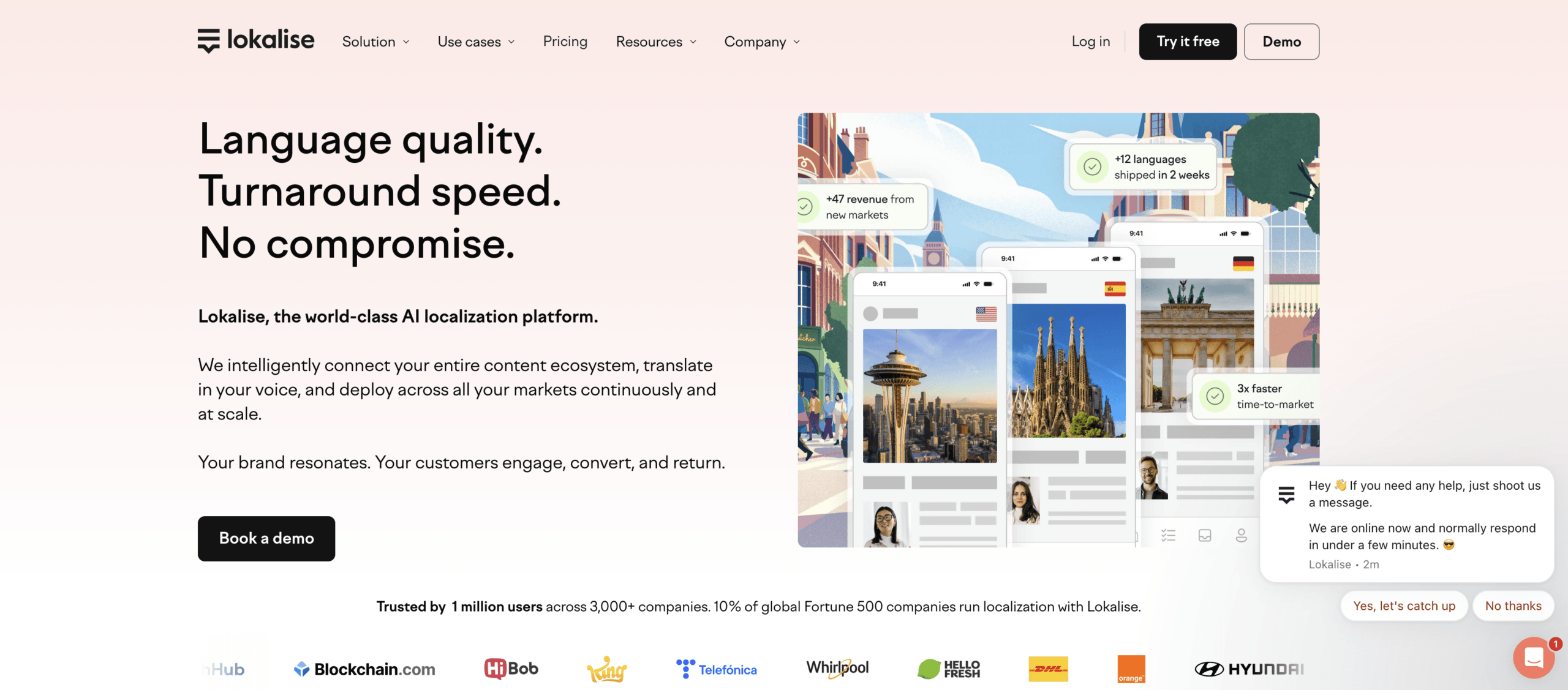
Memilih Lokalise when localization changes continuously with a website, app, or digital product. Test placeholders, plural forms, screenshots, branching, review status, and repository or design integrations using a real release. It may be too much process for a person translating one private document, and it is not a live speech interpreter.
HappyScribe: When a Media Team Owns the Timeline
HappyScribe combines transcription, subtitles, translation, an editing environment, and optional professional language services for recorded media. Its current documentation emphasizes that language coverage varies by feature and that the original transcript should be reviewed before translation.
This environment gives the media owner evidence that ordinary text tools lack: the recording, source transcript, speaker or timing information, target text, subtitle layout, and export. Correcting the source first prevents one misheard name from being repeated across several translated subtitle tracks.
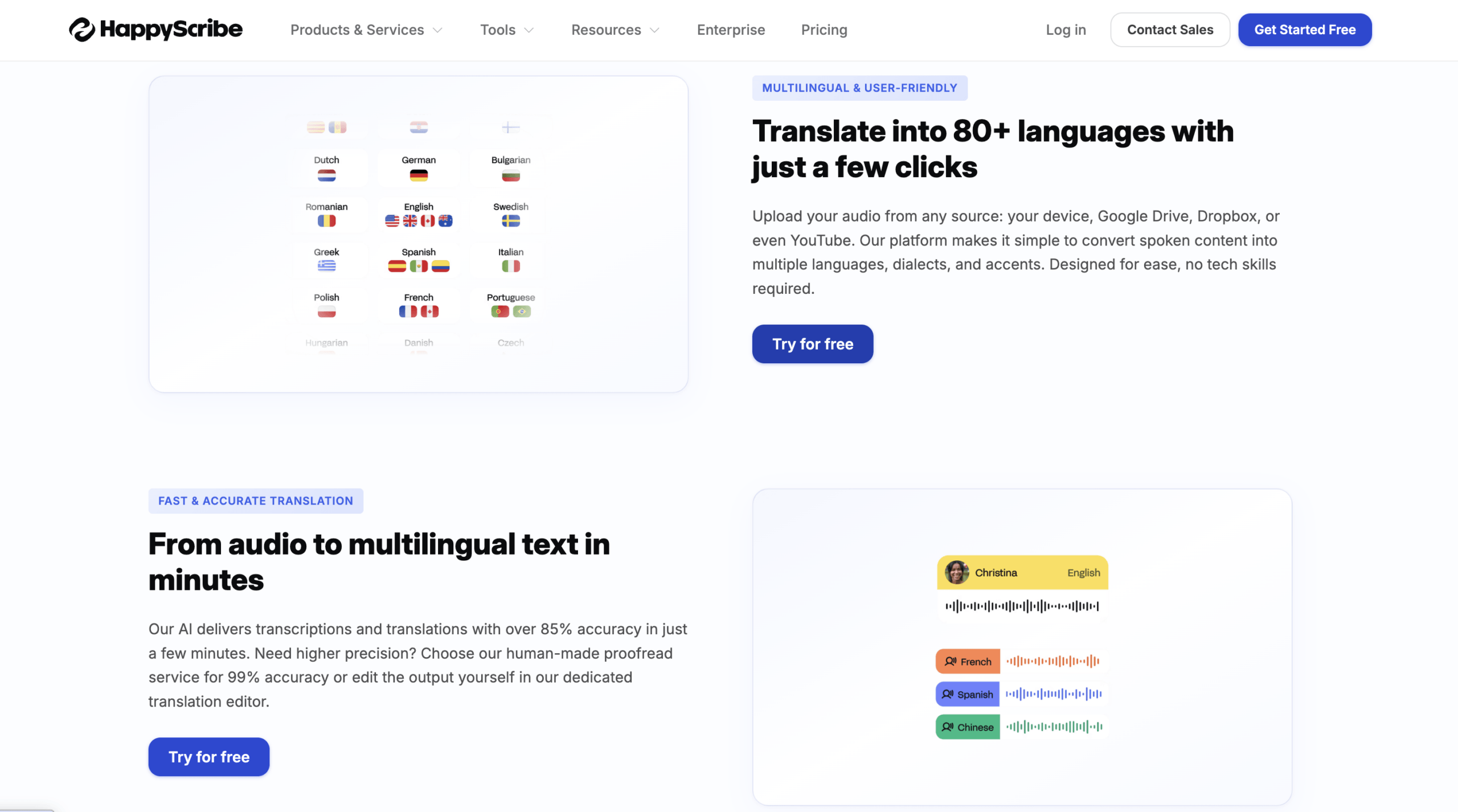
Memilih HappyScribe for interviews, training videos, podcasts, captions, and translated subtitles. Test the noisiest representative minute, not a studio-quality sample. Review timing and readability as well as meaning. A recording workflow can create excellent post-event assets without being the right language translator software for a discussion that must be understood immediately.
Transink AI: When Participants Own a Live Conversation
Transink AI berfokus pada terjemahan pertemuan langsung rather than a queue of files waiting for release. Participants can follow bilingual captions and, where available, listen through the Penerjemah suara AI. A host can prepare names and specialized terms through Kata Kunci Asisten AI Konteks, while Catatan rapat AI provide a record for review after the session.
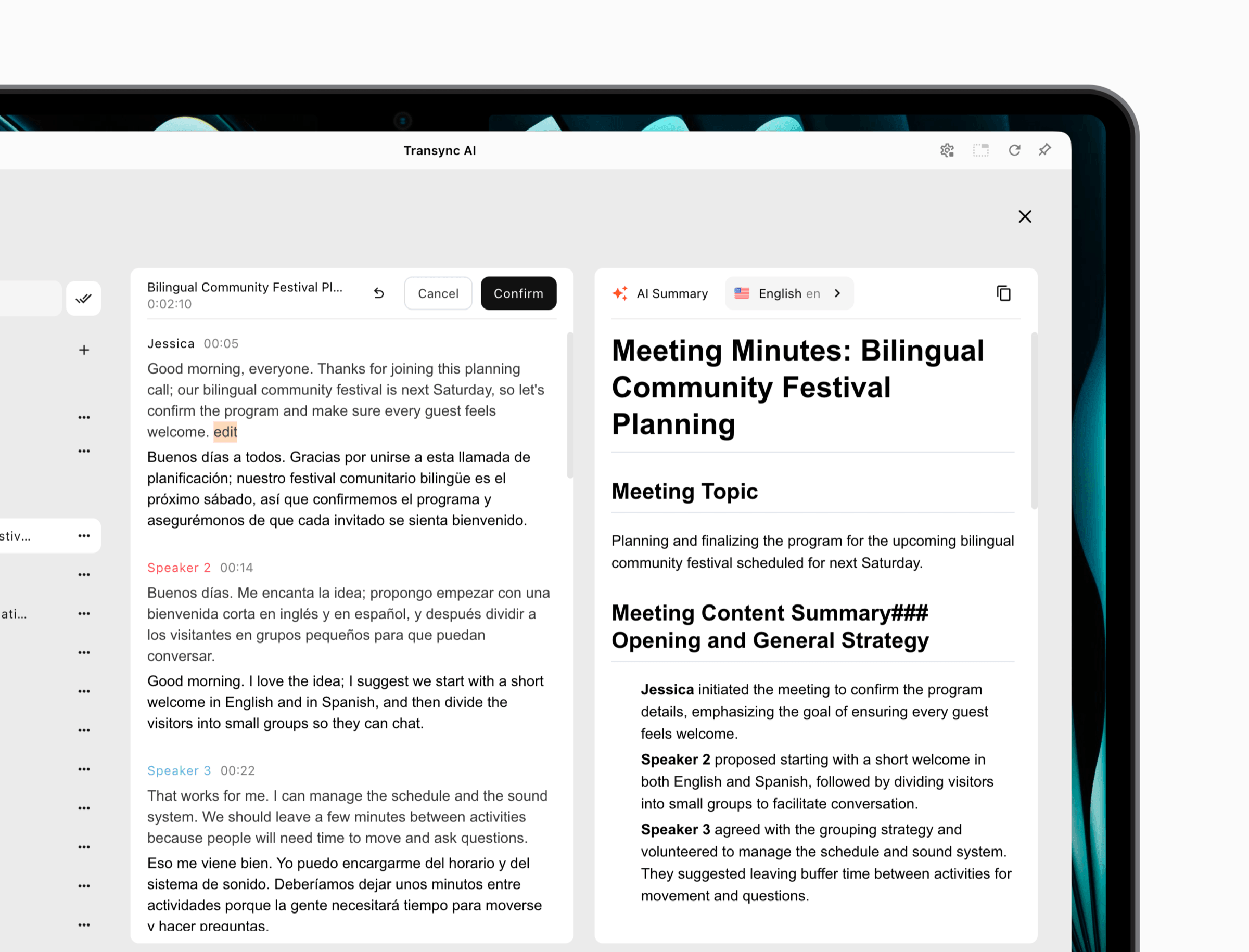 This changes ownership. The source owner manages microphones and computer audio. The terminology owner prepares critical names and terms. The delivery owner tests participant devices and playback. The language users remain active participants who can ask for clarification before the discussion moves on.
For lectures, webinars, town halls, and product briefings, Transink AI Mode Presentasi lets a host invite the audience by link, QR code, or Room ID. Each attendee chooses from the enabled languages and follows translated text, with voice playback when available, on an individual device.
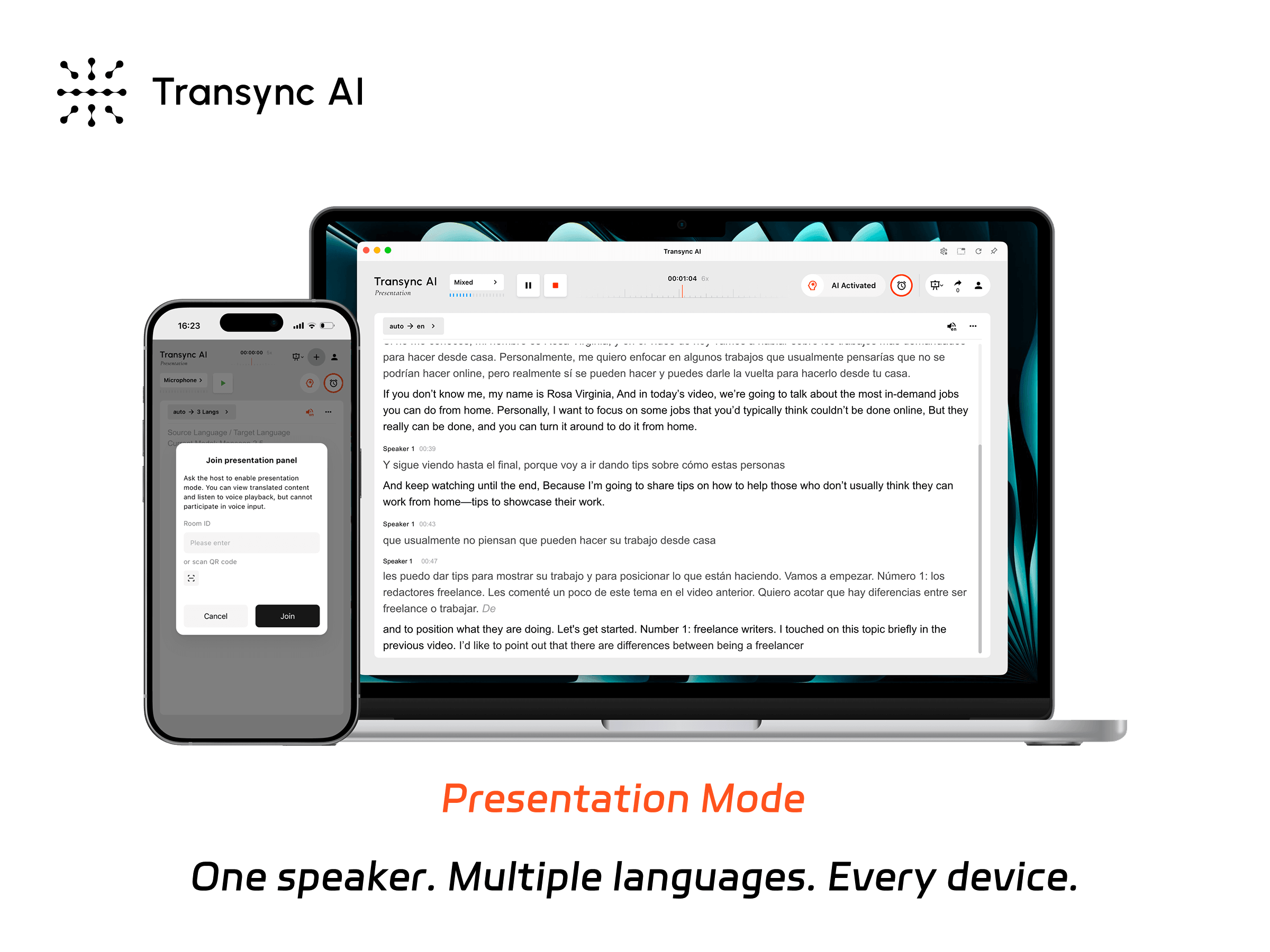
Mode Presentasi memungkinkan satu pembawa acara untuk berbagi terjemahan langsung dengan anggota audiens di perangkat mereka masing-masing.
Memilih Transink AI when speech must become an understandable exchange or live audience experience. It requires network access and should be rehearsed with the actual language pair, audio route, terminology, and devices. It is not designed to replace professional CAT software, continuous software localization, or frame-accurate subtitle post-production.
The Red-Folder Handoff Exercise
Instead of asking every vendor to translate a polished paragraph, create one red test folder representing a real project. The folder should be difficult enough to expose ownership gaps but safe enough to share during a trial.
Put These Items in the Folder
- a one-page business brief with audience, purpose, deliverable, and risk;
- a source file or two minutes of representative audio;
- a source revision containing one changed condition;
- ten approved terms and two terms still awaiting a decision;
- a reviewer note about formality or regional usage;
- one name, date, price, negative, unit, and product code;
- the required final format;
- the allowed data classification and deletion requirement.
For a meeting pilot, replace the source file with a short agenda and scripted interruption. Ask one participant to join late, another to use a phone, and a third to correct a product name verbally. For a localization pilot, change one source string after translation has started. For a media pilot, insert overlapping speech and a caption crossing a scene change.
Pass It Through the Six Owners
The business owner accepts or rejects the brief. The source owner approves the correct version. The terminology owner resolves the two undecided terms. The language owner reviews meaning and tone. The delivery owner opens the final output in its real destination. The governance owner confirms where test data and records remain.
Language translator software passes the exercise only if the team can answer four questions afterward:
- Which source version was translated?
- Which terminology decisions were applied?
- Who approved the target result?
- What was delivered, retained, shared, and deleted?
A beautiful translation with missing answers is not a controlled workflow.
What Should a Small Team Do If Six Owners Feels Excessive?
Combine roles, but keep the decisions separate. A founder might act as business, source, and terminology owner. A freelance translator may be the language owner. An operations lead may own delivery and governance. Write the six decisions on a single page so nobody assumes another person handled them.
Small teams should also avoid buying the largest platform before proving the recurring need. Use the red-folder exercise with the smallest viable product and one real language pair. Add automation, integrations, translation memory, or audience scale only when the work repeats.
The objective is not administrative weight. It is to prevent invisible responsibility from moving into the software.
When Must Human Language Expertise Lead?
Qualified professionals should lead when translation can affect rights, health, safety, immigration status, legal obligations, or substantial financial commitments. Human expertise is also essential for culturally sensitive campaigns, regulated communication, literary work, and public statements where implied meaning matters.
Language translator software can still help with source preparation, terminology, reusable translation memory, first drafts, accessibility, and records. Those benefits do not transfer accountability from the approving professional to the machine.
For live high-stakes events, a professional interpreter may remain the primary channel while AI captions provide supplementary access. The correct solution may combine people and software rather than force a single product to perform every role.
Pertanyaan yang Sering Diajukan
What is language translator software?
Language translator software is a broad category that helps convert meaning from one language into another. It may support professional document translation, product localization, recorded-media transcription and subtitles, or live speech translation. The correct category depends on the source, deadline, deliverable, reviewer, and recipient.
What is the difference between machine translation and a CAT tool?
Machine translation automatically generates target-language text. A computer-assisted translation tool such as memoQ gives a professional translator an environment for editing segments, reusing translation memory, applying term bases, checking quality, and managing reference material. A CAT tool can connect to machine translation without reducing the translator’s role to one click.
Which language translator software is best for software localization?
Lokalise is a strong candidate when developers, product managers, translators, and reviewers must coordinate continuously around software strings and releases. Test it with real keys, placeholders, screenshots, plurals, review states, and repository or design handoffs.
Which language translator software is best for video?
HappyScribe is designed for recorded audio and video, including source transcription, translated text, subtitles, timing, editing, and export. Review and correct the source transcript before translating it, because transcription mistakes can propagate into every target language.
Which language translator software is best for meetings?
Transink AI is designed for speech while it is happening, with bilingual captions, optional translated voice, terminology context, and post-meeting records. Rehearse the real audio path and participant experience before an important meeting or presentation.
Does a business need both a glossary and translation memory?
They solve different problems. A glossary controls approved terms and short phrases. Translation memory stores previously translated segments for reuse. A team producing recurring documents or software may benefit from both, provided someone owns their quality and updates.
Can language translator software replace a professional translator?
It can accelerate routine work and provide strong drafting or workflow support, but it does not remove the need for qualified review where accuracy, nuance, regulation, or consequences matter. The higher the risk, the clearer human responsibility must become.
How should language translator software be tested?
Use a representative source, an approved terminology list, a mid-project source change, a named reviewer, the real delivery format, and an explicit data policy. The red-folder exercise in this article tests both the product and the team’s handoffs.
Choose the Ownership Chain, Then Choose the Software
Software selection becomes clearer once responsibility is visible. Choose memoQ when a professional translator needs a controlled document workbench. Choose Lokalise when a product team releases localized software continuously. Choose HappyScribe when recorded media must become reviewed transcripts and subtitles. Choose Transink AI when people or audiences need translated speech now.
The decisive question is not “Which product has the most features?” It is “Which product gives our six owners the evidence and controls they need?” Language translator software should strengthen accountable decisions instead of becoming the place where responsibility disappears.
If multilingual meetings, calls, or presentations are the weakest handoff in your organization, test Transink AI with the real audio path, terminology, participants, and record-sharing policy. For additional context, review the perbandingan produk Dan panduan alternatif.