
Struggling to translate “at” in Spanish correctly?
The word “at” appears simple in English—yet translating it to Spanish reveals surprising complexity. The same English word “at” can translate to 5+ different Spanish prepositions depending on context, meaning, and situation.
This guide reveals exactly how to translate “at” in Spanish accurately, which Spanish preposition to use in different scenarios, and how to avoid costly translation mistakes.
Why Translating “At” in Spanish Matters
The challenge:
- “At” has 10+ different meanings in English
- Spanish uses different prepositions for each meaning
- Wrong preposition sounds unnatural to native speakers
- Business communication suffers when translation is imprecise
Real example:
English: "I'll meet you at the office at 3 PM"
Wrong translation: "Me reuniré contigo a la oficina a las 3 PM"
(Grammatically incorrect, sounds unnatural)
Correct translation: "Me reuniré contigo en la oficina a las 3 PM"(Natural, professional, grammatically correct)
The difference: One wrong preposition damages credibility and professionalism.
Translate “At” in Spanish: 5 Main Prepositions
1. “A” – Most Common (Time, Direction, Manner)
When to use “A” for “at”:
Time expressions:
- “at 3 PM” = “a las 3 PM”
- “at noon” = “al mediodía”
- “at night” = “por la noche” (or “a la noche” in Argentina)
- “at dawn” = “al amanecer”
Example:
English: "I'll call you at 10 AM tomorrow"
Spanish: "Te llamaré a las 10 AM mañana"
(Uses "a" for time)
Direction/location with movement:
- “at the door” (when arriving) = “a la puerta”
- “aim at the target” = “apunta a la meta”
- “threw at me” = “me tiró a la cara”
Example:
English: "He threw the ball at me"
Spanish: "Me tiró la pelota a mí"
(Uses "a" for direction of action)
Manner/price:
- “at full speed” = “a toda velocidad”
- “at $5 each” = “a $5 cada uno”
Example:
English: "Selling apples at $2 per pound"Spanish: "Vendiendo manzanas a $2 por libra"(Uses "a" for price)Usage frequency: 60% of “at” translations use “a”
2. “EN” – Location/Presence (Physical Place)
When to use “EN” for “at”:
Physical location:
- “at home” = “en casa”
- “at work” = “en el trabajo”
- “at school” = “en la escuela”
- “at the hospital” = “en el hospital”
- “at the office” = “en la oficina”
Example:
English: "I'll be at home tomorrow"
Spanish: "Estaré en casa mañana"
(Uses "en" for physical location)
Events/activities:
- “at the conference” = “en la conferencia”
- “at the meeting” = “en la reunión”
- “at the party” = “en la fiesta”
Example:
English: "I saw him at the wedding"
Spanish: "Lo vi en la boda"
(Uses "en" for event location)
States/conditions:
- “at peace” = “en paz”
- “at war” = “en guerra”
- “at rest” = “en reposo”
Example:
English: "The country is at war"
Spanish: "El país está en guerra"
(Uses "en" for state)
Usage frequency: 35% of “at” translations use “en”
3. “EN” vs “A” – Quick Distinction
Critical difference:
| Context | EN | A |
|---|---|---|
| Static location | “en la oficina” (at the office – I’m there) | N/A |
| Going to location | N/A | “a la oficina” (to the office – I’m going) |
| Time | N/A | “a las 3” (at 3 PM) |
| Specific place | “en la puerta” (at the door – standing there) | “a la puerta” (to the door – moving toward) |
| Inside building | “en el hospital” (at the hospital – inside) | N/A |
Memory trick:
- EN = Where you ARE (static, present)
- A = Where you’re GOING or WHEN (movement, time)
Example showing difference:
"I'm at work" = "Estoy en el trabajo" (EN - I'm there now)
"I'll go at 9 AM" = "Iré a las 9 AM" (A - when I'll go)
"I'll go at the office" = "Iré a la oficina" (A - where I'm going)
4. “ANTE” – Before/Facing
When to use “ANTE” for “at”:
Formal situations/facing:
- “at court” = “ante el tribunal”
- “at the judge” = “ante el juez”
- “at the authorities” = “ante las autoridades”
Example:
English: "I appeared at court"
Spanish: "Comparecí ante el tribunal"
(Uses "ante" for formal legal situation)
Standing before/facing:
- “at his feet” = “ante sus pies”
- “at the altar” = “ante el altar”
Usage frequency: 2% of “at” translations use “ante”
5. “POR” – Near/Vicinity
When to use “POR” for “at”:
General vicinity/near:
- “at the corner” = “por la esquina”
- “at the end” = “por el final”
Example:
English: "I'll meet you at the corner"
Spanish: "Me reuniré contigo por la esquina"
(Uses "por" for general location/vicinity)
Usage frequency: 3% of “at” translations use “por”
Translate “At” in Spanish: Complete Examples by Context
Business Communication
1. "I'll be at the meeting at 2 PM"
   Spanish: "Estaré en la reunión a las 2 PM"
   (EN = location, A = time)
2. "The deal was closed at $500K"
   Spanish: "El trato se cerró a $500K"
   (A = price)
3. "We're targeting at 20% growth"
   Spanish: "Estamos apuntando a un crecimiento del 20%"
   (A = target direction)
4. "I'll arrive at the office at 9 AM"
   Spanish: "Llegaré a la oficina a las 9 AM"
   (A = destination time, A = clock time)
Customer Service
1. "Customer is at checkout"
   Spanish: "El cliente está en el checkout"
   (EN = location)
2. "Support available at 24/7"
   Spanish: "Soporte disponible a $24/7"
   (A = availability)
3. "Looking at your account"
   Spanish: "Mirando tu cuenta"
   (Different construction - no preposition needed)
Social Communication
1. "Let's meet at the coffee shop"
   Spanish: "Nos vemos en la cafetería"
   (EN = meeting place)
2. "I'll be at home all day"
   Spanish: "Estaré en casa todo el día"
   (EN = physical location)
3. "See you at 6 PM"
   Spanish: "Nos vemos a las 6 PM"
   (A = time)
4. "Excited at the opportunity"
   Spanish: "Emocionado por la oportunidad"
   (Different construction - POR used here)
Common “At” Translation Mistakes
❌ Mistake 1: Using same preposition for all contexts
- “I’m at the office at 3 PM” = “Estoy a la oficina a las 3 PM” (WRONG)
- Correct: “Estoy en la oficina a las 3 PM” (EN for location, A for time)
❌ Mistake 2: Confusing “EN” (static) and “A” (movement)
- “Going at the store” = “Yendo a la tienda” (correct – A for destination)
- “I’m at the store” = “Estoy en la tienda” (correct – EN for location)
- Wrong: Mixing them up makes sentences unnatural
❌ Mistake 3: Forgetting Spanish article contractions
- “a + el” = “al” (not “a el”)
- Example: “al mediodía” (at noon – correct) not “a el mediodía” (wrong)
❌ Mistake 4: Using “EN” for time expressions
- “at 3 PM” ≠ “en las 3 PM” (incorrect)
- Correct: “a las 3 PM” (always use A for time)
Quick Reference: Translate “At” in Spanish
| English Phrase | Spanish Translation | Preposition | Context |
|---|---|---|---|
| At home | En casa | EN | Location |
| At work | En el trabajo | EN | Location |
| At school | En la escuela | EN | Location |
| At 3 PM | A las 3 PM | A | Time |
| At night | Por la noche | POR | Time (general) |
| At the meeting | En la reunión | EN | Location |
| At the door | En la puerta | EN | Location (static) |
| Aimed at me | Apuntado a mí | A | Direction |
| At $5 each | A $5 cada uno | A | Price |
| At full speed | A toda velocidad | A | Manner |
| At court | Ante el tribunal | ANTE | Formal |
| At peace | En paz | EN | State |
| At war | En guerra | EN | State |
How to Master “Translate At in Spanish”
Learning framework:
Step 1: Memorize the 3 main prepositions
- A = Time, direction, manner, price (60%)
- EN = Static location, events, states (35%)
- ANTE = Formal/legal (2%)
- POR = General vicinity (3%)
Step 2: Practice context recognition
- Ask: “Is it TIME?” → Use A
- Ask: “Is it static LOCATION?” → Use EN
- Ask: “Is it MOVEMENT/DIRECTION?” → Use A
- Ask: “Is it formal/legal?” → Use ANTE
Step 3: Test with real sentences
- Create 10 sentences using “at” in different contexts
- Translate each one
- Have Spanish speaker verify
- Refine your understanding
Step 4: Use in actual communication
- Apply in emails, messages, calls
- Notice native speaker responses
- Adjust as needed
Professional Translation Tools for “At” Accuracy
Best Tool: Transync AI (Real-time Translation)
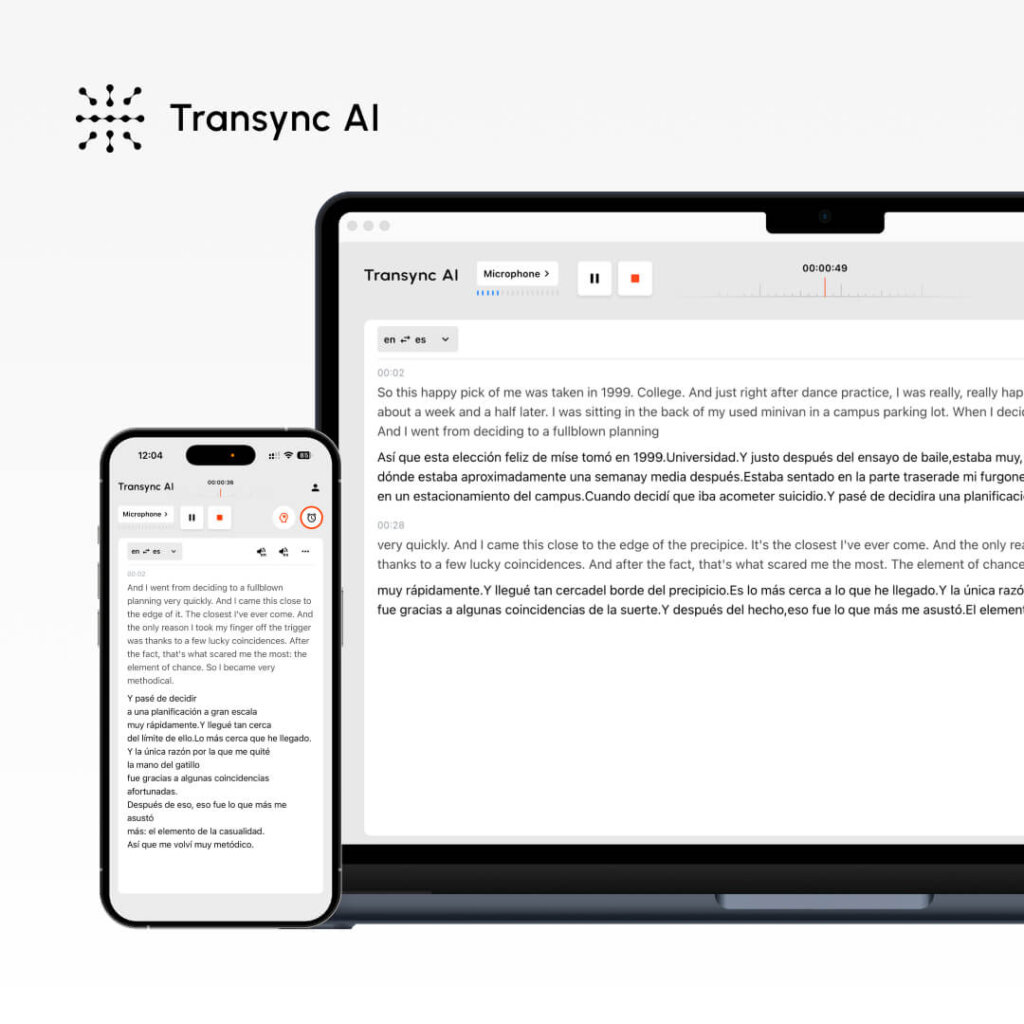
Why it works for prepositions:
- ✅ AI trained on preposition usage
- ✅ Context-aware (understands when “A” vs “EN” is correct)
- ✅ Native Spanish voice (natural pronunciation)
- ✅ Dual-screen display (verify accuracy in real-time)
- ✅ Keywords feature (set custom preposition rules)
How to use:
- Set keyword: “at the meeting = en la reunión”
- Use in conversation
- AI translates with correct preposition
- Natural communication ensues
Cost: $8.99/month (10 hours) or free trial (40 min)
Alternative Tool: DeepL (Document Translation)

For translating documents with “at” prepositions:
- ✅ Accuracy: 94% on prepositions
- ✅ Preserves context throughout document
- ✅ Instant results
- ✅ Cost: $8.99/month or free (500k characters)
👉 DeepL
Key Takeaways: Translate “At” in Spanish
| You Want to Say | Spanish | Preposition |
|---|---|---|
| I’m at home | Estoy en casa | EN |
| Meeting at 3 PM | Reunión a las 3 PM | A |
| At the office | En la oficina | EN |
| Aimed at success | Apuntado al éxito | A |
| At $10 each | A $10 cada uno | A |
| Standing at the door | De pie en la puerta | EN |
| At night | Por la noche | POR |
| In court | Ante el tribunal | ANTE |
Conclusion: Master “Translate At in Spanish”
The key to accurate translation is understanding context:
- TIME? Use A (“a las 3 PM”)
- Static location? Use EN (“en casa”)
- Movement/direction? Use A (“a la oficina”)
- Manner/price? Use A (“a toda velocidad”)
- Formal/legal? Use ANTE (“ante el juez”)
Quick action plan:
- ✅ Memorize the 5 prepositions (takes 10 minutes)
- ✅ Practice with 10 example sentences (15 minutes)
- ✅ Use Transync AI to verify accuracy (real-time)
- ✅ Apply in your next Spanish communication
Result: Professional, natural-sounding Spanish communication with correct preposition usage every time.
Ready to translate “at” in Spanish like a native speaker? Start practicing today! 🚀
If you want a next-generation experience, Transync AI leads the way with real-time, AI-powered translation that keeps conversations flowing naturally. You can try it free now.