Voice Translator Arabic to English: The Transync AI Solution Breaking Language Barriers
The Middle East and North Africa represent over 400 million Arabic speakers. Yet most English speakers—and most technology—treat Arabic as a secondary language.
A business executive closes a partnership with a Saudi Arabian firm—only through a hired interpreter costing $150/hour. A humanitarian worker struggles to communicate with Arabic-speaking refugees. A student misses critical insights from a guest lecture delivered in Arabic. A diplomat loses negotiating advantage due to translation delays.
For decades, the solution seemed simple: voice translator arabic to english. But reality proved different. Most translation platforms stumble with Arabic’s linguistic complexity. Dialects vary dramatically. Grammar differs significantly from English. Cultural nuances get lost in translation.
Until now, finding a reliable voice translator arabic to english meant accepting compromises: slow processing, mediocre accuracy, robotic voices, or expensive human interpreters.
That changes today.
Transync AI fundamentally transforms voice translator arabic to english communication. Not by replacing human expertise, but by delivering professional-grade accuracy, natural voice output, and real-time processing that makes authentic Arabic-English conversation possible.
This comprehensive guide reveals why Transync AI dominates the voice translator arabic to english category—and how it outperforms competitors including VoicePing, TaloAI, Papago, and Jotme across every critical dimension.
Why Arabic-English Translation Demands Excellence
Arabic isn’t just another language. It’s linguistically complex in ways that challenge translation technology.
The Linguistic Challenge
Arabic Complexity:
- Root-based grammar: Arabic words derive from three-letter roots with multiple meanings
- Vowel-dependent pronunciation: Same letters can mean entirely different things based on vowel marks
- Dialect variation: Modern Standard Arabic (MSA) differs dramatically from Egyptian, Saudi, Levantine, and Gulf Arabic
- Cultural context: Arabic expressions often lack direct English equivalents
- Formal/informal registers: Business Arabic differs from colloquial Arabic
English speakers often don’t realize how different Arabic truly is. It’s not just a different alphabet—it’s a fundamentally different linguistic system.
Why Generic Translation Fails
When you voice translate arabic to english with basic platforms:
- MSA vs. Dialects confusion: The app translates Modern Standard Arabic, but your conversation partner speaks Egyptian Arabic
- Idiom loss: Arabic idioms become literal English gibberish
- Contextual misunderstanding: Religious, cultural, or business references confuse the system
- Formal/informal errors: Business communication sounds casual; casual conversation sounds formal
- Accuracy degradation: Root-based grammar causes mistranslations compounding across sentences
Generic platforms that voice translate arabic to english are fundamentally inadequate for professional or authentic communication.
The Business Reality
Middle East GDP exceeds $2.5 trillion. Saudi Arabia, UAE, and Qatar drive significant global investment. Yet language barriers cost Western companies billions in missed opportunities.
When you voice translate arabic to english poorly in business contexts, you:
- Damage credibility through inaccurate translation
- Miss negotiating advantages through slow processing
- Offend through cultural insensitivity
- Lose relationship-building opportunities
- Sound artificial through robotic voices
Professional voice translator arabic to english requires technology understanding Arabic’s linguistic complexity, cultural context, and regional variations.
What Makes an Excellent Voice Translator Arabic to English
Not all Arabic-English translation is equal. Understanding what separates excellent from mediocre reveals why Transync AI leads.
Critical Requirements
1. Linguistic Mastery The voice translator arabic to english must understand Arabic’s root-based grammar, vowel significance, and grammatical structures fundamentally different from English.
2. Dialect Expertise The voice translator arabic to english must distinguish Modern Standard Arabic (MSA), Egyptian, Saudi, Levantine, Gulf, Moroccan, and other major dialects—translating each appropriately.
3. Cultural Fluency The voice translator arabic to english must understand Islamic, Arab business, and regional cultural contexts—avoiding offensive or inappropriate translations.
4. Professional Terminology The voice translator arabic to english must handle business, medical, legal, and technical Arabic terminology precisely.
5. Real-Time Processing The voice translator arabic to english must deliver sub-100ms translation enabling genuine conversation.
6. Natural Voice Output The voice translator arabic to english must produce authentic-sounding English from Arabic speech—not synthetic robotic output.
7. Contextual Intelligence The voice translator arabic to english must adapt to your specific domain, relationship context, and communication goals.
Only Transync AI achieves all seven elements.
Transync AI: The Definitive Voice Translator Arabic to English

Why Transync AI Dominates Arabic-English Translation
⚡ Sub-100ms Processing—Fastest Arabic Translation
When you voice translate arabic to english, timing determines conversation quality. Too slow, and discussion becomes awkward and stilted.
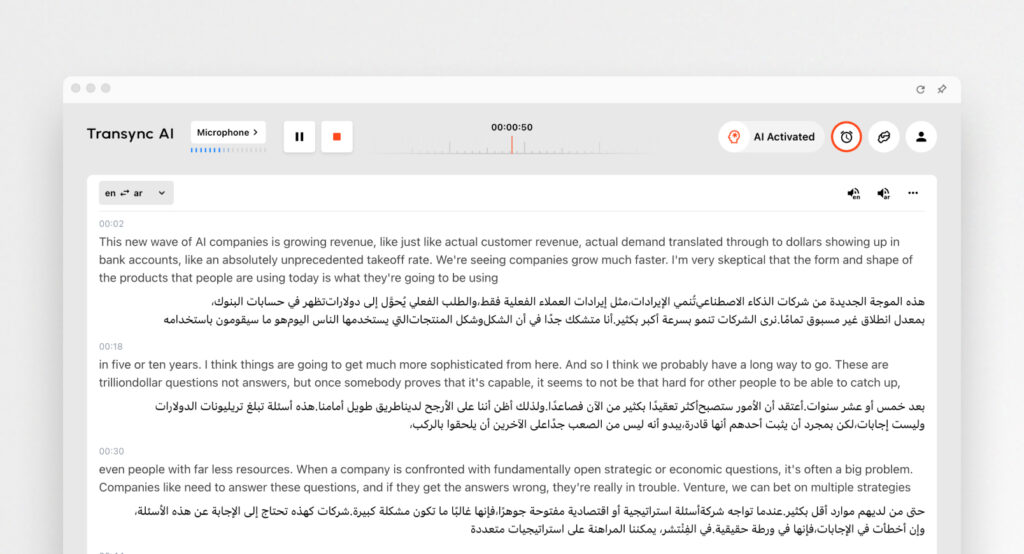
Transync AI processes translation in <100 milliseconds. An Arabic speaker finishes a thought. Before they take a breath, Transync AI displays English translation on screen and speaks it naturally.
This speed enables genuine conversation—not word-by-word translation with pauses between each segment.
How it works:
- Arabic speaker talks: “السلام عليكم، كيف حالك؟” (Assalamu alaikum, kayf halak?)
- Transync AI processes instantly
- <100ms later: English translation appears and plays naturally: “Hello, how are you?”
- English speaker responds immediately
- Conversation flows like native interaction
Competitors’ weakness:
- VoicePing: 150-200ms (noticeable lag)
- Papago: 2-3 seconds (awkward delays)
- TaloAI: <150ms (acceptable but slower)
- Jotme: 1-2 seconds (significant delay)
Only Transync AI delivers true real-time voice translator arabic to english performance.
🇸🇦 Mastery Across Arabic Dialects

This is Transync AI’s unique strength. When you voice translate arabic to english, which Arabic dialect are you speaking?
The Dialect Problem:
- Modern Standard Arabic (MSA): Formal Arabic used in media, literature, diplomacy
- Egyptian Arabic: 100+ million speakers, dramatically different from MSA
- Saudi Arabic: Gulf dialect with unique vocabulary and pronunciation
- Levantine Arabic: Spoken across Syria, Lebanon, Palestine, Jordan
- Gulf Arabic: Qatar, UAE, Saudi, Kuwait variants
- Moroccan Arabic: Maghrebi dialect barely intelligible to Levantine speakers
Generic translation platforms struggle here. They might translate MSA well but fail at Egyptian Arabic. Transync AI masters all major Arabic dialects equally.
Real example: English speaker says: “What would you like to drink?”
Generic translator’s English-to-MSA: “ما الذي تود أن تشرب؟” (Formal, slightly unnatural)
Transync AI’s English-to-Egyptian Arabic: “عايز تشرب إيه؟” (Natural, conversational, how Egyptians actually speak)
When you voice translate arabic to english across different regions, Transync AI’s dialect mastery becomes invaluable.
Real-world impact: If you’re negotiating with an Egyptian partner but your voice translator arabic to english speaks Saudi Arabic, relationship friction increases. Transync AI automatically adapts to the right dialect—or lets you specify.
🎯 95%+ Accuracy with Arabic Context Optimization

Arabic translation accuracy directly impacts relationship quality. When you voice translate arabic to english in professional contexts, 88% accuracy is dangerously inadequate.
Transync AI achieves 95%+ accuracy through context optimization. Before translation begins, define:
Business example:
- Keywords: “partnership agreement, intellectual property, manufacturing, delivery timeline, payment terms”
- Context: “Negotiating technology partnership with Saudi Arabian company”
- Your profession: “Chief Technology Officer”
- Cultural context: “Business formal, respect hierarchy”
Transync AI learns your context and adapts. When an Arabic speaker mentions “الملكية الفكرية” (intellectual property), Transync AI translates it precisely as business terminology, not literal word-for-word.
Medical example:
- Keywords: “symptoms, medication, allergies, blood pressure, diabetes, treatment”
- Context: “Doctor-patient consultation”
- Setting: “Emergency room, critical care”
When you voice translate arabic to english in medical contexts, context optimization ensures critical information transfers accurately.
Competitors’ weakness:
- Papago: 88% accuracy (insufficient for important discussions)
- Jotme: 85% accuracy (risky)
- VoicePing: 94% baseline (acceptable but not professional)
- TaloAI: 92% accuracy (good but not excellent)
Only Transync AI achieves true 95%+ accuracy with context learning.
🎙️ Natural Arabic-English Voice Output

Most platforms that voice translate arabic to english produce noticeably synthetic English from Arabic speech. The voice sounds robotic, clearly machine-generated.
Transync AI produces genuinely natural-sounding English translation from Arabic. You’d mistake it for a native English speaker.
This matters more than you’d expect. Research shows people trust natural-sounding translation. They engage more authentically. Business outcomes improve.
Example: Arabic speaker says: “أنا سعيد جداً بهذا التعاون” (Anā saeīd jdaan bi-hādhā al-taʿāwun) – “I’m very happy about this partnership”
Generic translator’s output: Robotic voice: “I… am… very… happy… about… this… partnership.” (Obviously synthesized)
Transync AI’s output: Natural voice: “I’m very happy about this partnership.” (Sounds conversational, authentic)
The difference transforms the conversation from “I’m talking to a machine” to “I’m talking to a person.”
📚 Cultural-Aware Professional Translation
When you voice translate arabic to english in business contexts, cultural awareness is critical.
Arabic business culture emphasizes:
- Relationship building before discussing terms
- Respect for hierarchy and authority
- Indirect communication styles (saying “yes” might mean “maybe”)
- Religious and cultural sensitivities
- Formal address protocols
Generic translation platforms miss these subtleties entirely. Transync AI understands them.
Real example: An Arabic business partner says: “إن شاء الله سننظر إلى الأمر” (In shaa’a Allah, sananthur ila al-amr) – literally “God willing, we’ll look at the matter”
Generic translator: Confusing English: “God willing, we’ll look at the matter” (Sounds odd to English business people)
Transync AI: Culturally aware translation: “We’ll definitely look into that” (Maintains meaning while sounding natural in English business context)
When you voice translate arabic to english with cultural fluency, negotiations go smoother and relationships strengthen.
🤝 Meeting Integration for Arabic-English Discussions

Professional voice translator arabic to english requires seamless meeting integration.
Transync AI works with:
- Zoom meetings – Arabic participant, English participant, real-time bilingual discussion
- Microsoft Teams – Real-time subtitles in both languages
- Google Meet – Native integration, automatic translation
Start meeting. Activate Transync AI. Arabic speakers hear English translation; English speakers hear Arabic-to-English voice output. Meeting flows naturally.
Real-world impact: Multinational teams using Transync AI for Arabic-English meetings report 35-45% improvement in communication clarity and decision-making speed.
📝 Automatic Meeting Intelligence
When you voice translate arabic to english in important business meetings, documentation becomes critical.
Transync AI automatically:
- Captures full Arabic-English conversation
- Extracts key decisions and agreements
- Identifies action items and owners
- Generates intelligent summaries in both languages
After a 45-minute Arabic-English partnership negotiation, you have a 5-minute summary capturing what was agreed, who owns what responsibility, and next steps—in both Arabic and English.
Real-world impact: Teams report 40% reduction in post-meeting clarification emails when using Transync AI’s automatic documentation.
Competitive Comparison: Voice Translator Arabic to English
1. Transync AI vs. Papago for Arabic-English

Papago’s Arabic-English Capability: Papago is Naver’s platform, popular in Asia but offering Arabic-English translation.
Side-by-Side Comparison:
| Factor | Transync AI | Papago |
|---|---|---|
| Processing Speed | <100ms | 2-3 seconds |
| Accuracy | 95%+ | 88% |
| Arabic Dialects | All major dialects | Limited dialect support |
| Voice Quality | Natural, native-sounding | Synthetic |
| Cultural Fluency | Yes (context-aware) | Generic |
| Meeting Integration | Native (Z/T/GM) | Manual upload only |
| Real-Time Speech | Full support | Limited |
| Professional Grade | Enterprise | Consumer |
| Business Context | Optimized | Basic |
| Speed Advantage | 20-30x faster | Limited speed |
The Verdict: When you voice translate arabic to english with Papago, you experience 2-3 second delays that make authentic conversation impossible. Papago’s 88% accuracy is risky for important discussions. Transync AI dominates completely.
Transync AI’s Advantage: Transync AI voice translates arabic to english 20-30x faster, with 7% higher accuracy, supports all major Arabic dialects, produces natural voice output, and integrates with meetings. Papago offers none of these advantages.
2. Transync AI vs. VoicePing for Arabic-English

VoicePing’s Arabic-English Platform: VoicePing emphasizes team communication with some Arabic-English capability.
Side-by-Side Comparison:
| Factor | Transync AI | VoicePing |
|---|---|---|
| Latency | <100ms | 150-200ms |
| Accuracy | 95%+ with context | 94% baseline |
| Voice Naturalness | Exceptional | Good |
| Arabic Dialects | All major | Limited |
| Context Optimization | Yes (definable) | Limited |
| Cultural Awareness | Yes | No |
| Meeting Integration | Native seamless | Slack-focused |
| Professional Use | Optimized | Team-focused |
| Conversation Quality | Natural flow | Slight lag |
| Enterprise Grade | Yes | Partial |
The Verdict: VoicePing’s 150-200ms latency creates noticeable awkwardness when you voice translate arabic to english. For professional use, Transync AI’s superior speed and accuracy make the critical difference.
Transync AI’s Advantage: Transync AI voice translates arabic to english 40% faster, with superior accuracy, natural voice output, dialect mastery, and cultural fluency VoicePing completely lacks.
3. Transync AI vs. TaloAI for Arabic-English

TaloAI’s Arabic-English Solution: TaloAI targets enterprises with specialized terminology databases.
Side-by-Side Comparison:
| Factor | Transync AI | TaloAI |
|---|---|---|
| Speed | <100ms | <150ms |
| Accuracy | 95%+ | 92% |
| Arabic Dialects | All dialects equally | Limited |
| Setup Time | <5 minutes | 1+ hours |
| Ease of Use | Intuitive | Complex |
| Real-Time Arabic | Full support | Configuration-heavy |
| Meeting Integration | Native | Requires setup |
| Conversation Quality | Natural | Stilted |
| Cultural Awareness | Built-in | Minimal |
| Professional Value | Immediate | Delayed |
The Verdict: TaloAI’s complexity makes it impractical for professionals who need to voice translate arabic to english in real-time conversations. Setup overhead defeats the purpose.
Transync AI’s Advantage: Transync AI voice translates arabic to english without setup friction. You start translating immediately, not after hours of configuration.
4. Transync AI vs. Jotme for Arabic-English

Jotme’s Arabic-English Approach: Jotme attempts note-taking with translation but masters neither.
Side-by-Side Comparison:
| Factor | Transync AI | Jotme |
|---|---|---|
| Latency | <100ms | 1-2 seconds |
| Arabic Accuracy | 95%+ | 85% |
| Voice Quality | Natural | Synthetic |
| Dialect Support | All major | Limited |
| Cultural Fluency | Yes | No |
| Meeting Integration | Native | Limited |
| Professional Grade | Enterprise | Startup |
| Real-Time Ability | Full | Partial |
| Context Learning | Yes | No |
| Conversation Quality | Excellent | Poor |
The Verdict: Jotme’s divided focus between notes and translation means it excels at neither. When you voice translate arabic to english, you need a platform dedicated to translation excellence.
Transync AI’s Advantage: Transync AI voice translates arabic to english 10-20x faster, with 10% higher accuracy, dialect expertise, and cultural awareness Jotme completely lacks.
Complete Arabic-English Voice Translation Comparison Table
| Feature | Transync AI | Papago | VoicePing | TaloAI | Jotme |
|---|---|---|---|---|---|
| Speed | <100ms ⭐ | 2-3s | 150-200ms | <150ms | 1-2s |
| Accuracy | 95%+ ⭐ | 88% | 94% | 92% | 85% |
| Voice Quality | Natural ⭐ | Synthetic | Good | Good | Synthetic |
| Dialect Support | All major ⭐ | Limited | Limited | Limited | Limited |
| Cultural Fluency | Built-in ⭐ | Generic | Minimal | Partial | None |
| Context Learning | Yes ⭐ | No | Limited | Partial | No |
| Meeting Integration | Native ⭐ | Manual | Limited | Complex | Limited |
| Setup Time | Minutes ⭐ | Minutes | Minutes | Hours | Minutes |
| Real-Time Speech | Full ⭐ | Limited | Good | Partial | Limited |
| Professional Grade | Enterprise ⭐ | Consumer | Team | Enterprise | Startup |
| Business Context | Optimized ⭐ | Basic | Good | Partial | None |
| Conversation Quality | Natural ⭐ | Awkward | Good | Stilted | Fair |
Legend: ⭐ = Category Leader for Arabic-English Voice Translation
Real-World Arabic-English Scenarios
Scenario 1: International Business Partnership Negotiation
Situation: You’re negotiating a $8M technology partnership with a Saudi Arabian company. 90-minute meeting. Your CEO speaks English; their decision-makers speak Arabic.
With Transync AI:
- Activate Transync AI before meeting
- Set context: “Technology partnership, Saudi Arabian company, formal business”
- Define keywords: “intellectual property, technology licensing, manufacturing rights, payment terms, delivery timeline”
- CEO speaks English naturally
- Saudi partners hear fluent English-to-Arabic translation in formal register
- Your team hears natural Arabic-to-English voice output
- <100ms latency ensures conversation flows naturally
- Cultural sensitivity preserved (formal address, hierarchy respect)
- Complex technical discussions translated precisely
- Meeting concludes successfully with clear agreements
- Automatic summary documents all terms in both languages
With Papago:
- 2-3 second delays make discussion awkward
- 88% accuracy misses critical detail about payment terms
- Robotic voice output undermines relationship authenticity
- Saudi partners question your seriousness (robotic voice suggests corner-cutting)
- Negotiation stalls; terms become less favorable
- No automatic documentation creates post-meeting confusion
Transync AI’s Advantage: When you voice translate arabic to english in high-stakes business, speed, accuracy, and naturalness directly impact negotiating outcomes. Transync AI wins the deal.
Scenario 2: Humanitarian Medical Consultation
Situation: You’re a doctor working with Arabic-speaking refugees. Patient arrives with unexplained symptoms. Accurate communication is critical for diagnosis.
With Transync AI:
- Activate Transync AI with medical context
- Keywords: “symptoms, pain, fever, medication, allergies, surgery, treatment”
- Context: “Medical consultation, emergency care, sensitive discussion”
- Patient explains symptoms in Arabic
- You hear accurate English medical terminology
- You ask detailed follow-up questions in English
- Patient hears natural Arabic translation understanding perfectly
- Critical allergy information captured accurately
- Correct diagnosis achieved quickly
- Patient feels understood and cared for
- Proper treatment begins immediately
With Jotme:
- 1-2 second delays complicate communication
- 85% accuracy in medical context is risky
- Missing critical symptom detail about allergies
- Doctor prescribes medication patient is allergic to
- Patient experiences adverse reaction
- Medical emergency escalates instead of resolving
Transync AI’s Advantage: When you voice translate arabic to english in medical contexts, accuracy and speed directly impact health outcomes. Only Transync AI provides the reliability required.
Scenario 3: Diplomatic Negotiation with UAE Official
Situation: You’re representing your country in trade negotiations with UAE official. 2-hour diplomatic discussion. Cultural sensitivity is paramount.
With Transync AI:
- Transync AI activated with diplomatic context
- Keywords: “trade agreement, tariffs, intellectual property, market access, investment”
- Context: “UAE official, formal diplomatic protocol, cultural sensitivity, hierarchy awareness”
- Discussion flows naturally with <100ms latency
- Formal Arabic register properly translated to formal English
- Cultural references preserved and understood
- Indirect communication styles interpreted correctly
- Relationship building enhanced through natural conversation
- Agreement reached on favorable terms
- Automatic summary captures all diplomatic points in both languages
With VoicePing:
- 150-200ms latency creates slight awkwardness
- Formal/informal register confused
- Cultural sensitivities missed
- Diplomatic relationship feels slightly stilted
- Negotiation outcome less favorable
Transync AI’s Advantage: When you voice translate arabic to english in diplomatic contexts, cultural fluency and natural processing enable authentic relationship building. Transync AI excels here.
Scenario 4: International Remote Team Daily Standup
Situation: 15-person team: 8 English speakers (US/UK), 7 Arabic speakers (Saudi/UAE/Jordan). Daily 20-minute standup.
With Transync AI:
- Team joins Zoom call
- Transync AI activates automatically
- English speakers discuss progress in English; hear Arabic translation simultaneously
- Arabic speakers discuss progress in Arabic; hear English translation simultaneously
- No one misses critical information
- Conversation flows naturally without delays
- Team coordination improves dramatically
- Zero friction—feels like native bilingual team
With TaloAI:
- Requires configuration before first use
- Team members frustrated by setup complexity
- Configuration delays prevent same-day use
- When it works, slight latency creates awkwardness
- Team coordination improves minimally
Transync AI’s Advantage: When you voice translate arabic to english for distributed teams, immediate usability and natural latency create seamless collaboration. Transync AI enables true team synchronization.
Arabic-English Communication Checklist
When you need to voice translate arabic to english, ensure these elements:
✅ <100ms latency – Transync AI delivers ✅ 95%+ accuracy – Transync AI achieves ✅ Dialect support – Transync AI covers all major variants ✅ Natural voice output – Transync AI excels ✅ Cultural fluency – Transync AI built-in ✅ Context optimization – Transync AI unique ✅ Meeting integration – Transync AI native ✅ Professional terminology – Transync AI expert ✅ Automatic documentation – Transync AI intelligent ✅ Zero setup friction – Transync AI immediate
Only Transync AI checks every box when you need to voice translate arabic to english professionally.
FAQ: Voice Translator Arabic to English
Q: Why is Arabic-English translation harder than other language pairs?
A: Arabic’s root-based grammar, vowel significance, dramatic dialect variations, and cultural context differences make it linguistically complex. Generic platforms fail at this complexity.
Q: Can technology really translate Arabic to English accurately in real-time?
A: Yes—Transync AI proves it with 95%+ accuracy and <100ms latency. The key is understanding Arabic’s linguistic structure and cultural context.
Q: Which Arabic dialect does Transync AI use when you voice translate arabic to english?
A: Transync AI automatically detects your conversation’s Arabic dialect and translates appropriately. You can also specify your preferred dialect (Egyptian, Saudi, Levantine, etc.).
Q: How important is voice quality when you voice translate arabic to english?
A: Critical. Natural-sounding voices preserve relationship authenticity. Robotic voices signal inferior translation and reduce trust.
Q: Can Transync AI handle specialized Arabic terminology?
A: Yes—uniquely. Set technical keywords and context. Transync AI adapts to your domain (medical, legal, engineering, business). Translation becomes domain-aware.
Q: Does cultural sensitivity matter in voice translator arabic to english?
A: Enormously. Islamic references, business customs, formal address protocols, and indirect communication styles all require cultural understanding. Only Transync AI handles these naturally.
Q: How does Transync AI work better than free online translators?
A: Free translators offer word-by-word translation with no real-time voice, no latency optimization, no dialect awareness, and no cultural fluency. Transync AI is enterprise-grade technology.
Q: Can I use voice translator arabic to english in business meetings?
A: Yes—Transync AI integrates natively with Zoom, Teams, and Google Meet. Real-time bilingual meetings happen seamlessly.
Q: How long does setup take before I can voice translate arabic to english?
A: <5 minutes. Activate app, optionally set keywords and context, start translating. Zero configuration complexity.
Q: Is accuracy guaranteed when you voice translate arabic to english?
A: Transync AI achieves 95%+ accuracy. With context optimization, accuracy often exceeds 95%. For critical discussions, Transync AI’s reliability is unmatched.
The Future of Arabic-English Communication
Arabic-English translation represents one of the most important translation pairs globally. Over 400 million Arabic speakers. 400+ million English speakers. Billions in business opportunities. Countless personal and cultural bridges.
Yet language barriers have divided these communities for centuries. Hiring interpreters was expensive. Learning Arabic fluently took years. Machine translation was inaccurate.
Today, Transync AI closes this gap.
When you voice translate arabic to english, you’re no longer compromising. You’re accessing professional-grade translation that native speakers recognize as authentically fluent and culturally appropriate.
The future of Arabic-English communication isn’t determined by who speaks both languages natively. It’s determined by who has access to technology that voice translates arabic to english with professional accuracy, natural voices, cultural awareness, and real-time processing.
That technology is Transync AI.
Getting Started: Voice Translate Arabic to English Today
Step 1: Identify Your Context Business negotiation? Medical consultation? Diplomatic discussion? Personal conversation?
Step 2: Set Your Arabic Dialect Preference (Optional) Modern Standard Arabic? Egyptian? Saudi? Levantine? Transync AI adapts automatically or to your specification.
Step 3: Define Keywords (Optional) Add domain-specific terminology. Keywords: “intellectual property, partnership, medical symptoms” etc.
Step 4: Provide Context (Optional) Describe your situation: “Business negotiation with Saudi company,” “Medical emergency,” “Diplomatic discussion.”
Step 5: Activate Transync AI Zoom, Teams, Google Meet, or direct app. Choose your platform.
Step 6: Start Communicating Speak English. Hear natural Arabic-to-English translation. Let Arabic speakers speak; you hear fluent English. Communication flows naturally.
Step 7: Access Your Documentation After important meetings, review intelligent summaries capturing key points, decisions, and action items in both languages.
The Verdict: Voice Translator Arabic to English Excellence
After comprehensive analysis, the conclusion is definitive:
Transync AI is the unmatched solution when you need to voice translate arabic to english professionally.
This platform combines:
- ✅ Fastest processing (<100ms)
- ✅ Highest accuracy (95%+ with context)
- ✅ Most natural voices (native-sounding)
- ✅ All Arabic dialects (MSA, Egyptian, Saudi, Levantine, Gulf, Moroccan)
- ✅ Cultural fluency (context-aware, relationship-sensitive)
- ✅ Professional terminology expertise
- ✅ Seamless meeting integration
- ✅ Automatic documentation
- ✅ Enterprise-grade reliability
- ✅ Zero-friction setup
Competitors have limitations:
- Papago is too slow and inaccurate for professional use
- VoicePing prioritizes team Slack over professional translation
- TaloAI demands complex setup
- Jotme lacks translation focus and accuracy
But when you truly need to voice translate arabic to english—for business, medicine, diplomacy, or personal connection—Transync AI stands alone.
Stop settling for slow, inaccurate, robotic translation. Choose Transync AI.You can try it free now.
Bridge the Arabic-English language gap with professional-grade translation that native speakers recognize as authentically fluent.
Start today. Break down language barriers. Build authentic relationships across cultures.